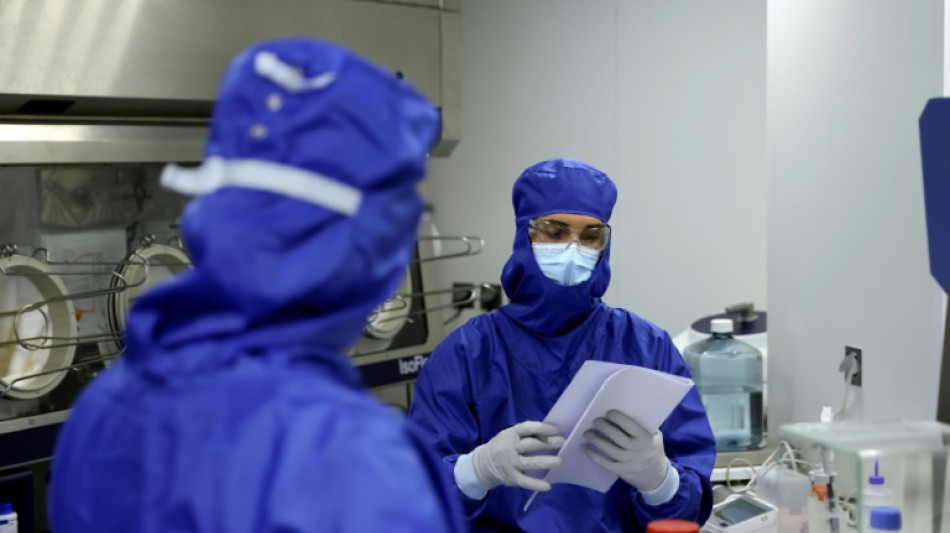
Treatment found to reduce progression of rare blood cancer by 74% / Photo: © AFP/File

 Hearn dismisses Fury talk of Joshua no-show for super fight

 'Like a war zone': France evacuates 20,000 due to wildfires

 Ships avoid Ukrainian grain ports after Russian attacks

 Oil passes $100 a barrel again: why it's more serious this time

 Who are the six candidates vying to lead the UN?

 Hamilton proud of recovery after hitting rock bottom a year ago

 Carapaz eyes polkadot mountains jersey after stage win

 Fields medal awarded to four young mathematicians

 Carapaz claims Tour de France stage as Pogacar loses key team-mate

 Alonso welcomes Aston Martin upgrade, warns against unreal expectations

 Anderson declares Man City 'kings of Manchester' after £116 mn move

 Relieved Russell says Mercedes have solved his power problems mystery

 Oil soars above $100 as Middle East fears grow

 Venezuelans turn to scrap collecting in quake-hit beach 'paradise'

 Heptathlon champion Johnson-Thompson joins list of Commonwealth Games absentees

 Nigeria's Dangote raises $2.5bn to expand Africa's largest refinery

 Oil soars to $100 on fresh Mideast attacks

 Coal-fired power generation rising globally on Mideast war: IEA

 Premier League champions Arsenal sign Greece winger Tzolis from Brugge

 French Jewish DJ sues after activists disrupt gig: lawyer

 Venice film festival promises Pattinson, Oasis and Musk doc

 ASEAN calls for open straits as US-Iran war casts shadow

 Ford and Geely to form joint venture at struggling Spain plant

 Russia warns US against Ukraine arms sales in Manila meeting

 New UK PM announces tax cut for struggling pubs

A treatment that involves genetically modifying the body's own immune cells has been found to cut the risk of disease progression by 74 percent in people with a rare type of blood cancer, results showed Monday.
Ciltacabtagene autoleucel -- also known by its trade name Carvykti -- was tested in a clinical trial involving 419 patients with multiple myeloma, whose disease was not responsive to the current frontline drug lenalidomide, a chemotherapy medicine.
"Lenalidomide has become a foundation of care for people with myeloma, but as its use has expanded, so has the number of patients whose disease will no longer respond to the treatment," said oncologist Oreofe Odejide at the American Society of Clinical Oncology's annual meeting where results were presented.
Ciltacabtagene autoleucel "delivers remarkably effective outcomes compared to patients' current options" and "can be used safely earlier in the treatment phase," added Odejide, an expert who was not part of the research.
Multiple myeloma affects a type of white blood cells called plasma cells, and can cause cascading harms to the bones, kidneys, and immune health.
It affects seven people out of 100,000 every year, according to the Cleveland Clinic, with 100,000 people impacted in the United States. There is currently no cure, though progression can be stopped for a long time.
Risk increases with age, with men more likely to be affected than women, and Black people at higher risk than other races. Not everyone requires immediate treatment and the disease may be monitored if it is slow growing.
In the new clinical trial, half the patients were randomly assigned ciltacabtagene autoleucel, while the other half received a cocktail of drugs that represents the current standard of care, including chemotherapy and steroids.
"After a median follow-up of 16 months, the researchers found that ciltacabtagene autoleucel reduced the risk of disease progression by 74 percent, compared with the standard-of-care treatments," a press statement said.
Ciltacabtagene autoleucel is a type of chimeric antigen receptor (CAR) T-cell therapy, a newer form of treatment.
CAR T-cell therapy involves removing the patient's disease fighting T cells, and genetically engineering them in a lab so they have specific proteins known as receptors that, once returned to the body, will seek out and destroy cancer cells.
Nearly all the patients in both groups experienced severe to life-threatening adverse events, including infections and low blood cell counts.
Three-quarters of patients on ciltacabtagene autoleucel developed Cytokine release syndrome, in which the immune system is sent into overdrive. It can affect multiple organs and cause death.
Around five percent of patients on ciltacabtagene autoleucel developed immune effector cell-associated neurotoxicity syndrome (ICANS), which affects a person's nervous system.
Next, the researchers will continue to follow the study participants to determine long-term effects and impacts on quality of life.
The clinical trial was funded by Janssen Research & Development and Legend Biotech USA.
M.Furrer--BTB