China prepares to send first civilian into space / Photo: © AFP

 Hearn dismisses Fury talk of Joshua no-show for super fight

 'Like a war zone': France evacuates 20,000 due to wildfires

 Ships avoid Ukrainian grain ports after Russian attacks
 Oil passes $100 a barrel again: why it's more serious this time

 Who are the six candidates vying to lead the UN?

 Hamilton proud of recovery after hitting rock bottom a year ago
 Carapaz eyes polkadot mountains jersey after stage win
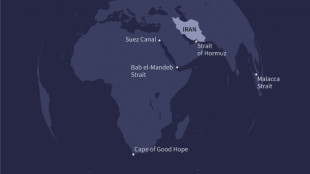
 Fields medal awarded to four young mathematicians

 Carapaz claims Tour de France stage as Pogacar loses key team-mate
 Alonso welcomes Aston Martin upgrade, warns against unreal expectations
 Anderson declares Man City 'kings of Manchester' after £116 mn move
 Relieved Russell says Mercedes have solved his power problems mystery

 Oil soars above $100 as Middle East fears grow
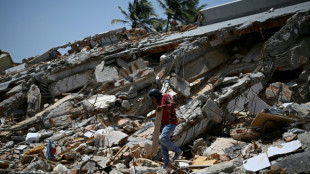 Venezuelans turn to scrap collecting in quake-hit beach 'paradise'

 Heptathlon champion Johnson-Thompson joins list of Commonwealth Games absentees

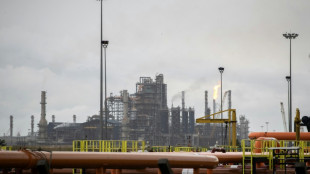 Nigeria's Dangote raises $2.5bn to expand Africa's largest refinery

 Oil soars to $100 on fresh Mideast attacks
 Coal-fired power generation rising globally on Mideast war: IEA

 Premier League champions Arsenal sign Greece winger Tzolis from Brugge

 French Jewish DJ sues after activists disrupt gig: lawyer

 Venice film festival promises Pattinson, Oasis and Musk doc

 ASEAN calls for open straits as US-Iran war casts shadow

 Ford and Geely to form joint venture at struggling Spain plant
 Russia warns US against Ukraine arms sales in Manila meeting
 New UK PM announces tax cut for struggling pubs

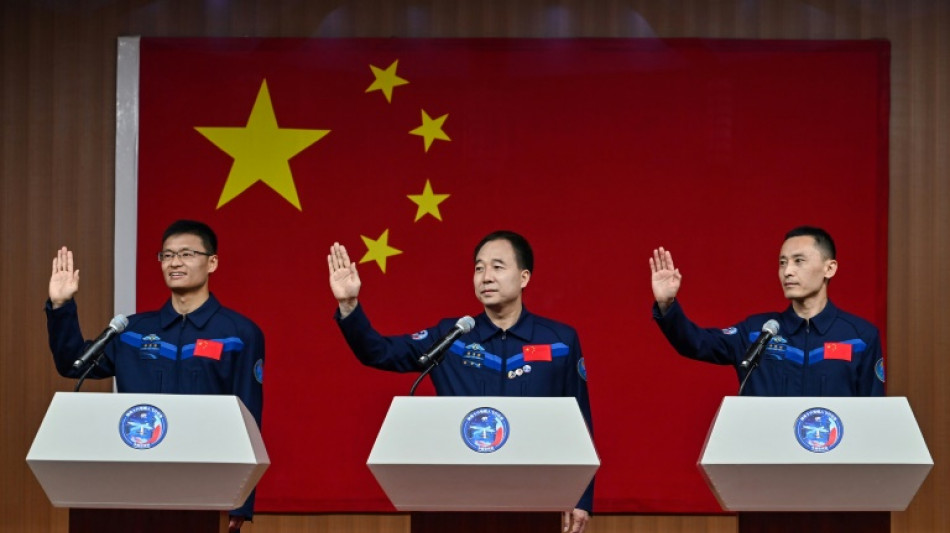
China will send its first civilian astronaut into space as part of a crewed mission to the Tiangong space station on Tuesday as it pursues its ambitious plans for a manned lunar landing by 2030.
The world's second-largest economy has invested billions of dollars in its military-run space programme, trying to catch up with the United States and Russia after years of belatedly matching their milestones.
Until now, all Chinese astronauts sent into space have been part of the People's Liberation Army.
Gui Haichao is a professor at Beijing's Beihang University, and will manage scientific experiments on the station during the mission, China Manned Space Agency (CMSA) spokesperson Lin Xiqiang told reporters on Monday.
His mission will "carry out large-scale, in-orbit experiments... in the study of novel quantum phenomena, high-precision space time-frequency systems, the verification of general relativity, and the origin of life," Lin said.
"I've always had this dream," Gui told a press conference on Monday.
His university said he hailed from an "ordinary family" in the southwest province of Yunnan.
He had "first felt the attraction of aerospace" listening to the news of China's first man in space, Yang Liwei, on campus radio in 2003, the institution said in a post on social media.
Gui's addition is "particularly significant", independent analyst Chen Lan told AFP, given previous missions only carried astronauts trained as pilots responsible for more technical tasks and not specialist scientists.
"It means that, from this mission on, China will open the door to space for ordinary people," he said.
Gui is set to take off onboard the Shenzhou-16 spacecraft from the Jiuquan Satellite Launch Centre in northwest China on Tuesday at 9:31 am (0131 GMT), the CMSA said.
The commander is Jing Haipeng -- on his fourth mission into space, according to state media -- and the third crew member is engineer Zhu Yangzhu.
Jing said he hadn't gone home for nearly four years because of fears travel could disrupt his training.
"As astronauts going into space... our main responsibility and mission is striving for glory for our country," he said at a press conference on Monday.
The three will stay in Earth's orbit for around five months.
- 'Space dream' -
Under President Xi Jinping, plans for China's "space dream" have been put into overdrive.
China is planning to build a base on the Moon, and CMSA spokesman Lin on Monday reaffirmed Beijing's plan to land a manned mission there by 2030.
"The overall goal is to achieve China's first manned landing on the Moon by 2030 and carry out lunar scientific exploration and related technological experiments," he said.
The final module of the T-shaped Tiangong -- whose name means "heavenly palace" -- successfully docked with the core structure last year.
The station carries a number of pieces of cutting-edge scientific equipment, state news agency Xinhua reported, including "the world's first space-based cold atomic clock system".
The Tiangong is expected to remain in low Earth orbit at between 400 and 450 kilometres (250 and 280 miles) above the planet for at least 10 years.
It is constantly crewed by rotating teams of three astronauts.
While China does not plan to use Tiangong for global cooperation on the scale of the International Space Station, Beijing has said it is open to foreign collaboration.
China "is looking forward to and welcomes the participation of foreign astronauts in the country's space station flight missions," Lin said Monday.
China has been effectively excluded from the International Space Station since 2011, when the United States banned NASA from engaging with the country.
L.Janezki--BTB