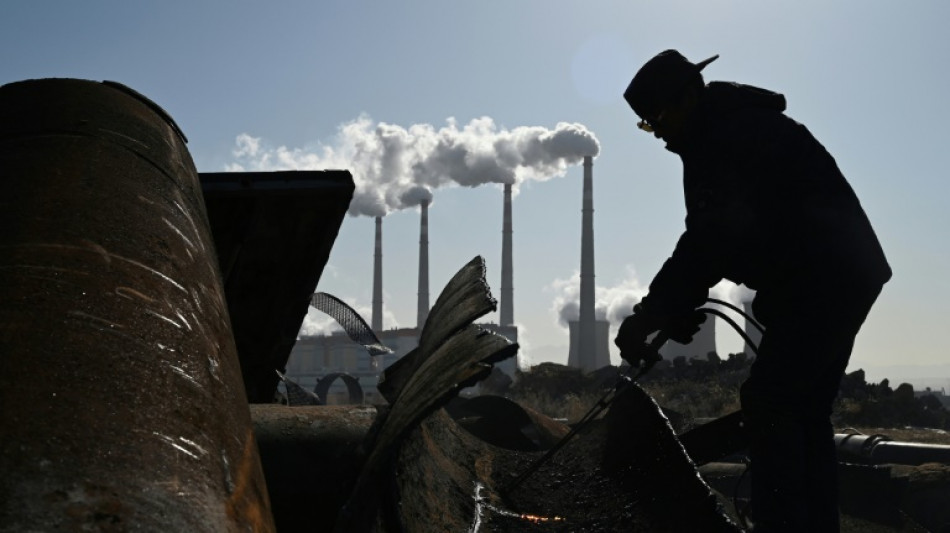
China backpedals on climate promises as economy slows / Photo: ©

 Colombian judge bans strikes on guerrillas if minors are present

 Khachanov shocks ailing Auger-Aliassime, Swiatek and Osaka advance at US Open

 Lone juror blocking verdict in US mother's child murder trial: defense
 'Kinda chic' - Williams sisters set to launch US Open doubles bid

 Volkswagen says cutting 100,000 jobs by end of decade

 Russia slaps curfew on charity director over army criticism

 Ailing Auger-Aliassime upset by Khachanov at US Open

 Richarlison omitted from Tottenham's Premier League squad

 How El Nino is choking the Panama Canal

 Hamilton drives his Ferrari dream at Monza

 Senegal has an IMF loan, now what?

 Auger-Aliassime upset by Khachanov at US Open

 Hugging Face, the French start-up that became AI's warehouse

 World Cup winner Llorente retires from Spain team at 31

 Osaka squeezes into US Open third round

 Apple faces £2 bn lawsuit in UK over app privacy feature
 Former champ Swiatek eases into US Open third round

 DR Congo latest to promise moving Israel embassy to Jerusalem

 War criminal Mladic's body returns to Serbia with military honours

 Pierre Cardin museum brings designer's futurist style to Venice

 Slovenian rookie Omrzel triumphs as Mas extends Vuelta lead

 British, French leaders talk migrants, EU relations

 Heading for Ferrari's home race, Leclerc still dreams of world title
 Cafe at centre of Israel culture clash agrees to shut on Sabbath

 Spacecraft bound for Mercury begins 'tricky' arrival

When China's President Xi Jinping issued his traditional Lunar New Year wishes from the country's coal heartland in January, the subtext was clear: Beijing is not ready to kick its coal addiction, despite promises to slash emissions.
The ink had barely dried on the hard-fought deal struck at last year's United Nations climate conference in Glasgow when Beijing's backslide on pledges began.
The country's central economic planner has watered down a roadmap to slash emissions, greenlighted giant coal-fired power plants, and told mines to produce "as much coal as possible" after power shortages paralysed swathes of the economy last year.
Environmentalists are concerned this would mean China would continue to pollute beyond the 2030 deadline by which it has promised to have reached peak emissions.
Xi's trip to mining towns in Shanxi –- China's biggest coal producing province -- saw him making crispy noodle snacks with families "recently lifted out of poverty".
"We are not pursuing carbon neutrality because others are forcing us, it's something we must do. But it can't be rushed," he said later, while inspecting a thermal power plant.
"We can't delay action, but we must find the right rhythm."
Days earlier, Xi told Communist Party officials in Beijing that low-carbon goals should not come at the expense of "normal life" -- a major change in rhetoric from his 2020 announcement at a UN assembly that China would be carbon neutral by 2060.
- Dependent on coal -
The Glasgow pact encourages countries to slash their emissions targets, with the aim of limiting warming to well below 2 degrees Celsius (36 degrees Fahrenheit) ideally to 1.5 degrees.
Experts have warned that global emissions must be halved within a decade to have a chance of achieving that goal.
A report issued by the UN's climate science advisors on Monday said that warming beyond 1.5C would wreak permanent damage to the planet and that nearly half the world's population is already "highly vulnerable" to the accelerating impacts of climate change.
"The world's biggest polluters are guilty of arson of our only home," UN chief Antonio Guterres said in response to this most compelling scientific overview of climate change impacts to date.
China generates an estimated 29 percent of the world's greenhouse gas emissions -- double the US share and three times that of the European Union.
Environmentalists had hoped that post-Glasgow, Beijing might announce a maximum carbon cap for the whole country but Li Shuo, a campaigner for Greenpeace China, told AFP that is now "off the table".
Policymakers in Beijing have long walked a tightrope balancing climate objectives with domestic growth.
Beijing has pledged to curb coal consumption after 2025 -- but last year, half of China's economy was fuelled by it.
Now as growth slows, authorities are resorting to an old formula of propping up smokestack industries to juice the economy.
In late 2021 China began construction on 33 gigawatts of coal-fired power plants -- the most since 2016 -- that will emit as much carbon dioxide annually as Florida, according to data from Global Energy Monitor.
Even more new plants are being built in the first few months of 2022 as well, all of which can operate for 40 years on average.
- 'Ambition in jeopardy' -
During the Glasgow talks the Chinese delegation -- like many others -- promised a detailed roadmap to peak emissions for different industries and regions over the next decade.
Existing guidelines issued just before the talks only include vague targets for increasing energy efficiency and say renewables will supply a quarter of China's electricity by 2030.
They have not yet been updated.
This "suggests that the politics are tough, ambition is in jeopardy, and the regulators are reserving as much wiggle room (to pollute) as possible for the next few years," Greenpeace's Li said.
Earlier last month, Beijing pushed back the deadline for slashing emissions from the steel sector -- China's biggest carbon emitter -- five years to 2030.
"Steel and cement need to peak earlier than the country as a whole to ensure China's targets are on track," said Lauri Myllyvirta, lead analyst at the Centre for Research on Energy and Clean Air.
Meanwhile, China's investments in overseas oil and gas projects tripled to $10.9 billion last year, according to a Fudan University report in January.
- Renewable bottlenecks -
Another of China's key pledges -- to increase wind and solar capacity to three times the current level over the next decade -- has been blown off-course as well by supply chain disruptions and soaring raw material costs.
The price of polysilicon, used to make solar panels, jumped 174 percent in December from the previous year.
Analysts fear more fossil fuels will be burnt to meet China's growing energy needs as the rollout of renewables slows.
"The political signals are much more cautious (than before), saying the transition will be slow, and coal would remain a mainstay of China's energy supply for a long time," said Myllyvirta.
C.Meier--BTB