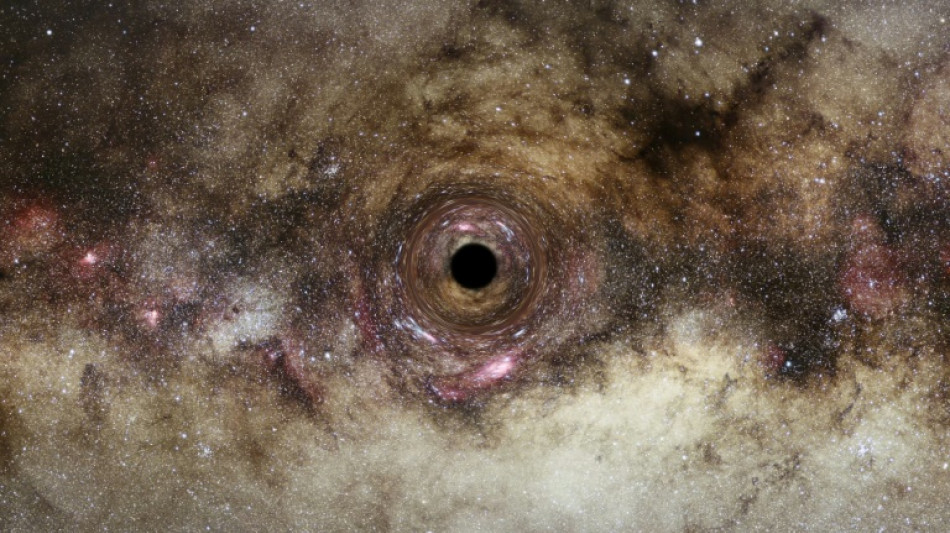
Astronomers discover one of biggest black holes ever recorded / Photo: © ESA/HUBBLE/AFP

 Oil passes $100 a barrel again: why it's more serious this time

 Who are the six candidates vying to lead the UN?

 Hamilton proud of recovery after hitting rock bottom a year ago

 Carapaz eyes polkadot mountains jersey after stage win
 Fields medal awarded to four young mathematicians

 Carapaz claims Tour de France stage as Pogacar loses key team-mate

 Alonso welcomes Aston Martin upgrade, warns against unreal expectations

 Anderson declares Man City 'kings of Manchester' after £116 mn move

 Relieved Russell says Mercedes have solved his power problems mystery

 Oil soars above $100 as Middle East fears grow

 Venezuelans turn to scrap collecting in quake-hit beach 'paradise'

 Heptathlon champion Johnson-Thompson joins list of Commonwealth Games absentees

 Nigeria's Dangote raises $2.5bn to expand Africa's largest refinery

 Oil soars to $100 on fresh Mideast attacks

 Coal-fired power generation rising globally on Mideast war: IEA

 Premier League champions Arsenal sign Greece winger Tzolis from Brugge

 French Jewish DJ sues after activists disrupt gig: lawyer

 Venice film festival promises Pattinson, Oasis and Musk doc

 ASEAN calls for open straits as US-Iran war casts shadow

 Ford and Geely to form joint venture at struggling Spain plant

 Russia warns US against Ukraine arms sales in Manila meeting

 New UK PM announces tax cut for struggling pubs

 Supporters flood India's 'cockroach' protesters with food

 Modi vows punishment for exam leaks fuelling India protests

 Norway set to make formal complaint to FIFA over Balogun red card saga

One of the largest black holes ever recorded has been discovered using a new technique that could spot thousands more of the insatiable celestial monsters in the coming years, according to astronomers.
The ultramassive black hole, one of just four ever observed, is more than 30 billion times the mass of the Sun, a new study said.
It is the first black hole ever observed using a phenomenon called gravitational lensing, in which light travelling towards us from a distant galaxy appears to magnify and bend inwards, giving away the presence of a dark giant.
James Nightingale, an astronomer at the UK's Durham University and the study's lead author, told AFP the process was "similar to shining light through the base of a wine glass".
He said it was "very fortuitous" that the light of a galaxy in the distant universe travelled extremely close to this black hole, which is roughly two billion light years from Earth.
It could even be the biggest black hole ever recorded, but it was difficult to say for sure given the varying techniques and uncertainties involved, he added.
Supermassive black holes sit at the centre of galaxies using their vast gravitational pull to gobble up stars like specks of dust, not even allowing light to escape.
Previous black holes of this size have been observed when their voracious devouring gives off huge amounts light at the margins -- or by measuring the orbit of stars that speed up as they pass by.
But these techniques only work for galaxies relatively close to Earth.
- Landscape to 'dramatically change' -
Gravitational lensing allows astronomers to "discover black holes in the other 99 percent of galaxies that are currently inaccessible," Nightingale said.
There are currently around 500 known gravitational lenses -- at least one of which we now know is a supermassive black hole.
But "the landscape is about to dramatically change," Nightingale said.
The European Space Agency's Euclid mission, planned to launch into space in July, will open a "big data era" for black hole hunters by creating a huge high resolution map of the universe, he said.
In the next six years Euclid could find 100,000 new gravitational lenses, which would potentially point towards thousands of previously hidden black holes, Nightingale added.
For the latest discovery, the researchers used computer simulations and images from the Hubble Space Telescope to confirm their findings, as well as eliminating other possibilities such as an overconcentration of dark matter.
The huge size is also consistent with what would be expected for a black hole at the centre of its giant host galaxy, Nightingale said.
The mass of all the stars in the galaxy, dubbed Abell 1201, is more than a trillion times that of our Sun, meaning it would be expected to have a particularly large black hole at its centre.
The study was published in the journal Monthly Notices of the Royal Astronomical Society on Tuesday.
K.Thomson--BTB