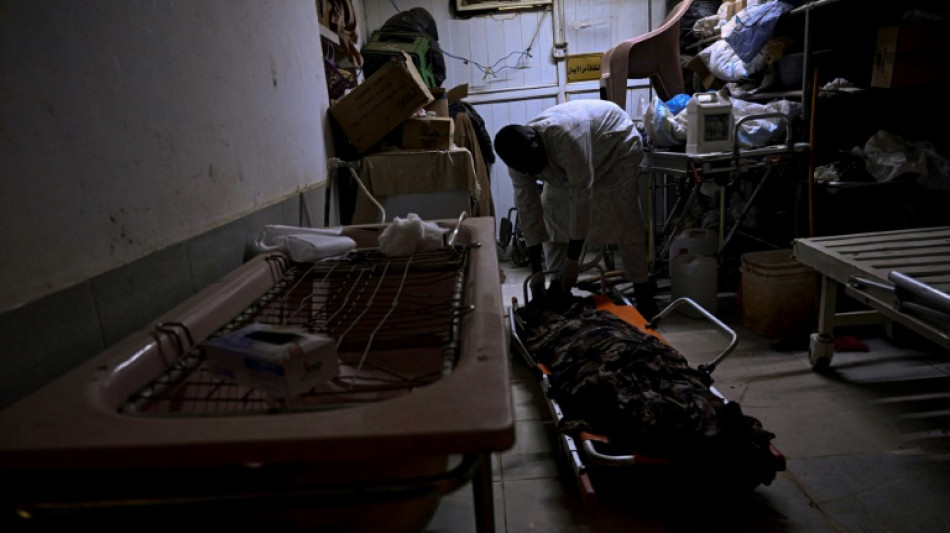
Dealing with the dead in the ruins of Sudan's war / Photo: © AFP

 Scotland boss Clarke resigns after World Cup exit confirmed

 Kane, Bellingham on target as England win World Cup group

 Croatia battle past Ghana to sew up World Cup Last 32 spot

 US, Iran clash, putting fragile deal under growing strain

 Ryu takes one-shot lead over Henderson at Women's PGA Championship

 Jangoo and Chase put West Indies in control against Sri Lanka

 World Cup star Gakpo requests privacy after death of unborn son
 Aid planes landing at partially reopened Venezuela airport after quakes
 Spain's Williams hits out at Uruguay over World Cup injury
 World's largest particle smasher halts for upgrade to boost hunt for dark matter

 Ex-Olympic medallist Canderloro elected French Ice Sports chief
 Prince Harry and family to stay at royal residences on UK visit

 'Why not?': Cape Verde eye seismic World Cup shock against Argentina
 Russell snatches controversial pole in Austria after Verstappen crash

 Davidovich Fokina wins in Mallorca for first ATP title

 Sabalenka urges Grand Slams to 'get it done' in prize money boycott row
 Russell snatches pole as Verstappen, Antonelli fourth for Austria GP grid

 Smith and supersub Foulkes strike for New Zealand in England finale
 Supersub Foulkes strike for New Zealand in England finale

 Wolff says Russell will be at Mercedes next season

 Djokovic inspired by Serena as he targets history at Wimbledon

 Stokes falls cheaply as England collapse in New Zealand decider
 Russell bounces back to beat Antonelli in final practice

 Iran says US violated peace deal as both sides trade fire
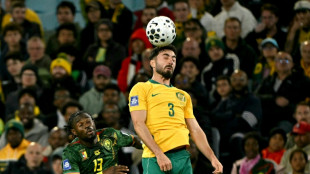 Injured Australian pair Leckie, Italiano out of World Cup
At a makeshift morgue in Khartoum, engineer turned mortician Ali Gebbai clicked through a spreadsheet of the dead. Thousands of entries, each with a photo and burial site, keep a harrowing record of Sudan's war.
Every time the team of volunteers finds a body, they post to social media and wait 72 hours in the hopes that the victim's loved ones will come across the picture and claim the person.
"We photograph every body. We check if there's anything in their pockets to help us identify them, and we mark the spot where we buried them," Gebbai told AFP.
It was a blazing April day and a dead woman lay on the ground of the small, air-conditioned room in the Sudanese capital, her brown-speckled thobe pulled over her face and body.
If no one came to identify her, the team would prepare a clean white shroud, wash her according to Muslim custom and bury her nearby.
It is all anyone in Khartoum can hope for by way of a morgue. And it is far more than what most victims of Sudan's war receive: a shallow grave, hastily dug into the dirt where they fell.
The conflict, now in its fourth year, between Sudan's army and the paramilitary Rapid Support Forces has no confirmed toll, though it has killed at least tens of thousands, and aid workers give estimates of more than 200,000.
"It's disheartening, all these estimations. When you have a population not knowing what has happened, that trauma and the impact cannot be overlooked," Jose Luis Pozo Gil, the International Committee of the Red Cross's deputy Sudan chief, told AFP.
In the year since the army recaptured Khartoum, authorities have exhumed and reburied "around 28,000 people", Hisham Zein al-Abdeen, head of forensic medicine at Sudan's health ministry, told AFP. And they have only cleared a little over half the capital.
Gebbai said he and his teams have buried 7,000 dead since the war began.
Ethnic massacres in Darfur, meanwhile, have killed thousands of people at a time, and this year alone at least 700 died in drone strikes on Kordofan.
- Morgues destroyed -
Across the country, there is nowhere to store the dead, and no way to count them.
During the worst massacres, when firebombs tear through mosques and markets, rescuers routinely run out of shrouds. The dead are buried where they lay, wrapped in their own clothes or plastic bags, often in villages with no clinic to speak of, much less a morgue that can send information to a central authority.
Zein al-Abdeen, one of only two forensic doctors in Khartoum, said the capital's morgues "were already full before the war".
According to the ICRC, Khartoum's four morgues were all forced out of service by the war, but the dead remained inside.
"When we went inside the Omdurman morgue, there were still many bodies. And there hadn't been any electricity for a long time -- you can imagine the state," Pozo Gil said.
The Omdurman morgue was "completely destroyed" in a strike, Zein al-Abdeen said, its compressors looted while bodies lay rotting everywhere they looked.
His team has been exhuming Khartoum's dead for a year, focusing on "those buried in shallow graves, in public spaces, in sewers and along the Nile".
As bullets flew and artillery arched over the river to crash into homes and hospitals, trapped civilians could not reach the next street over, much less the cemetery. So people buried their loved ones in courtyards, at playgrounds and on street corners.
Over three years, it turned Khartoum into an open-air graveyard.
"That leaves a mark on society, it destroys human dignity and it normalises death," Zein al-Abdeen said.
The same is true for the rest of Sudan: in Darfur, where pools of blood could be seen in satellite images; in al-Jazira, where bodies were dumped in canals; and in Kordofan, where killer drones still stalk civilians.
- Finding the missing -
Most of those exhumed and reburied in Khartoum are identified, Zein al-Abdeen said, by families who buried their loved ones themselves but needed authorities to give them a proper resting place.
But many are not. From every anonymous body, authorities remove a small bone or a piece of hair, in hopes they will one day be identified. But Sudan has no working DNA labs to test the samples, and nowhere to store them until then.
"The safest place to keep the DNA samples is buried separately in the ground, and marked clearly," Zein al-Abdeen told AFP, "or we'll exhume the bodies again later."
According to the ICRC, there are at least 11,000 missing persons in Sudan.
"We know that the lack of closure for families leaves an open wound. In any kind of recovery in the future, in order to find closure, to rebuild trust, the issue of the missing has to be addressed," Pozo Gil said.
Gebbai the mortician spoke with steely-eyed resolve, but it began to crack when he remembered one young man.
"He was looking for his father and his uncle for over a year. When he came to us, he found out they had both been shot dead in the street in the early weeks of the war. It broke him, he collapsed and cried for a long time."
But at last, at least, he could visit their graves.
L.Meier--VB