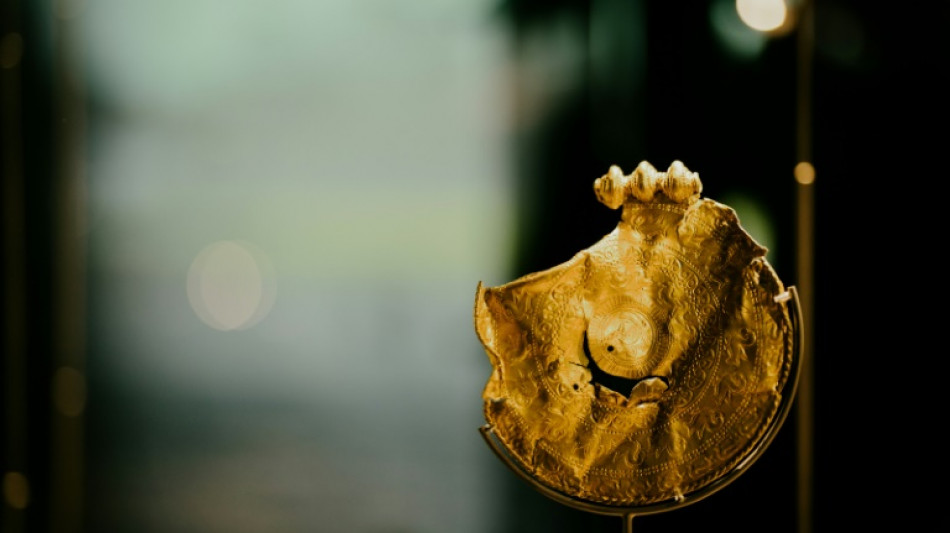
Treasure hunters' gems go on display in Denmark / Photo: © National Museum of Denmark/AFP

 Relieved Russell says Mercedes have solved his power problems mystery

 Oil soars above $100 as Middle East fears grow

 Venezuelans turn to scrap collecting in quake-hit beach 'paradise'

 Heptathlon champion Johnson-Thompson joins list of Commonwealth Games absentees

 Nigeria's Dangote raises $2.5bn to expand Africa's largest refinery

 Oil soars to $100 on fresh Mideast attacks

 Coal-fired power generation rising globally on Mideast war: IEA

 Premier League champions Arsenal sign Greece winger Tzolis from Brugge

 French Jewish DJ sues after activists disrupt gig: lawyer

 Venice film festival promises Pattinson, Oasis and Musk doc

 ASEAN calls for open straits as US-Iran war casts shadow

 Ford and Geely to form joint venture at struggling Spain plant

 Russia warns US against Ukraine arms sales in Manila meeting
 New UK PM announces tax cut for struggling pubs

 Supporters flood India's 'cockroach' protesters with food

 Modi vows punishment for exam leaks fuelling India protests

 Norway set to make formal complaint to FIFA over Balogun red card saga

 Floods in northeast India kill at least 41

 Nestle siphons off bottled water business into joint venture
 Hundreds hospitalised in Japan heatwave 'disaster'

 Renault says sales stalled in first half
 EasyJet says profits nosedive on Mideast war

 Modi vows punishment for exam fraud fuelling India protests

 Six candidates in race to lead UN set for televised debate

 Comic-Con kicks off with Marvel's return

They may be derided elsewhere but in Denmark, hobby archaeologists who hunt treasures with metal detectors are such an asset the National Museum has dedicated an entire exhibit to their finds.
"What they save now means the world for what we can do in the future and how we can build our museums," exhibit curator Line Bjerg told AFP.
"What they do really matters."
In Denmark's muddy soil, if objects "are not saved, then they are lost to history", she added.
In three rooms on the museum's bottom floor, visitors can learn about "detectorists" and admire some of their discoveries, including rings, necklaces and gold coins, all marked with the name of their finder.
In the Scandinavian country once populated by Vikings, amateurs can use metal detectors almost everywhere as long as they get permission from the landowner. They are not, however, allowed to dig beneath the top layer of soil.
Any archaeological finds have to be turned over to a local museum for an initial evaluation before they are transferred to the National Museum for an in-depth assessment -- and a possible reward.
Detectorists' hauls can be abundant.
"Last year, we had almost 18,000 objects that were sent for treasure trove processing. The year before that it was 30,000 objects," Bjerg said.
Known as "Danefae", any archaeological artefacts found by treasure hunters automatically belong to the state, under an old medieval law.
According to Torben Trier Christiansen, an archaeologist with the Historical Museum of Northern Jutland, the collaboration with the hobbyists is invaluable.
They are "one of the most important collaborators of the museum", he insisted.
There are more than 250 detectorists in his region, with the most active among them handing over around a hundred objects per year.
Arne Hertz, a 64-year-old pensioner who heads a local association of detectorists, said "people are pleased to do the right thing by handing over the findings".
- Writing history together -
The unique collaboration is based on a mutual understanding. On the one hand, archaeological sites won't be looted. On the other, authorities are able to showcase the amateur discoveries.
"Sometimes it's these particular finds that change our history because they add knowledge that we simply did not have before," Bjerg noted.
One section of the biggest exhibition room is dedicated to the "Vindelev Treasure".
Comprised of 22 gold objects, it was buried in the sixth century in southwestern Denmark and found in late 2020 by an amateur who had just bought a metal detector.
The treasure trove includes a bracteate -- a thin coin stamped on one side.
"And on the inscription of the bracteate is mentioned the name of Odin, the Norse god. And it puts Odin 150 years before we actually knew that he existed as a god," Bjerg said.
"We're building our history together in Denmark."
For detectorists, whose finds have on occasion been displayed at local museums, the exhibit at the National Museum is a major recognition.
"It's very impressive to see how the things we've found are displayed -- and to see that we are actually helping a little to enrich Denmark's history," 38-year-old Simon Grevang, who works in online marketing and has been a detectorist for four years, told AFP.
The exhibit has drawn crowds since opening in February.
Annie Lund, a 72-year-old retiree who was enthralled by the jewellery on display, said it was a good way of making history accessible.
"Twenty or forty years ago, this was only for a small group of people, scientists... not for the general public. So I think this is really good," she said.
W.Lapointe--BTB