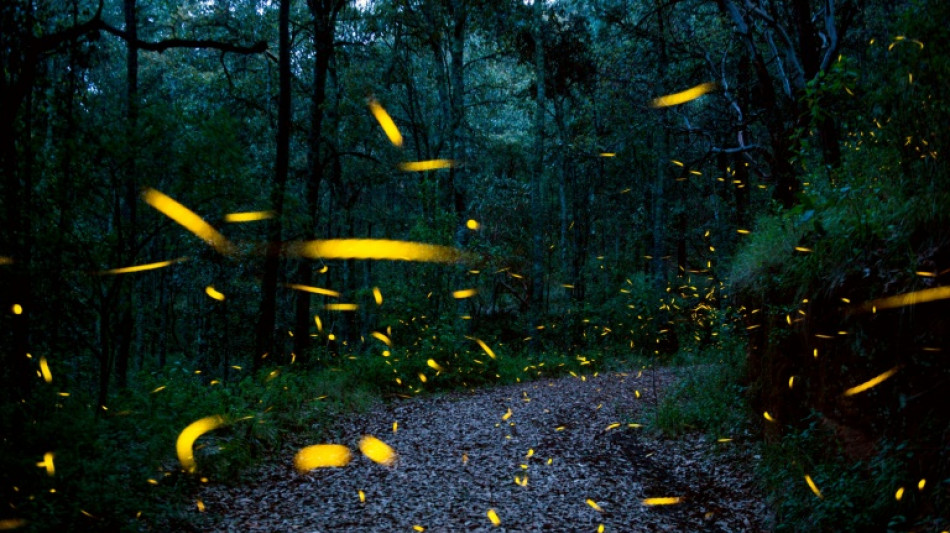
From robot fireflies to okra plasters: 2022's nature-inspired solutions / Photo: © AFP/File

 ASEAN calls for open straits as US-Iran war casts shadow

 Ford and Geely to form joint venture at struggling Spain plant

 Russia warns US against Ukraine arms sales in Manila meeting

 New UK PM announces tax cut for struggling pubs

 Supporters flood India's 'cockroach' protesters with food

 Modi vows punishment for exam leaks fuelling India protests

 Norway set to make formal complaint to FIFA over Balogun red card saga

 Floods in northeast India kill at least 41

 Nestle siphons off bottled water business into joint venture

 Hundreds hospitalised in Japan heatwave 'disaster'

 Renault says sales stalled in first half
 EasyJet says profits nosedive on Mideast war

 Modi vows punishment for exam fraud fuelling India protests

 Six candidates in race to lead UN set for televised debate

 Comic-Con kicks off with Marvel's return

 Dutch riders dreaming of crazy party corner of Alpe d'Huez
 Houthis target Red Sea shipping as US hits Iran

 Record-equalling Red Sox streak halted at 15 wins

 Messi-less Miami beat Fire 3-2 to spoil Lewandowski's MLS debut

 Mercedes expect Hungary challenge from Hamilton and Ferrari

 In Ghana, one man's race to save critically endangered fish

 Wilson captain, Slipper absent in Kiss's first Wallabies squad
 New Mideast fighting puts eurozone rate-setters on alert

 Venezuelans search for animal companions lost in the quakes

 Argentine Football Association says US did not detain its president

Even as animals and plants face widespread extinction from human-driven causes like climate change, the natural world continues to inspire scientific discovery in unexpected ways.
"Nature has spent hundreds of millions of years optimising elegant solutions to extremely complicated problems," said Alon Gorodetsky, a biomedical engineer at the University of California, Irvine.
"So if we look to nature, we can shortcut our development process and get to a valuable solution right away," he told AFP.
From squid-skin food warmers to a lubricant made of cow mucus, here is a selection of this year's scientific work inspired by nature.
- Okra plasters stop bleeding hearts -
Stopping the bleeding hearts and livers of dogs and rabbits without stitches may now be possible with a biodegradable plaster made of sticky okra gel.
Okra is a fuzzy green vegetable with a slimy texture that inspired Malcolm Xing from Canada's University of Manitoba to turn it into a medical adhesive.
"Okra is a fantastic material," said Xing.
In the July study published in Advanced Healthcare Materials, researchers discovered that refining okra in a juicer and then drying it into a powder creates an effective bioadhesive that quickly creates a physical barrier and starts the blood clotting process.
The researchers plan to test this plaster on humans in the coming years.
- Cow mucus lubricant -
Snot may invoke feelings of disgust, but laboratory tests found that a lubricant made of cow mucus showed promise at curtailing the spread of certain sexually transmitted infections.
The study, published in Advanced Science in September, is very preliminary, however. It has not yet been tested on humans and should not replace other forms of protection, like condoms.
Researchers extracted the mucus from the salivary glands of cows and turned it into a gel that binds to and constrains viruses. Mucus is made of a protein called mucin that might have antiviral properties.
It is also both a solid and a liquid.
"Being a solid, it can trap bacteria or viruses in the body. Being a liquid, it can clear those pathogens from the body," said study co-author Hongji Yan from Sweden's KTH Royal Institute of Technology in Stockholm.
- Robot fireflies -
Fireflies that light up the night sky inspired scientists at the Massachusetts Institute of Technology to create tiny, bug-sized robots that emit light when they fly.
The glowing artificial muscles help the honey bee-sized robots communicate with each other, which may make them useful for search and rescue missions some day.
Though the robots can only operate in a laboratory environment so far, the researchers are excited at their potential future uses.
- Cancer-sniffing ants -
There are an estimated 20 quadrillion ants in the world, and researchers have discovered that one species might be able to sniff out cancer in human breasts.
In a study conducted at Sorbonne Paris Nord University and published on the preprint server bioRxiv, which has not yet been peer-reviewed, scientists used a sugar-water reward to train ants to smell the difference between mouse urine implanted with, and without, human tumours.
While dogs can be trained to use their super noses to detect cancer, this is expensive and takes time.
Ants might provide a cheaper, albeit less cute, alternative.
- Squid-skin tea cosies -
The strange skin of squids has inspired a packaging material that can keep coffee and food warm for as long, or as little, as wanted, according to a March study published in Nature Sustainability.
Squids have miniature organs called chromatophores that can drastically change size, and also help them change colour.
To mimic "these pigment-filled organs", study co-author Alon Gorodetsky, from the University of California, Irvine, said they developed "little metal islands that you could move apart" and contract.
The heat level can then be controlled by how much the material is stretched.
"If you put it around a warm object -- for example, a coffee-filled cup or a hot sandwich -- you can control the rate at which it cools down," he said.
"Nature really is the epitome of innovation and engineering," Gorodetsky added.
C.Kovalenko--BTB