Wimbledon courts chief has global vision for tennis on grass / Photo: © AFP

 Devan Ekambaram and Susha’s 'Varuvaaiy' Makes History as First Tamil Song Nominated for a Grammy

 Miranda Lambert Leads North Texans with Seven Grammy Nominations for 2027

 DiDi Advances Robotaxi Operations in China with New R2 Vehicle and Expanded Safety Infrastructure

 Smart Car Seats Tested: Do Sensors and Apps Actually Improve Safety?

 5 Strategies for Fort Worth Households to Reduce Summer Electricity Costs

 Central Bank of Malta Links Energy Subsidies to Middle East Conflict and Price Volatility

 Shomari Figures Defies Redistricting in Alabama Amid Disaster Relief Crisis

 BYD Dolphin G Leasing Deal: Plug-in Hybrid Supermini Available from £174 a Month

 Egypt Opens Registration for 2027 Total Solar Eclipse Viewing Packages

 French Economy Shrinks 0.1% as Consumer Confidence Slumps

 Wall Street Ends Turbulent Week Higher Despite Inflation and AI Jitters
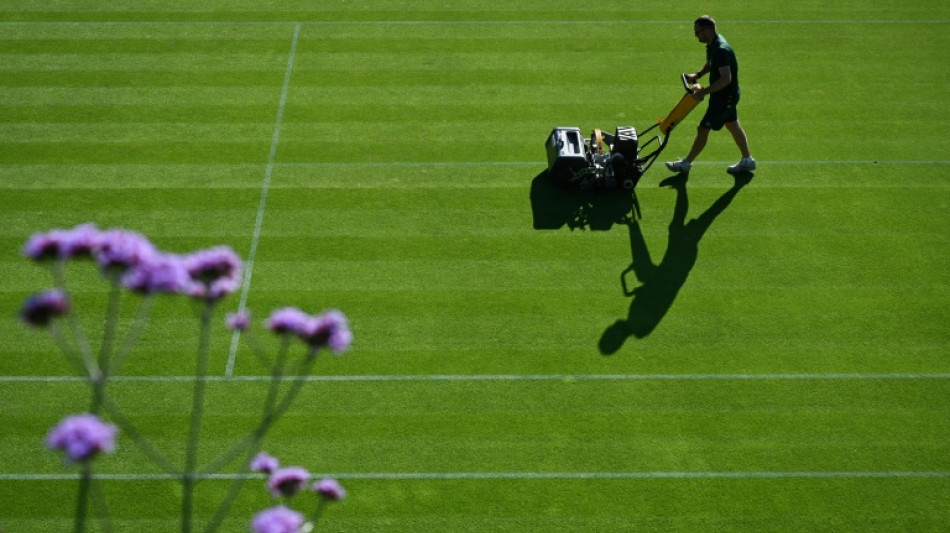
Wimbledon head of courts Neil Stubley is on a mission to champion grass-court tennis around the world by harnessing modern technology to recreate the unique conditions of the All England Club.
Players only get the chance to compete on the surface for a few weeks each year, with clay and hard-court tournaments dominating international tours.
But Stubley, whose role is to keep the lush turf of Wimbledon in tip-top shape, is involved in trials in Britain and Australia using synthetic fibres alongside grass to improve court surfaces.
"One of the biggest challenges for grass tennis is that you need quite a heavy clay soil because what you need to do is be able to dry it out and get the ball bounce," he said.
"In the UK we've naturally got quite a lot of clay soil within our soil make-up, whereas in other parts of the world some countries are very much dominated by chalk or sand so they find it a lot harder to find the sort of soils that we naturally find in the UK."
Stubley said using grass-stitching with sandier soils helps make the structure of the playing surface more stable and resilient.
"You can actually have a more free-draining surface but you can still get the hardness on the surface as well so then you can go to places like Australia that have got very silty, sandy soils and create good grass courts, so that's part of our research."
Stubley said the first aim was to make sure the new courts worked for tennis, reproducing the characteristics of a grass court.
The head of courts and horticulture, who has worked at Wimbledon for nearly three decades, is passionate about promoting grass-court tennis.
"We want to champion global grass tennis, not just for the Championships but hopefully you can potentially have tournaments in any country in the world, depending on whether it's a warm-season or a cool-season grass," he said.
"We're doing a lot of research in southern hemisphere grasses, Bermuda grasses and the like, so we can actually end up having a product where we can have the right root zone and the right grasses on top to give us the same characteristics of a court at Wimbledon."
- Football lesson -
Stubley said tennis was learning from football, which has used grass-stitching for a number of years.
He said other sports including cricket were interested in the technology as it could lead to longer seasons.
"We've got some trial courts that we've built (in Britain)," said Stubley.
"We're just getting players and members to play on it, get feedback, doing that same data collection that we would do with STRI (sports turf consultancy), with hardness, ball bounce, ball height, speed, the ball coming through.
"If we can have a more free-draining soil, could we actually extend the grass-court season by four to six weeks and make it more appealing for the general public to play grass-court tennis?"
But Stubley does not see any immediate use for grass-stitching on Wimbledon's courts.
"The stich system probably for the betterment of world grass-court tennis," he said. "I think the Championships are a standalone.
"We kind of get to the point where we can have better-quality courts around the world. It's more about getting juniors more used to grass so it's not so alien to them when they come on the main tour."
But Stubley said Wimbledon itself, which from this year permanently loses its middle Sunday rest day, meaning more constant wear and tear, has benefited from technological advances over the years.
This has included painstakingly trialling and selecting the best type of ryegrass and a better understanding of the use of nutrients and chemicals.
Steam-sterilising the courts at high temperatures helps control weeds, pests and fungi, meaning there is less reliance on fungicides.
"It's just a combination of those sorts of things that's put us in a position now where we just feel confident that that extra day won't have a direct impact on the quality of the turf," he said.
C.Meier--BTB