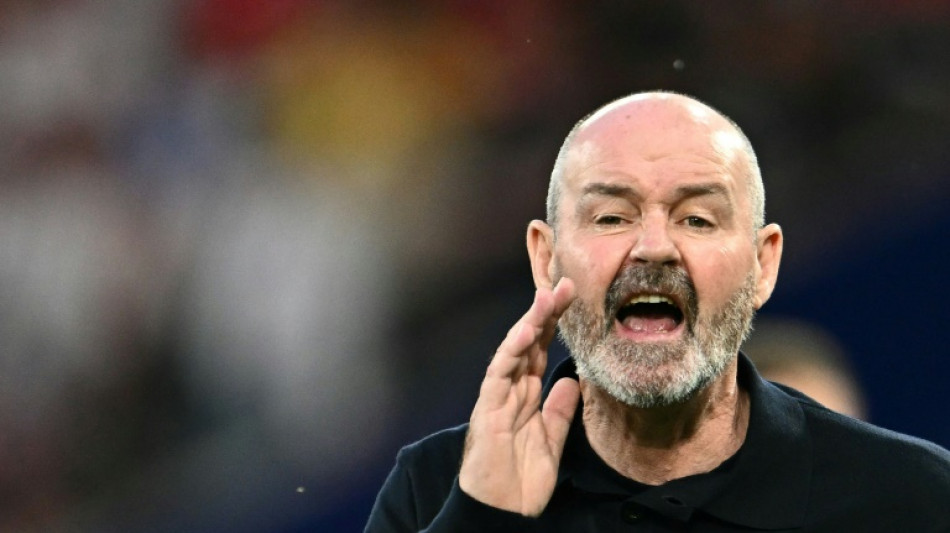
Scotland must emulate Croatia's 'conveyor belt of talent': Clarke / Photo: © AFP/File

 Devan Ekambaram and Susha’s 'Varuvaaiy' Makes History as First Tamil Song Nominated for a Grammy

 Miranda Lambert Leads North Texans with Seven Grammy Nominations for 2027

 DiDi Advances Robotaxi Operations in China with New R2 Vehicle and Expanded Safety Infrastructure

 Smart Car Seats Tested: Do Sensors and Apps Actually Improve Safety?

 5 Strategies for Fort Worth Households to Reduce Summer Electricity Costs

 Central Bank of Malta Links Energy Subsidies to Middle East Conflict and Price Volatility

 Shomari Figures Defies Redistricting in Alabama Amid Disaster Relief Crisis
Steve Clarke believes Scotland can emulate Croatia's eye-catching success at major tournaments but must radically rethink their approach to developing talented young players.
Croatia, who face Scotland in the Nations League on Friday in Glasgow, finished third at the 1998 and 2022 World Cups as well as reaching the final in 2018.
With a population of around four million, about 1.5 million lower than Scotland, the country has long been used as a potential template for Scottish football.
"They've got a system set up right from the young ages all the way through because they seem to have a conveyor belt of talent," Scotland manager Clarke said Thursday. "They keep bringing players through.
"They also have a lot of players with longevity at the top level, with over 100 caps or between 75 and 100.
"They've just got the balance right. They produce a lot of good young players and allow them to play a lot of games in their own country before they move out -- which is a really good grounding and something we can maybe get better at here."
Clarke said Scotland, struggling to stay in the top tier of the Nations League, "still have a lot of work to do" to improve their systems.
"At some stage, people have to sit down -- a think tank or whatever -- and try something a bit different that we haven't tried before to see if we can improve it," he said.
"If we keep doing what we're doing, it's not going to get better."
A recent Scottish Football Association report revealed that the country "lags significantly behind comparable nations in terms of young player minutes at every level of the game", with the ages of 16 to 21 a particular problem.
Clarke said club managers were under pressure to get results, meaning they sometimes relied on more experienced players.
"I don't think we'll ever go back to the utopia where you've got 16 Scottish players at one club that feed the first team," he said.
"That's not going to happen anymore. At the moment, you've probably only got two or three that are in and around the fringes at most clubs.
"Can we get more? Can we get half a dozen? Can we get eight? That's the type of numbers that I think we should be looking to get."
L.Stucki--VB