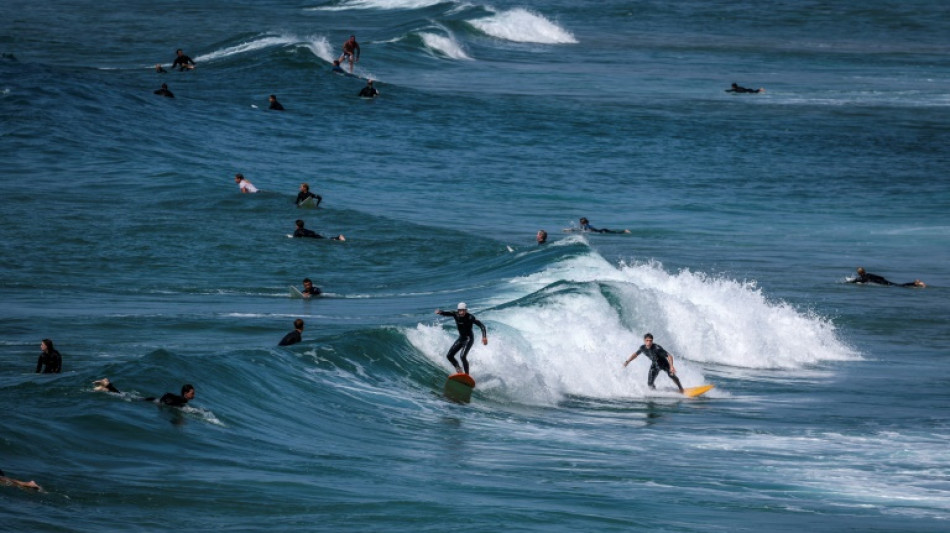
Surfboards with bright lights could deter shark attacks - researchers / Photo: © AFP

 Devan Ekambaram and Susha’s 'Varuvaaiy' Makes History as First Tamil Song Nominated for a Grammy

 Miranda Lambert Leads North Texans with Seven Grammy Nominations for 2027

 DiDi Advances Robotaxi Operations in China with New R2 Vehicle and Expanded Safety Infrastructure

 Smart Car Seats Tested: Do Sensors and Apps Actually Improve Safety?

 5 Strategies for Fort Worth Households to Reduce Summer Electricity Costs

 Central Bank of Malta Links Energy Subsidies to Middle East Conflict and Price Volatility

 Shomari Figures Defies Redistricting in Alabama Amid Disaster Relief Crisis
Covering your surfboard in bright lights sounds like an open invitation to great white sharks, but research released Tuesday by Australian scientists found it might actually stave off attacks.
Biologist Laura Ryan said the predator often attacked its prey from underneath, occasionally mistaking a surfer's silhouette for the outline of a seal.
Ryan and her fellow researchers showed that seal-shaped boards decked with bright horizontal lights were less likely to be attacked by great white sharks.
This appeared to be because the lights distorted the silhouette on the ocean's surface, making it appear less appetising.
"There is this longstanding fear of white sharks and part of that fear is that we don't understand them that well," said Ryan, from Australia's Macquarie University.
The study, published in the journal Current Biology, was conducted in the waters of South Africa's Mossel Bay, a popular great white feeding ground.
Seal-shaped decoys were strung with different configurations of LED lights and towed behind a boat to see which attracted the most attention.
Brighter lights were better at deterring sharks, the research found, while vertical lights were less effective than horizontal.
Ryan said the results were better than expected and is now in the process of building prototypes for use on the underside of kayaks and surfboards.
Australia has some of the world's most comprehensive shark management measures, including monitoring drones, shark nets and a tagging system that alerts authorities when a shark is near a crowded beach.
Ryan said her research could allow less invasive mitigation methods to be used.
More research was needed to see if bull and tiger sharks -- which have different predatory behaviour -- responded to the lights in a similar way, the authors said.
There have been more than 1,200 shark incidents in Australia since 1791, of which 255 resulted in death, official data shows.
Great white sharks were responsible for 94 of those deaths.
S.Leonhard--VB