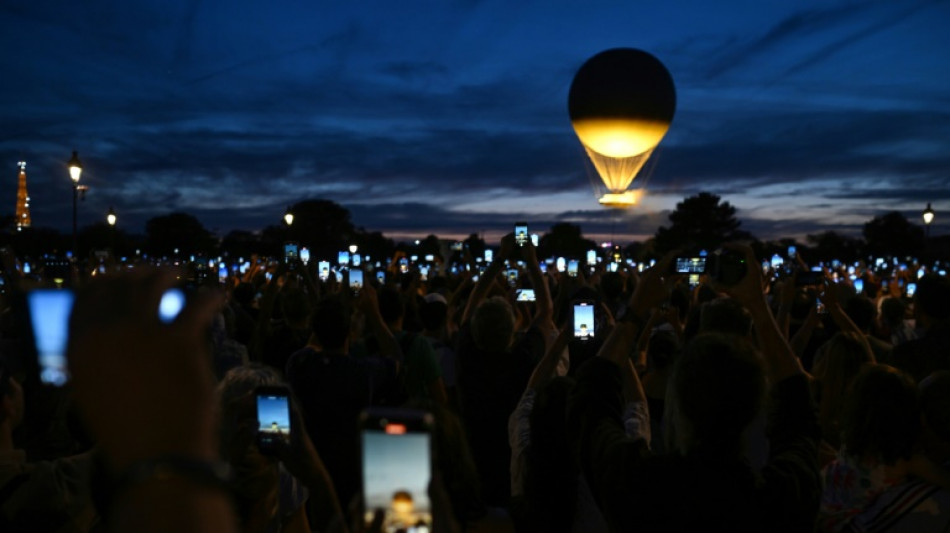
Paris Olympic cauldron could stay permanently / Photo: © AFP

 Jimmy Carr Confirms 25-Year Estrangement From Father Amid Podcast Reflections

 Arizona Superintendent Tom Horne to Leave Office, Plans Law Practice and Charter School

 Japan and Peru Mark 150 Years of Diplomatic Ties Amidst Trade and Investment Talks

 Ian Jackson Scores Game-High 22 Points After Rick Pitino's Prank Suspension

 Khan Welcomes Milburn’s Youth Employment Reforms Amid High NEET Rates

The Olympic cauldron rising over Paris beneath a huge balloon each night has become such a popular sight that it may become a permanent fixture in the City of Light.
The unique version of the Olympic flame, located in the Tuileries Gardens between the Louvre Museum and Concorde obelisk, has been one of many innovations for this year's Games.
The seven-metre (23-foot) ring of flame is not actually fire, but is made up of clouds of mist lit by LED rays, built by French energy firm EDF and powered by 100-percent renewable electricity.
Each night at sunset, it is drawn up into the sky for two hours by a 30-metre helium balloon, coated in light-reflecting satin paint.
All 10,000 daily slots to watch it rise up-close have been booked out until the end of the Games on Sunday, and it will return for the Paralympics at the end of the month.
The "real" Olympic flame, transported from Greece to France, is installed a few steps from the cauldron in a lantern sheltered by a display case.
Now, many politicians are talking about making the cauldron a permanent addition to the Paris skyline.
The decision lies with President Emmanuel Macron's government. He told reporters last week that the idea "would be a dream for many people" and that his team would "look at all that in due time".
It was an idea first floated by Paris mayor Anne Hidalgo, who told France 2 television she was "very keen" on keeping it.
"I'm not the one who decides since it is on the site of the Louvre, which belongs to the state. So I wrote to the president," she said.
That has already sparked some competition, with the head of the wider Paris region, Valerie Pecresse, suggesting it could be shifted to the Parc de La Villette on the edge of the city if it cannot stay in the Tuileries.
The huge popularity of the new landmark -- with thousands coming daily for selfies -- has been a surprise for its designer, Mathieu Lehanneur.
"It touches me deeply, which I had not expected, or at least not to this extent," he told AFP.
"It's an inverted sunset: the ritual and daily elevation of the Olympic sun. The support was immediate. We had thought about it and designed it to be absolutely recyclable after the Games and now we are considering a long-term destiny for it," he added.
L.Stucki--VB