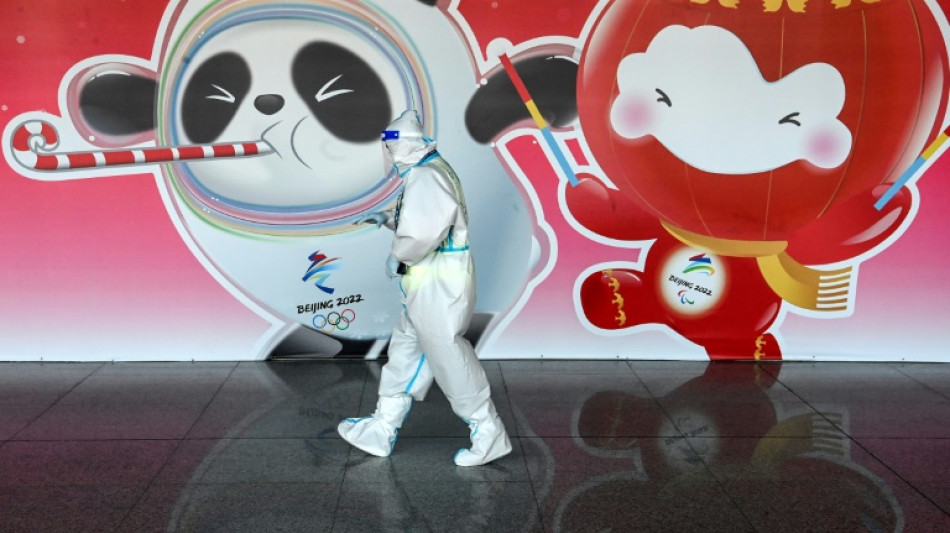
No slogans: Beijing curbs its enthusiasm for Winter Olympics / Photo: ©

 Germany's Merz vows to stay course despite new vote losses
 Man City outgun Sunderland despite Brobbey hat-trick, Man Utd rescue Fulham draw
 Mourinho blames ref committee for Real Madrid derby defeat

 Maresca craves a 1-0 win after eight-goal Man City thriller
 Atletico Madrid beat Real Madrid in tense derby clash
 Reusser retains world time-trial title

 Man City outgun Sunderland despite Brobbey hat-trick, Liverpool win at Bournemouth

 Top US, Chinese economic officials meet ahead of Trump-Xi summit
 Erdogan's LGBTQ crackdown 'first step of election campaign': activist
 Mass drone barrage on Moscow kills two
 82-year-old dies after beach fight in Greece over sun lounger
 US warns of rapid escalation in Mideast war
 Iran 'put hearts on the court' to win Asian Games basketball bronze
 School girl Yu helps China dominate in Asian Games swimming openers
 Myanmar win first Asian Games teqball gold as Spain great Puyol watches
 China's 13-year-old Yu scorches to first major gold at Asian Games
 Russians vote on last day of parliamentary elections
 Hong Kong pays final respects to former city leader Tung
 Typhoon put people off Asian Games opening ceremony, official says
 China's 13-year-old Yu cruises as Asian Games swimming begins
 AI 'warning shots' focus Beijing on national security risks
 Philippine tribe in limbo over US-led tech hub
 Leo XIV, first US pope transcends his restrained style
 Singer Ed Sheeran says Gaza situation 'unjustifiable' following controversy

 In 'Tenzing', a Sherpa mountaineer gets his due
When Beijing won the bid for the 2008 Summer Olympics, crowds poured onto the streets of the Chinese capital bursting with national pride. Two decades later, locals are noticeably lukewarm about the Winter Games.
The build-up to the Beijing Winter Olympics, which start next Friday, has been largely muted, with an absence of the ubiquitous slogans, extravagant floral arrangements and flags from last time.
"The enthusiasm is not as strong as in 2008," said one Beijinger surnamed Liu, who preferred not to give his full name.
Winter Games generally attract less attention than Summer ones, but the apparent ennui could also be down to a changing Chinese perception of their country's power.
"In 2008, the economic stature of the country was not yet so high in the world so we thought hosting the Olympics was a symbol of national rebirth," Liu told AFP.
"Today, the Games are a sporting event like any other."
Since the 2008 Beijing Olympics, China has become the second-largest economy in the world and the warmer image it pushed back then has been replaced by a fiery nationalism.
Under President Xi Jinping, China has presented a far more muscular attitude to world affairs.
"2008 really was China showing that it was firmly on the global stage," said Heather Dichter, sports historian at De Montfort University in England.
Simon Chadwick, sports industry expert for Emlyon Business School, said: "It was almost like the relaunch of brand China -- it was a coming-out party, it was an announcement that China was back on the global scene.
"China perhaps feels less dependent on the rest of the world (now) and in a position of strength, which means that it no longer worries so much about the external gaze."
- Fans and bubbles -
In addition, with Beijing 2022 the second Olympics to be held under a coronavirus shadow, measures brought in to ensure that the Games are Covid-safe have left many of the capital's residents feeling locked out.
Two years of a global pandemic have upended the organisation of all big sports events, but China has maintained a strict "zero-Covid" policy, keeping its borders largely closed since spring 2020.
Beijing is counting on the Games to showcase the success of this approach, which it has repeatedly hailed as mirroring the success of its system of top-down governance.
"If there is a resurgence of the epidemic during these Games it will clearly be a failure for China and potentially backfire for Beijing," said Carole Gomez, specialist in sports geopolitics at the French Institute for International and Strategic Affairs.
The Games will have no international spectators and only a small number of invited domestic fans.
Foreign athletes will be locked in a tight bubble and all Olympic sites are sealed off from the rest of the city.
During a recent rehearsal of the opening ceremony at the "Bird's Nest" stadium, police blocked off all the streets leading to the main Olympic Park for as much as a kilometre away.
Local Jiang Haoliang told AFP he has little interest in the Olympics.
"Most people won't be able to attend in person," he shrugged.
- 'Ideological heat' -
The reduced enthusiasm for the Games might also be down to the simple fact that winter events generally arouse less public interest than Summer Olympics.
This is particularly true in China, where government efforts to build interest in winter sports have been ramped up in recent years but started from a nearly non-existent base.
And while China is a superpower in the Summer Games, it is a relative minnow in winter sports.
"Winter sports in China tend to be much more the domain of the affluent middle classes," said Chadwick.
"For some of the events, like curling, it might be somewhat an esoteric event that doesn't capture the popular imagination the same way."
But these Games also land in a very different China to the more outward facing country from two decades ago.
A more nationalistic Beijing is riding heightened tensions with Western nations and some of its neighbours, with confrontations escalating since Xi became president in 2013.
Foreign media has been facing mounting challenges in recent years in the country, while the space for any form of domestic criticism has tightened dramatically.
"The ideological heat has been turned up," said Chadwick. "And so we don't know how susceptible people have become to this portrayal of outsiders as somehow being hostile, as well as being potential transmitters of the virus."
Y.Bouchard--BTB