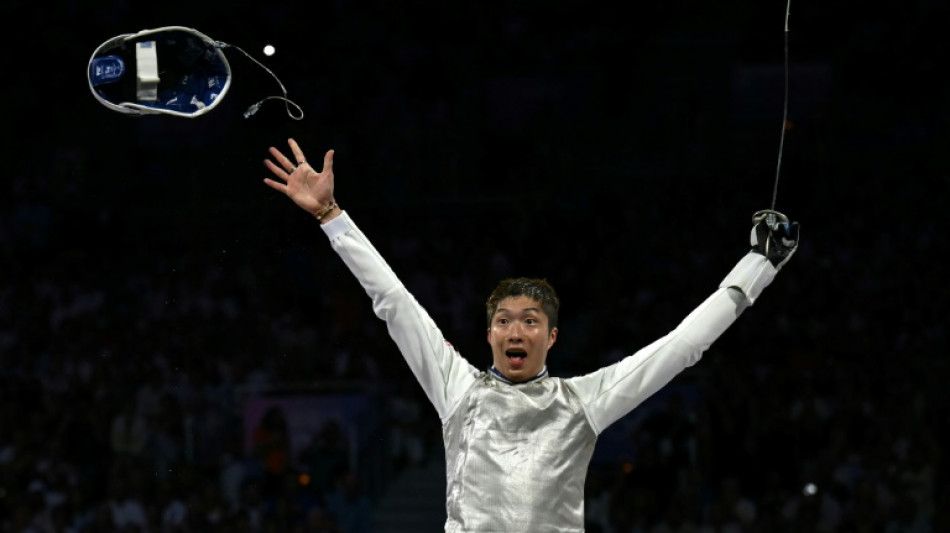
How Hong Kong's stunning fencing success was 50 years in the making / Photo: © AFP

 How young is too young as child prodigies win big at Asian Games

 UK Labour party meets buoyed by Burnham but eager for concrete plans
 Thousands protest ahead of Mexican president's report on missing students
 Bangkok floods force thousands into shelters
 AI startup urges optimism from Europe despite safety fears

 'Godlike, invincible': Japan hails 11-year-old Games history-maker
 Nepal's hydropower ambitions face climate reality check

 Power cuts, rubble: millions come home to find Sudan's capital unlivable
 Internationals keep Presidents Cup lead with late fightbacks
 Tuchel to 'keep pushing' England to reach Spain's level
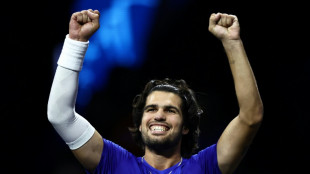 Alcaraz saves match points to keep Europe ahead in Laver Cup
 Spain success driven by hunger to improve, says De La Fuente
 Lyon collapse at Stade Francais to suffer first Top 14 loss
 Oyarzabal and Spain sink England again as Modric shines for Croatia
 Housing protesters camp in central Madrid after mass demonstration

 Louise Trotter expands her palette at Bottega Veneta
 Pope prays at Lourdes after huge Paris mass
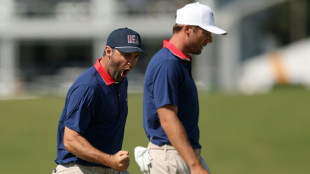 USA trims International lead after Presidents Cup four-balls
 Russia accuses Europe of blocking Ukraine talks, as strikes drag on
 'He said hello': Families pray with pope on Paris avenue
 Pope celebrates giant Paris mass, flies to Lourdes
 Thousands march in Madrid over eviction of 87-year-old woman
 England women back to winning ways with last-gasp defeat of New Zealand
 Trump rejects Iran proposal for deal to reopen Hormuz
 England's Cox says injured Buttler leaves 'big shoes to fill'
Hong Kong has emerged as a fencing powerhouse at the Paris Olympics, topping the sport's medal table with two gold medals, but the seeds of success were sown half a century ago.
Brought in by Portuguese settlers after World War II, the sport did not take off until the 1970s when it began to breed champions, pull in government funding and create the base for a rich legacy.
The southern Chinese City, with a population of around 7.5 million, has only won four Olympic golds in Games history, but three have come in the swashbuckling sport at the last two editions.
Vivian Kong Man-wai took a thrilling sudden-death gold medal in the women's epee on Saturday's opening day in Paris.
Two days later Edgar Cheung Ka-long won gold in similarly dramatic fashion as he became the first fencer in 68 years to retain the men's foil title.
"We can prove that we can realise a lot of different things," said Cheung.
"We will not give up just because we come from a very small place."
The sword-fighting sport grew in popularity in Hong Kong in the 1970s when the Jubilee Sports Centre, the city's only elite athlete institute under British rule, began to offer fencing training to physical education teachers.
These teachers then passed on the skills in school classes and extracurricular activities, according to Lobo Louie, a senior lecturer in physical education at the Education University of Hong Kong creating a base for success.
"You can understand a sport's development with a 'pyramid theory'," said Louie, who is also a member of the city's sports commission.
"The youth and their schools form the base, the community in the middle, and the elites are at the top," he told AFP.
"The wider the base, the larger the top of the elites you will get."
By the 1990s, young Hong Kong fencers had pocketed over a dozen medals -- including golds in the first five Asian Youth and Cadet Fencing Championships.
Professional athletes began to qualify for the Asian Games and even the Olympics, benefiting the next generation.
"After the professional fencers retired, they started fencing schools in the community," Louie said.
"People know more about the sport because there are people teaching it."
- Chasing a dream -
Wong Tsan, the principal of the Hong Kong Fencing School, was one of the pioneers in founding private clubs in the early 2000s.
He was also Olympic medallist Cheung's first coach.
According to Wong, the Hong Kong Fencing Association started organising competitions between primary schools.
"That made a lot of parents willing to invest in fencing" to enhance their children's chance to enrol in elite secondary schools, Wong said.
Following Cheung's win at Tokyo in 2021. the city now has more than 40 fencing clubs, offering classes to learners as young as three.
"They are almost everywhere," Wong said.
Lau Kwok-kin, a two-time fencing Olympian and now a coach running his own fencing school, said the achievements can also be attributed to a "more scientific, more professional" training system.
In 2002, the Hong Kong Sports Institute -- successor of the Jubilee Sports Centre -- was revamped to take over elite athlete training.
The programme now covers "everything, from retreat, practising, competition, techniques and physical conditions," according to Lau, and recruits top coaches from overseas.
More government subsidies have also been rolled out, unlike during Lau's time when he said they had to train "after class or work, when we were already tired".
Full-time top elite athletes receive a monthly subsidy of US$6,175 compared to the city's household median monthly income of $3,840.
Kong returned home to a hero's welcome on Thursday, and the "Sword Queen" was quick to thank all the fencers who came before and paved the way for her success.
"When they had much less resources than us now, they relied on their passion for this sport," she said, holding her medal.
"They worked really hard so that our generation can chase our dreams."
T.Germann--VB