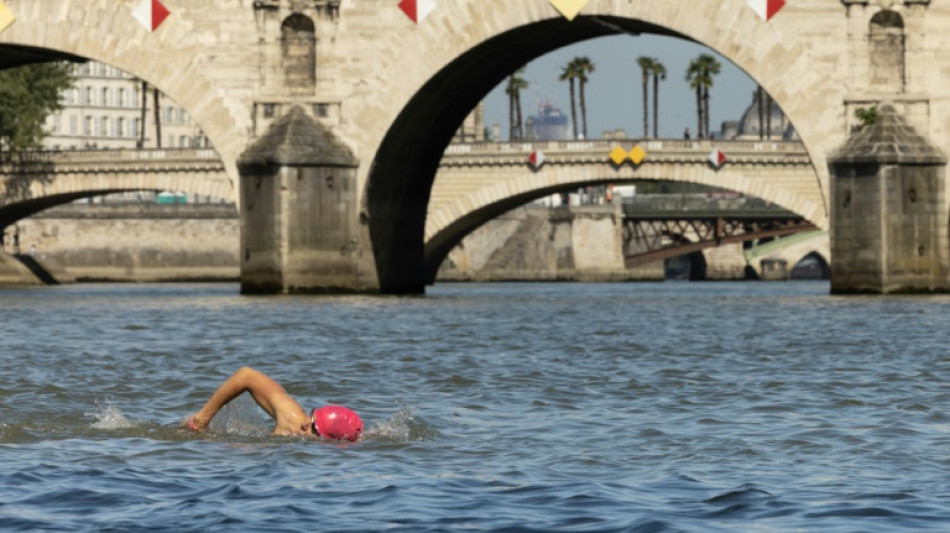
Olympics organisers cancel first triathlon training over Seine pollution / Photo: © AFP

 Progressive Vision Wins Irish Healthcare Awards 2026 Innovation Prize for Office-Based Cataract Surgery
 Eight-Year-Old Georgia Wins Penrith Valley Public Speaking Competition

 Steven Berkoff on Memory and His New Autobiography 'Shouting At Night'

 Jimmy Carr Confirms 25-Year Estrangement From Father Amid Podcast Reflections

 Arizona Superintendent Tom Horne to Leave Office, Plans Law Practice and Charter School

 Japan and Peru Mark 150 Years of Diplomatic Ties Amidst Trade and Investment Talks

 Ian Jackson Scores Game-High 22 Points After Rick Pitino's Prank Suspension

The River Seine failed its first Olympic test on Saturday as a training session for triathletes was scrapped after the water failed pollution checks.
A statement from Paris 2024 organisers and World Triathlon said "a joint decision was taken to cancel the swim leg of the triathlon familiarisation" but that running and bike training sessions would "go ahead as planned."
The quality of the Seine -- which is set to be used for triathlon and marathon swimming -- is dependent on the amount of rain that falls in and around Paris.
Heavy downpours of the sort seen on Friday during the sodden opening ceremony of the Games overwhelm the city's sewage system, leading to discharges of untreated effluent into the waterway.
"We're not particularly worried," chief organiser Tony Estanguet told reporters during a trip to an equestrian event at the Versailles Palace on Sunday. "We're vigilant as we have been since the beginning."
"We know that for 24 to 48 hours after heavy rain that we might need to delay (events)," he added. "The weather forecast shows that in theory the rain shouldn't return."
The triathlons are set to take place on July 30-31 and August 5, followed by the open-water swimming on August 8-9.
Due to an exceptionally wet spring and start to summer, the Seine had been consistently failing water tests until the start of July.
Levels of the E.Coli bacteria -- an indicator of faecal matter -- were sometimes 10 times higher than authorised limits.
"Paris 2024 and World Triathlon reiterate that the priority is the health of the athletes. The analysis carried out yesterday in the Seine showed water quality levels that... do not present sufficient guarantees to allow the event to take place," the statement said.
Organisers have the ability to delay the outdoor swimming events by several days in the event of rain.
As a last resort, they have said they will cancel the swimming leg of the triathlon and move the marathon swimming to Vaires-sur-Marne, on the Marne river east of Paris.
- Legacy achievement -
French authorities have invested 1.4 billion euros ($1.5 billion) over the last decade to clean up the Seine.
On July 17, Paris Mayor Anne Hidalgo swam in the river to demonstrate that it was ready for the Olympics, but also to underline what is meant to be one of the key legacy achievements of Paris 2024.
Hidalgo plans to create three public bathing areas in the Seine for the city's residents next year -- a century after swimming was banned.
French authorities have invested in new water treatment and storage facilities in and around Paris, as well as ensuring that thousands of homes and canal boats without waste water connections are linked up to the sewerage system.
The locations chosen for outdoor swimming at the Olympics have caused difficulties in the past, notably ahead of the 2016 Rio de Janeiro Games and those in Tokyo in 2021.
D.Schlegel--VB