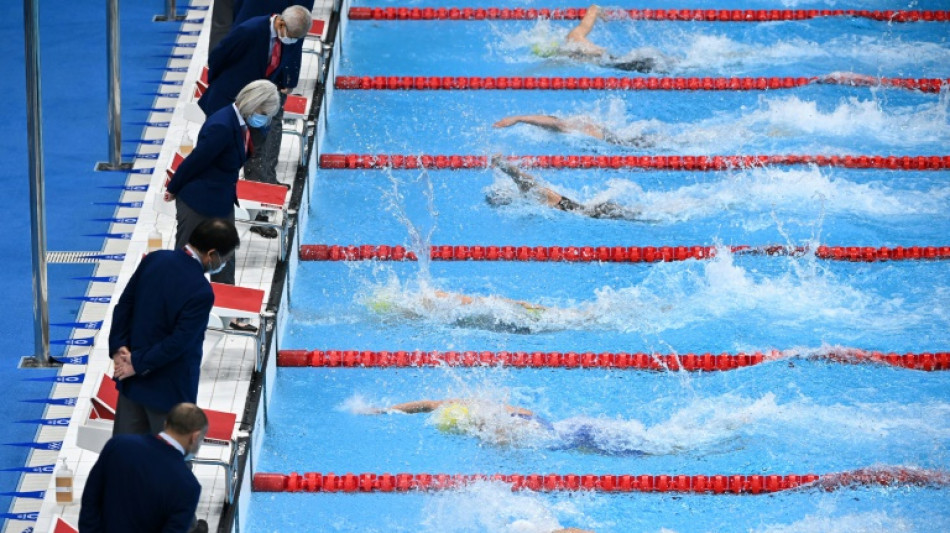
Drug testers target China's swimmers in Olympic build-up / Photo: © AFP

 ALIX LASERS shareholders remove Michael Sobitsch as managing director in view of the circumstances

 Progressive Vision Wins Irish Healthcare Awards 2026 Innovation Prize for Office-Based Cataract Surgery

 Eight-Year-Old Georgia Wins Penrith Valley Public Speaking Competition

 Steven Berkoff on Memory and His New Autobiography 'Shouting At Night'

 Jimmy Carr Confirms 25-Year Estrangement From Father Amid Podcast Reflections

 Arizona Superintendent Tom Horne to Leave Office, Plans Law Practice and Charter School

 Japan and Peru Mark 150 Years of Diplomatic Ties Amidst Trade and Investment Talks

World Aquatics has carried out its most rigorous drug testing programme ever in the lead-up to the Paris Olympics, with Chinese swimmers targeted.
Since the beginning of January, 2,145 anti-doping tests have been conducted on Games athletes, overseen by the International Testing Agency.
Including tests by other organisations, swimmers have been tested an average of 3.4 times, with 4,774 samples taken in total.
"It is our top priority that our athletes compete in a clean and fair competition," World Aquatics president Husain Al-Musallam said Tuesday.
"Our rigorous testing programme reflects our dedication to upholding the highest standards of integrity in aquatic sports and we are grateful for the ITA's partnership in conducting it."
Chinese swimmers were a key focus, with the 31 competing in Paris each tested at least 10 times by World Aquatics.
It follows revelations in April that 23 Chinese swimmers failed tests for banned heart drug trimetazidine in 2021.
They were allowed to compete at the Tokyo Olympics, where they won three golds, after anti-doping agency WADA accepted China's explanation that the positive results were caused by food contamination at their hotel.
Eleven of them are scheduled to swim in Paris.
The incident, uncovered in April by the New York Times and German broadcaster ARD, sparked global uproar, with US anti-doping authorities accusing WADA of a cover-up.
An independent investigation overseen by a retired Swiss prosecutor cleared the agency of any wrongdoing this month.
World Aquatics said it had conducted 418 tests on Chinese swimmers since January, independent of any other anti-doping organisation and using a WADA-accredited laboratory based in Europe.
Including tests conducted by other organisations, Chinese swimmers were tested on average 21 times.
In contrast, Australian swimmers were tested an average of four times in the same period, and US swimmers an average of six times.
Testing will continue during the nine-day swimming programme at La Defense Arena, which starts on Saturday.
H.Kuenzler--VB