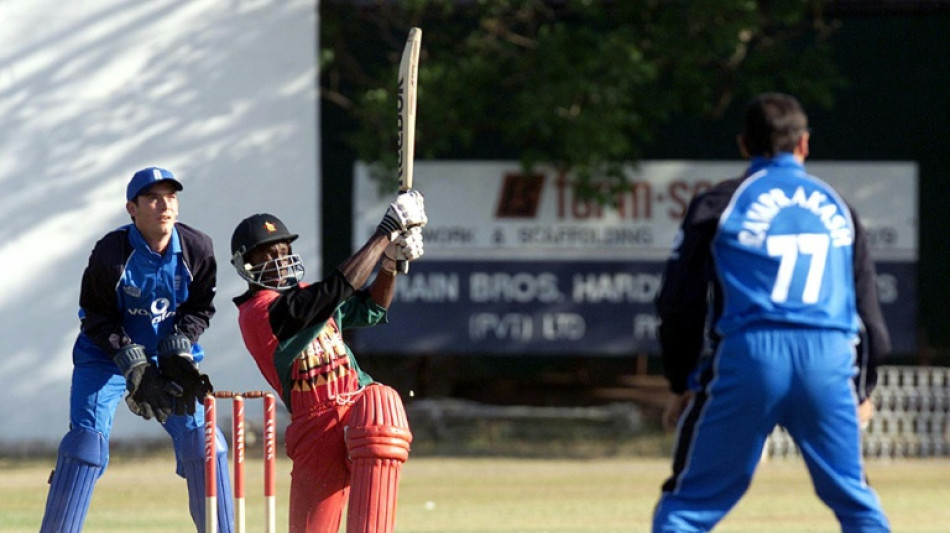
When the 'death of democracy' overshadowed cricket at 2003 World Cup / Photo: © AFP/File

 Musk backs SpaceX-Tesla merger as rocket firm turns profit

 Zelensky, US hail 'productive' talks to end Trump feud
 'Unbelievable' Foden back in the groove with treble in Man City rout
 Pistons rally to beat Celtics in NBA 2026-27 season opener

 PSG late show downs Barca in Champions League, Liverpool fight back
 Liverpool strike back to beat Villarreal in seven-goal thriller

 Dow boosted as markets rotate from tech shares
 Zelensky hails resumption of US advance warning of strikes on Ukraine
 Carrick says only wins can ease doubts over Man Utd future

 Top NBA Draft pick Dybantsa to miss opener with ankle sprain
 Italy sends troops, toughens security laws after Milan clashes
 Alberta separatists vow to fight on, risking turmoil for Canada
 Two men re-arrested for suspected spying for Iran in airbase scare: UK police

 Guatemalan man gets 30 years for truck smuggling deaths of 53 migrants

 'Clayface' gets under the skin of the superhero genre
 Zelensky, US envoys hold Oslo talks as Ukraine claims US missile holdup

 All-rounder Minhas stars as Pakistan crush England in tri-series
 Bavuma hits 179, Rabada strikes as South Africa dominate
 Allrounder Minhas stars as Pakistan crush England in tri-series
 Albania PM blames 'hybrid war' for week of unrest
 Bavuma hits 179 to lead South African fightback

 Solid GM results overshadowed by latest jump in commodity costs
 Houthi attacks undermine Saudi Arabia's economic ambitions
 French PM vows 'massive' police deployment for new demonstrations
 Power outage hits Google Cloud services, disrupting UK banks
Henry Olonga, by his own admission, was never the greatest cricketer to play the game but the Zimbabwean fast bowler left an indelible mark on the Cricket World Cup of 2003.
That was the year that he and teammate Andy Flower hit the front pages with their simple "Death of Democracy" protest against the authoritarian government of Robert Mugabe, spelling the end of both of their international playing careers.
At the previous edition in 1999, Olonga wrote himself a different chapter on the field when he took three Indian wickets in one over to secure a wholly unexpected three-run win in Leicester.
The protest, however, was a different fox altogether.
"I had nothing to gain," Olonga told AFP in a Zoom interview from his home in Adelaide.
"I had a decent lifestyle, I was paid well, I had some money stashed away, I had bought a house in Zimbabwe, a plot of land, I had a fiancee. Life was good.
"But I felt a deep urge to do what we did because I believed in the cause. I still do."
On the morning of Zimbabwe's opening match against Namibia, February 10, 2003, at the Harare Sports Club, Olonga and his white teammate Flower released a statement to the press saying they would be wearing a black armband for the duration of the World Cup.
"In doing so, we are mourning the death of democracy in our beloved Zimbabwe," it read. "We are making a silent plea to those responsible to stop the abuse of human rights in Zimbabwe. We pray our small action may help to restore sanity and dignity to our nation."
It was an immensely brave thing to do in a country that was ruled by the iron fist of Mugabe who had been in power since 1980 and would retain it until he was removed and replaced by Emmerson Mnangagwa.
As the soldiers took up post around the boundary with their AK47s, the foreign press lapped it up with many proclaiming Flower and Olonga as heroes.
Locally, however, it was met with mixed reactions, especially by other black Zimbabweans, something that still rankles with Olonga.
"There's a sense of disappointment that our message wasn't really something that was possibly attainable," says Olonga.
"We didn't change anything. We didn't transform the nation into this democratic fair country that we envisaged.
"I look back on the black armband and the very people that we were trying to help, the subjugated, oppressed and downtrodden, these were the very people who turned against me. I felt vilified by my own people.
"There's much talk of Stockholm syndrome, loving the abuser. That has made no sense to me."
Partly because of England's refusal to play in Harare, Zimbabwe qualified for the Super 8 part of the 2003 World Cup.
Olonga's final act on an international cricket field was having Kennedy Otieno leg before as Kenya romped to a seven-wicket win in Bloemfontein.
- 'Dignity' -
By then, Olonga was effectively on the run. His fiancee called it off and Olonga was charged with treason. He and Flower both left for England.
Unlike Flower, who played for Essex before going on to coach England to Ashes success in Australia, it was the end of Olonga's cricket career, aged 27.
He had taken 68 wickets in 30 Tests at an average of just under 40 and played 50 one-day internationals.
"I was quite a mediocre player but I was amazing on a couple of occasions," he says remembering that spell against India in 1999.
"And I was injury-prone so I had maybe three or four years left, no more.
"So I don't feel there was a tremendous loss in leaving the game. I don't look back with any form of regret on leaving when I did.
"At least I left the game with a bit of dignity."
Olonga struggled in England, not able to get a professional contract and bouncing bits of commentary, but he met physical education teacher Tara Read. They married, had children and then moved to Australia.
In the 20 years since the armband protest Olonga has yet to return to Zimbabwe where the sport has often struggled.
Zimbabwe failed to qualify for the 2023 World Cup which gets underway in India next week.
"The simple answer is I haven't felt safe," he says when asked why.
"Twenty years on I don't know if safety is a concern. It may not be. Many people have returned, Andy Flower has returned... It hasn't appealed to me."
Olonga is now a proud Australian citizen, to the point where he supported them during the recent Ashes series against England, and works as a singer - he appeared on the local version of 'The Voice' - and public speaker.
The 2003 protest is largely forgotten now by a world that has other, more pressing issues against which to rail. For Olonga, though, no matter how distant, that chapter will always be there.
"It's something I can't get away from. I don't try to get away from it," he says ruefully.
"But when I first started public speaking I'd spend about 20 minutes on it, now I just hint at it.
"For me it's been in the blink of an eye but it's a long time ago. Two decades. Life moves on, the sport has moved on."
G.Haefliger--VB