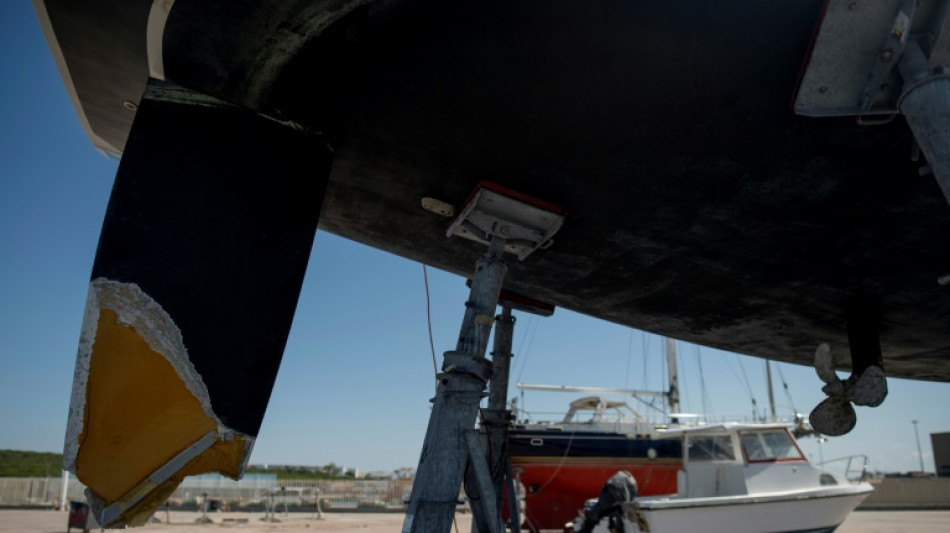
Scientists puzzled by killer whale boat attacks off Spain / Photo: © AFP

 Two dead as Istanbul endures heaviest rainfall in 80 years

 After latest Nepal flood, survivors fear for future

 EU leaders clash over budget as spectre of French elections looms

 'No place to breathe': life in Indonesia's fire epicentre

 'Can't sleep': Spain's housing crunch upends lives

 Musk calls on Ukraine's Zelensky to 'go' after satellite slowdown row

 Still smiling at 117, Albanian may be world's oldest woman

 Pope has 'good night' in hospital: Vatican

 China's economy seen missing target as global shocks bite: AFP poll

 Costa Rica opens jail inspired by El Salvador mega-prison

 Same-sex couple takes fight for equality to Slovakian court

 'High hopes' as Indonesian women get a football league, again

 'Expectations high' for Bordeaux-Begles' Champions Cup hat-trick bid, says Depoortere

 Rennie urges All Blacks to stay focused against 'hurting' Wallabies

 Palmeiras beat Fluminense 2-1 in Libertadores semi-final first leg

 Brewers blasts leave Dodgers on brink

 Tech stock lead rout after US inflation fuels rate hike bets

 Al-Fayed survivors say UK police missing 'bigger picture'

 Online 'witch hunt' sweeps up Asians misidentified as US rape accused

 Prospect of Bolsonaro win looms large over Brazil's Indigenous

 Freed from Belarus, founder of Lady Gaga's biggest fan site tells his story

 Behind AI's carbon footprint, a potential climate tool

 Trump's new press secretary faces scrutiny over credentials

 PSG 'got lucky' to win Man City thriller, says Luis Enrique

 Real Madrid comeback stuns Roma as Mourinho enjoys happy reunion

Groups of killer whales have rammed hundreds of small boats off the coast of Spain in recent years in "terrifying" behaviour that has baffled scientists.
"They directly attacked the rudder, not swimming around the boat, not playing with anything," Friedrich Sommer told AFP as he recalled how his sailboat Muffet was damaged earlier this year by "three or four" killer whales.
"They rammed at full speed against the rudder," the German sailor told AFP as he waited for his vessel to be fixed in Barbate, a coastal town in Spain's southern Cadiz province.
Rafael Pecci, manager of the shipyard where it is being repaired, is already busy repairing another sailboat that was attacked by killer whales, also called orcas.
"It has completely lost the rudder," he said, pointing to the damaged part of the vessel.
On Barbate's main beach, the mast of a sailboat that sank after it was rammed by killed whales in early May juts out of the water, a reminder of the danger ships face.
The attacks began in 2020 and they have taken place mainly between Cadiz and the port of Tanger in northern Morocco, near the Strait of Gibraltar.
Killer whales are drawn to these waters by the presence of their favourite prey -- bluefin tuna that migrate through the Strait of Gibraltar to breed in the warmer Mediterranean.
So far this year, Spain's coast guard has recorded 28 "interactions" between orcas and sailboats.
Between 2020 and 2022, there were nearly 500 such encounters, according to data released by the Atlantic Orca Working Group, known by its Spanish abbreviation GTOA, which researches orcas in the region.
- 'Fury' -
Jose Luis Garcia Varas, who heads the oceans programme at WWF Spain, told AFP that "very little is known about the causes of these interactions".
One theory is that a killer whale, christened Gladis, had a bad run-in with a boat in the past and is now teaching other killer whales to attack vessels in turn.
Gladis is the matriarch of a pod of killer whales that has been blamed for several boat attacks.
Stories and videos of the attacks have been widely shared on social media, turning the orca into a meme.
Killer whales "are group-oriented, they are very intelligent and are able to transmit knowledge orally", Garcia Varas said.
The species live, hunt and move in very closely connected family pods.
These tightly knit, matriarch-led groups have in some populations been shown to have their own pod-specific dialects.
Maria Dolores Iglesias, head of the environmental group Agrupacion Voluntarios de Trafalgar, believes Gladis has died and her descendants have continued their attacks out of anger.
One of Gladis's granddaughters has shown "fury" in her encounters with boats, Iglesias added.
- 'Quite terrifying' -
But Renaud de Stephanis, a biologist with the Spanish conservation group CIRCE who has been investigating the boat encounters, said they could be a form of "play".
"We don't have a final conclusion," he said.
De Stephanis is putting tracking devices on killer whales that will allow the authorities to locate them and hopefully minimise their encounters with boats.
Killer whales can measure up to nine metres (30 feet) and weigh up to six tonnes as adults.
While not all their collisions with boats lead to damage, when it does often it is a vital part that is destroyed like the rudder or mast.
"It is quite terrifying," April Boyes wrote on her Instagram account after her boat was attacked by killer whales while crossing from Portugal's Azores Islands to Gibraltar.
"We turned off the engine and waited, they started to bump into the rudder continuously for over an hour," she said, also posting a video showing crew members removing water from the boat to prevent it from sinking.
G.Schulte--BTB