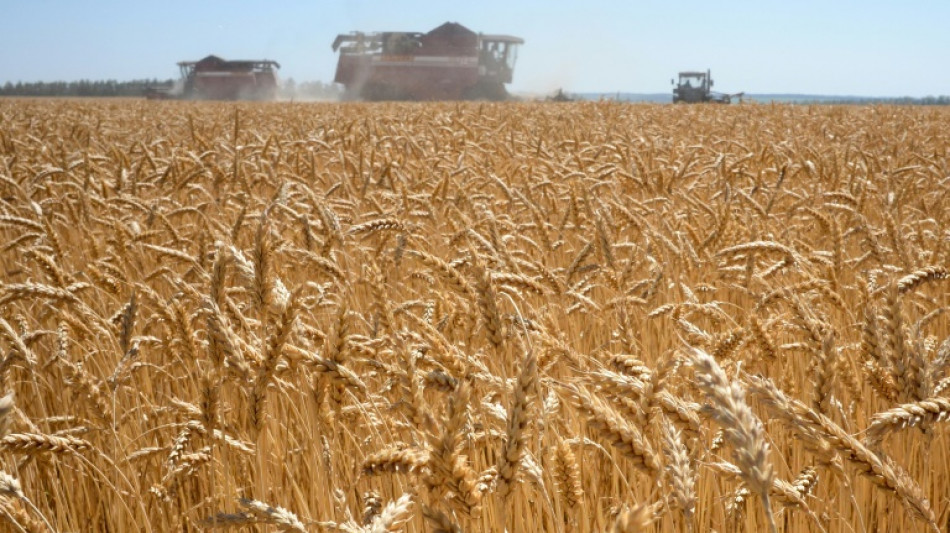
Wheat and corn prices ride the Ukrainian rollercoaster / Photo: ©

 Nordic leaders call Putin as local truce begins in Ukraine

 Osaka unveils crane outfit in Tokyo before win over Paolini

 Ronaldo in line for Portugal return after fallout with coach

 Norway media take legal action to block Meta from using content

 Bayern praise 'humble' Kane after Ballon d'Or win

 Colts retain Daniel Jones as starter despite continued offensive struggles

 Madushanka wrecks Pakistan as Sri Lanka press for final slot

 Destructive Abhishek 113 leads India to series win over New Zealand

 Norway, Finland leaders hold 'frank and substantive' talk with Putin

 Wall Street faces earnings and Fed tests after turbulent technology-led week

 Ukraine, Russia say US-brokered truce holding in ravaged city

 Police form SIT after vehicles in Rahul Gandhi convoy collide on expressway

 Delhi grants minimum monthly pay and DA to about 4,000 MCD health workers

 Ather Energy shares climb 14% after quarterly profit and expansion plan

 Gold ETF flows turn negative after 13 weeks as bullion loses 4%

 Pakistan's last antique restorers give old treasures new life

 India braces for Cyclone Arnab with evacuations

 Steel Strips Wheels gains 36% in two sessions on growth outlook

 Cavs edge T'Wolves in overtime despite superb Edwards

 Prescott fires Cowboys to 38-21 win over plummeting Eagles

 Kuwait padel chief hails national showing at Premier Padel Major

 Britain prepares constrained budget as debt and defence pressures mount

 Valkyries beat Dream to reach brink of WNBA title

 Benjamin Netanyahu: Israel's longest-serving PM fighting for survival

 Kuwait receives invitation to 2026 UN Water Conference in Abu Dhabi

The crisis between Ukraine and Russia, two of the world's biggest wheat and corn producers, has sent the commodities' prices on a wild ride -- with anything from a diplomatic statement to rumor of a maritime blockade roiling markets.
Usually much less volatile than stocks or oil, agricultural commodities are now often subject to spectacular spikes and drops.
"The market doesn't know nuance: Either it's war and it goes up, or it's peace and it goes down," said Gautier Le Molgat, an analyst at Agritel.
The grains' markets turned around three times in less than 24 hours this week: First on the Russian foreign minister's optimistic tone Monday, then on news of the United States relocating its Ukrainian embassy, and finally on Moscow's claims of a military pullback.
The stakes are especially high for wheat, with Russia being the world's top exporter and Ukraine the fourth, according to estimates by the US Department of Agriculture (USDA).
Together, the two countries account for almost a third of wheat's world trade.
On the corn side, Ukraine ranks fourth among exporters and accounts for approximately 22 percent of trade.
To date, however, the Russian army's movements have had little effect on Russian or Ukrainian exports.
While global wheat prices surge, Ukraine has seen its own rates fall by four percent over the last month, according to S&P Global Platts.
"If we remain in a latent conflict, volatility will remain in place and Russia and Ukraine will be losers in this," Le Molgat said.
"Their currencies will depreciate and few will risk buying from a distant origin without guaranteed delivery."
Ukraine is also the top sunflower oil exporter, with Russia a close second.
"We did see some customers that were pulling back buying sunflower oil from Ukraine, because they had worries about whether they would be able to deliver if they're involved in a military conflict with Russia," said Arlan Suderman, chief commodities economist at StoneX Financial.
However, according to Scheve, "over time, (such a latent crisis) would just be accepted as it's the risk that you face."
"And then until the problem rears its head again, that wouldn't necessarily put a premium on prices."
He also pointed out that exports from Ukraine and Russia traditionally slow down in March, "so that might be less of an issue."
- Blockade and embargo -
Those involved in commodities trading have a worst-case scenario in mind.
Were conflict to arise and Russia block the port of Odessa, Ukraine would have trouble exporting, Le Molgat said.
"In such a situation, one can imagine that there will be economic sanctions. The United States could thus decide to prohibit the trade of Russian wheat in dollars," he said.
Apart from Ukraine and Russia, the countries the most impacted would be their biggest customers, namely Egypt, Turkey, Indonesia and Morocco, which would be forced to find wheat elsewhere, probably at a higher price.
On the supply side, the European Union, United States and Australia, the other major players in terms of wheat, would be major benefactors of the disruption.
The exceptional uncertainty and volatility in the agricultural markets is a huge draw for investors. Earlier this month, the amount of short wheat positions (bets on price dropping) rose to levels not seen since July 2020.
In recent days, Teucrium, which manages ETF funds tracking agricultural commodities, has recorded inflows from investors looking to benefit from the price hike, said managing director Jake Hanley.
A diplomatic end to the crisis or the continuation of status quo in Ukraine would provide market relief, by all accounts, but prices could remain high.
Wheat and corn are currently 22 and 18 percent above their prices this time last year respectively.
The upcoming US wheat crop is threatened by a drought in the southern Plains, while corn crops are also expected to suffer from lack of rain in Argentina and Brazil.
"There's been so much focus on Russia, Ukraine," said Suderman, "that the global markets have pretty much lost touch with some of the other issues around the world."
O.Lorenz--BTB