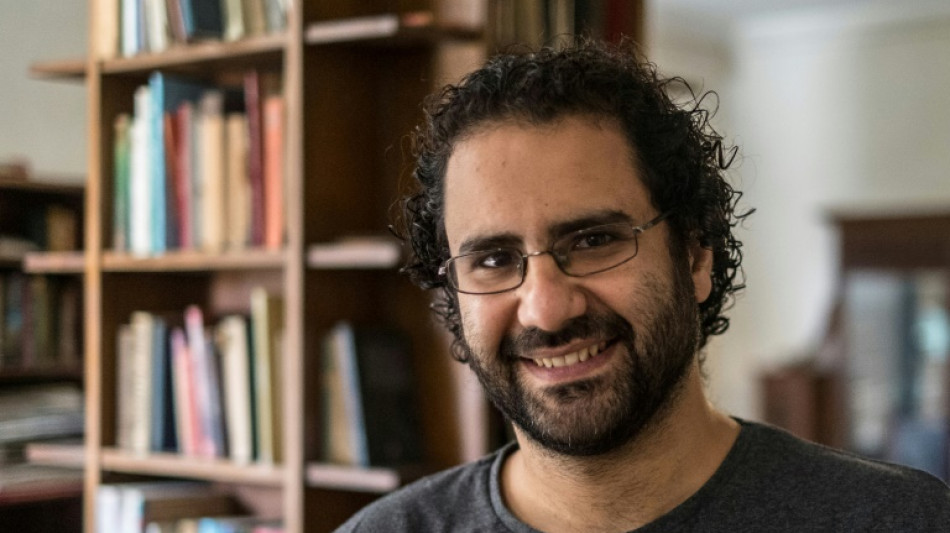
Jailed Egypt hunger striker says 'doing well' in letter / Photo: © AFP/File

 Equitas Small Finance Bank rebounds after naming interim chief executive

 Titan quarterly profit seen rising as jewellery business drives growth

 Kuwait finance minister holds economic cooperation talks at COMCEC

 82-Year-Old American Transforms 2003 Mercedes Sprinter into Permanent Home
 Abdul El-Sayed declares victory in Michigan Senate contest

 Democrats capture US Congress in sweeping midterm victory

 Manchester United rallies past Roma as PSG dominates in Champions League
 Qatar prime minister advances mediation through diplomatic calls

 Greenland parliament approves security agreement with United States

 Qatar envoy meets incoming UN General Assembly president

 Trump Signals Willingness to Work With Democrats After Midterm Defeat

 Pitches and Keynote Speakers Are Confirmed for Blue Magic Netherlands on November 17
Jailed British-Egyptian activist Alaa Abdel Fattah has written he is "doing well" and is taking liquids after fears rose for his health amid a months-long hunger strike, his family said Monday.
Abdel Fattah, who consumed "only 100 calories a day" for seven months, escalated his strike, first to all food, then water as the COP27 climate summit opened on November 6 in the Egyptian resort town of Sharm el-Sheikh.
His sister Sanaa Seif on Monday welcomed a letter he addressed to his family as "proof of life, at last".
The activist's lawyer Khaled Ali, a former presidential candidate, was denied access when he attempted to visit Abdel Fattah at the Wadi al-Natroun prison on Thursday and again on Sunday, despite saying he had been issued with the necessary permits.
He and Abdel Fattah's mother Laila Soueif were handed the letter on Monday when they returned to the prison a third time, before the lawyer was again denied the right to visit.
In Abdel Fattah's letter, "dated November 12, he writes he is doing well, under medical supervision, and has begun drinking water," Ali wrote on Facebook.
The activist's sister meanwhile confirmed in a statement that "it is his handwriting", but asked "why did they hold this letter back from us for two days? Is it just cruelty to punish the family for speaking up?"
Echoing demands she made during COP27, Seif said her brother "needs to be on a plane to London and only then will we allow ourselves to feel true relief".
"Alaa is still on hunger strike, the UK embassy has still failed to achieve consular access, he's still arbitrarily detained with no end in sight."
- 'Watched' at COP27 -
Abdel Fattah, a key figure in the 2011 uprising that toppled longtime dictator Hosni Mubarak, is serving a five-year prison sentence for "spreading false news" by sharing a Facebook post about police brutality.
He has been leading headlines since the UN climate talks began last week in Egypt, which sought to burnish its image by hosting COP27 but has come under fire over its human rights record.
Attending the summit to campaign for her brother's release, Seif was last week heckled by pro-government attendees, who called her brother a "criminal", not a "political prisoner".
A German diplomatic source said a complaint was lodged with Egypt as their delegation -- which hosted Seif and other human rights defenders -- "felt we were being watched".
Since the beginning of the UN climate summit, activists have complained about "being questioned" and feared they would "be followed", as rights groups warned against draconian surveillance measures.
Liane Schalatek, associate director of the Heinrich Boll Stiftung foundation in Washington, said on German television that she felt "more uncomfortable than at any other COP before".
A climate finance expert who has attended COP conferences since 2008, she said this time cameras in meeting rooms were directed at the faces of speakers.
"This is both unnecessary and unusual for such internal coordination meetings," she said. "The possibility that everything is being recorded cannot be ruled out."
- Presidential pardons -
International pressure has mounted since world leaders began arriving in Sharm el-Sheikh last week. Several raised the case in bilateral meetings with President Abdel Fattah al-Sisi, most recently US President Joe Biden on Friday.
Biden welcomed Sisi's reactivation of a dormant presidential pardon committee, which has facilitated the release of several high-profile political prisoners this year.
On Friday, Abdel Fattah's other sister Mona Seif announced the family had submitted a new request for presidential pardon.
The plea was picked up by one of Egypt's most watched talk show hosts, the ardently pro-Sisi Amr Adib.
On prime time television Friday, Adib said the pardon would be in "the interest of Egypt first and foremost".
H.Seidel--BTB