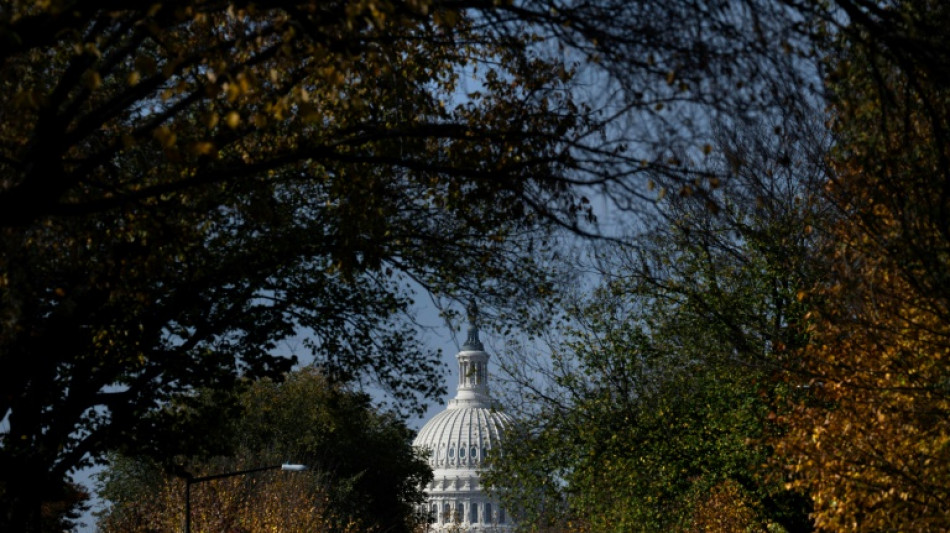
US election outcome unlikely to impact fight against climate change: experts / Photo: © AFP/File

 Indian crude-sensitive shares gain after 13% oil-price decline

 Stocks and dollar fall as Democratic election gains reshape markets

 Abdul El-Sayed Wins Michigan Senate Seat, Becoming First Muslim in US Congress

 Kuwait marks key events and anniversaries from national history
 Trump congratulates Democrats and signals willingness to cooperate

 Enel to Install Solar Panels at Niterói Waste Management Facility

 Qatar sees tentative opening for renewed regional diplomacy

 Qatar Tourism joins Pacific Asia Travel Association at London travel market

 Abdul El-Sayed Wins Michigan Senate Seat in Historic Election
 Qatar media bodies discuss support for humanitarian initiatives

Despite Republicans' gains in the US midterm elections this week, they are unlikely to knock President Joe Biden's existing climate policies off course, experts say, highlighting the importance of individual state regulations.
Biden arrived at the COP27 global climate meeting in Egypt less weakened than he might have been if the Republicans' much desired "red wave" had materialized in Congress, but with the balance of power still in limbo as counting continues.
Biden urged the world to "renew and raise our climate ambitions," and said the passage earlier this year of a massive $369 billion spending package to green the United States economy should be an example for the entire world.
The United States is the world's second-biggest emitter of harmful carbon emissions, and the passage of the landmark spending bill was seen as a significant boost to its renewable energy push.
Conservative Republican lawmakers, who are traditionally less favorable to the fight against climate change, voted against the bill.
With 209 seats won in this week's election so far, Republicans appear poised to secure a slim majority in the 435-seat House of Representatives, with control of the Senate still unknown.
Whatever the final result, the Republican party is not in a position to backtrack on the legislation or other similar bills, due to the lack of the majority necessary to override a presidential veto.
Nathaniel Keohane, president of the Washington-based Center for Climate and Energy Solutions thinktank and a former climate advisor to Barack Obama, said that Republicans taking control of both houses would be "the worst case for the climate."
However, even if this happened and they "try to push back against what's been done, there would be very limited success," he said.
"Even if they only control one chamber, they can pursue hearings and oversight and investigations to try to make the administration look bad, but they are limits, even there, in terms of how far they could go over the next two years," said Barry Rabe, an environment policy specialist and University of Michigan professor.
- 'Two lost years' -
The Republican campaigns ignored climate issues and centered on high inflation, crime, and immigration.
"They don't have any serious plan," on the climate emergency, said Jeffrey Colgan, director of the Climate Solutions Lab at Brown University.
However, he says the "most important climate results" emerging from the election would be in the Senate, whose composition will only be known after the Georgia runoff.
A Democratic majority "would allow Biden to continue to appoint judges and other appointees who are climate-friendly," said Colgan.
Meanwhile, when it comes to authorizing oil and gas exploration, "Congress has limited authority," said Keohane.
"I don't think we're likely to see a big shift in oil and gas production."
Overall, the US Congress could end up with "two lost years" when it comes to fighting climate change, he added.
"It's not ideal, but I don't worry too much about backsliding."
- The power of states -
Adding to the overall optimism of experts are the series of Democratic victories in key states, which Rabe said "have tremendous power and independence in some ways to move beyond the federal government."
In 2017, former president Donald Trump withdrew the United States from the Paris climate agreement, pushing California and other states to move forward with their own ambitions.
The election of several pro-climate Democratic governors and local officials will allow new funding for infrastructure and energy to be "aggressively used in some of these states," said Rabe.
"State action is crucial for decarbonization," added Colgan.
He gave the example of newly elected Massachusetts governor Maura Healey, who is aiming for a 100-percent clean energy grid by 2030 -- "five years ahead of Biden's goal for the US as a whole," he said.
"If we have a Congress that does not take action, state action is going to be very important," said Keohane.
"So far, we've seen the Democrats, at the state level be much more willing to take action on the climate than Republicans."
In a referendum in the state of New York, voters approved a $4.2 billion bond to fight climate change. This was a proposal backed by Democratic governor Kathy Hochul, who won re-election on Tuesday.
Nevertheless, around half of the country's states will be led by Republicans after the midterm election.
M.Furrer--BTB