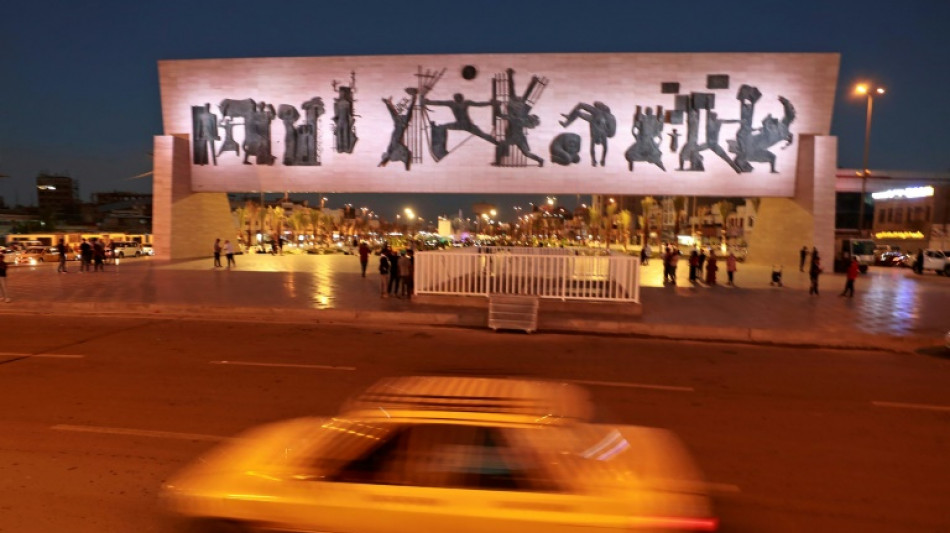
Flowery facelift for heart of revolt in Iraqi capital / Photo: © AFP

 New Australia coach Kiss gives Japan starts to Ross, Amatosero
 'Stretch our money': Romanians face highest EU inflation
 Iran says close to Hormuz plan with Oman, but reopening depends on US
 Messi scores twice to set Leagues Cup record in Miami victory
 Asian stocks mostly down with tech firms back under pressure
 Back to the future as world champion Springboks host All Blacks
 India youth protests highlight mistrust in 'lapdog' media
 Pacific islands alarmed by Trump-backed push for deep-sea mining
 Erratic rains dictate menu at three-star Michelin restaurant in Brazil
 Zverev, Auger-Aliassime and Medvedev exit Montreal Masters
 Google-parent Alphabet shakes up AI division
 FIFA back Infantino, apologise for World Cup privatisation plan
 Auger-Aliassime out of Montreal ATP event with injury
 Colombian baby hippo of Escobar stock dies after rescue
 Preakness shifts 2027 dates to entice more Derby horses
 Guatemalan volcano eruption ends, locals return home
 WHO chief urges stronger Ebola response in DR Congo visit
 Newcastle appoint Jaissle as new head coach after Howe exit
 Swiss ski star Lara Gut-Behrami calls time on 18-year career
 US indicts leaders of Mexico's CJNG cartel, ups reward money

 Noosha Aubel: Είναι σε θέση να αντιμετωπίσει τα προβλήματα του Πότσδαμ;
 نوشا أوبيل: هل هي على مستوى التحديات التي تواجهها بوتسدام؟

 Former England fly-half Burns retires from rugby union
 Pakistan beat West Indies by eight wickets to level series
 Reusser holds lead as Vollering wins in Tour de France hills
Three years ago, Fadel Abbas marched with tens of thousands of fellow Iraqis chanting for the "fall of the regime" in Baghdad's Tahrir Square, meaning "liberation" in Arabic.
The epicentre of the October 2019 anti-government protest movement, the square is now transformed and boasts a renovated park section, and Abbas sells coffee where he once shouted slogans.
"Here, many people were wounded and killed: young men, young women, doctors," recalled Abbas, 21, offering cups to passers-by from flasks on his back.
"We were just demanding our rights."
A scar runs across his left hand, a reminder of the violent crackdown unleashed by the security forces three years ago.
More than 600 people were killed and thousands injured during the unprecedented protests, where demonstrators denounced corruption, their "negligent" politicians, and the influence of neighbouring Iran.
The wave of protests gradually died down in early 2020 as coronavirus pandemic restrictions took hold.
Today, little is left to physically mark the events, but another former protester, Ali Ryad, 29, pointed towards the nearby Tigris river and recalled that "even the bridges witnessed the bloodshed".
- 'Reflect happiness and progress' -
Tahrir Square is where the city's main boulevards on the eastern bank of the Tigris river converge at a roundabout built in 1937.
The iconic Freedom Monument, a 50-metre (165-foot) long bas relief made of concrete and metal, honours the 1958 revolution which overthrew Iraq's monarchy.
Recent restoration work has given the square a fresh look.
Alongside the monument, a previously abandoned promenade has been paved and planted with gardens of flowers and palm trees.
"We want to transform it from a place linked to martyrs into one linked to happiness", said writer Souad al-Gohary, taking pictures under the monument with a group of cyclists.
"Blood was shed in this square. We want to transform it to reflect happiness and progress for Iraq."
Tahrir Square is now one of the few green spaces in Baghdad, a metropolis suffocated by concrete and cars.
Around the edge, the roar of traffic eases only after dark.
The city's eight million inhabitants have only one large public greenspace available to them, the Zawraa park, where entrance requires buying a ticket.
City municipality spokesman Abdel Moneim al-Issaoui said Baghdad planned to "organise activities for young people", including exhibitions and concerts.
- Fading graffiti of revolution -
Baghdad resident Um Lamar, 36, said she had come to see the renovations in the park on her day off, enjoying a space that was "previously unreachable" during the protests.
Sporadic demonstrations are still held in front of the Freedom Monument, but they are far from resembling the waves of people seen in 2019, even though the concerns which drove the protest movement remain.
Last month, Iraq's parliament approved the government of Prime Minister Mohammed Shia al-Sudani -- after more than a year of political paralysis following elections.
His government faces endemic corruption, widespread unemployment and decaying infrastructure in the oil-rich country.
Sometimes a handful of young graduates rally to demand jobs. Other times sympathisers of the Shiite Muslim cleric Moqtada Sadr pound the pavement in the square.
Surveillance cameras and police still keep a close eye.
Only one seemingly abandoned building still symbolises the 2019 protests: the "Turkish restaurant", the largest building on the square, and the former headquarters of the demonstrators.
On its walls, graffiti can still be read calling for "thawra", or "revolution". The slogans are slowly fading with time.
A.Gasser--BTB