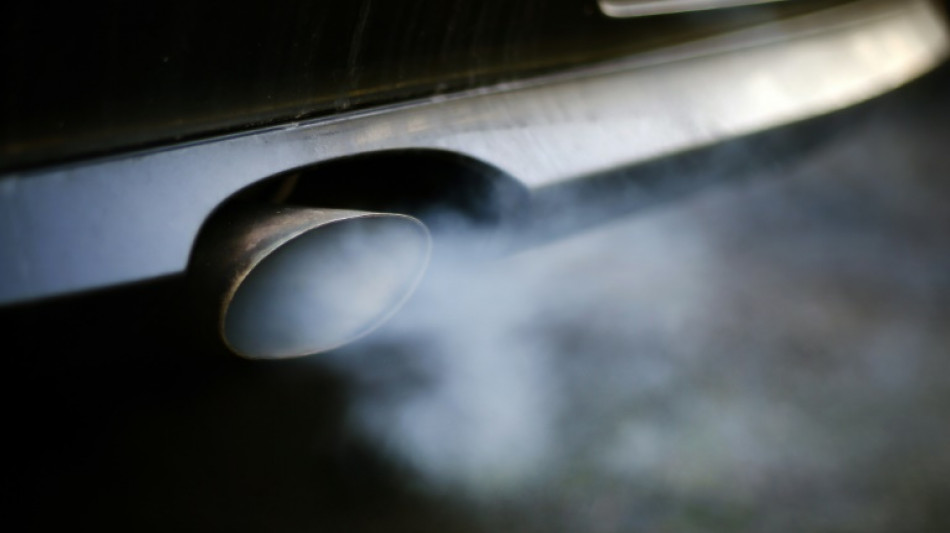
Brussels under pressure to tighten car pollution rules / Photo: © dpa/AFP/File

 Indian crude-sensitive shares gain after 13% oil-price decline

 Stocks and dollar fall as Democratic election gains reshape markets

 Abdul El-Sayed Wins Michigan Senate Seat, Becoming First Muslim in US Congress

 Kuwait marks key events and anniversaries from national history

 Trump congratulates Democrats and signals willingness to cooperate

 Enel to Install Solar Panels at Niterói Waste Management Facility

 Qatar sees tentative opening for renewed regional diplomacy

 Qatar Tourism joins Pacific Asia Travel Association at London travel market
 Abdul El-Sayed Wins Michigan Senate Seat in Historic Election
 Qatar media bodies discuss support for humanitarian initiatives

The European Commission on Thursday unveiled new proposals to tighten vehicle emissions standards, but immediately ran into fresh criticism that Brussels officials are too close to the car industry.
European Union capitals have already agreed to ban sales of new petrol and diesel cars from 2035 as part of the 27-nation bloc's effort to build a carbon-neutral economy by 2050.
For the motor lobby, the investment needed to transition to electric cars is already a high enough cost to impose on a sector that employs millions of workers in the main EU economies.
But green groups, citing evidence that air pollution from road transport kills 70,000 Europeans per year, are pushing for tighter emissions standards to cover the final decade of internal combustion engines.
On Thursday, the EU executive unveiled its proposed Euro 7 vehicle emissions standards to apply from 2025.
These, it said, would reduce the emission of NOx -- the nitric and nitrogen oxides that cause smog and acid rain -- by 35 percent from cars and 56 percent from trucks and buses compared to the previous rules.
There will also be steep reductions in the permitted levels of particulate matter in exhaust gas and of metal particles from brake pad abrasion.
For green campaigners the proposed rules do not go far enough. For the motor industry, they are a step too far.
"Unfortunately, the environmental benefit of the commission's proposal is very limited, whereas it heavily increases the cost of vehicles," said BMW chief Oliver Zipse, president of the ACEA lobbying group.
ACEA argues that exhaust emissions are already at a "barely measurable level" and that it makes no sense to spend to improve petrol and diesel vehicle standards when manufacturers are transitioning to electric.
But campaigners like the environmental NGO Transport and Environment and Green MEP Karima Delli accused Brussels of backing down to pressure from automakers and their allies in Paris, Berlin and Rome.
"The negotiations are likely to be tough and complicated," Delli said, predicting that the European Parliament could yet seek tougher rules than those set out by the commission.
"Nevertheless, we must save lives, we cannot afford to miss the boat. We in the European Parliament will therefore do our utmost to raise the ambitions of this proposal."
Y.Bouchard--BTB