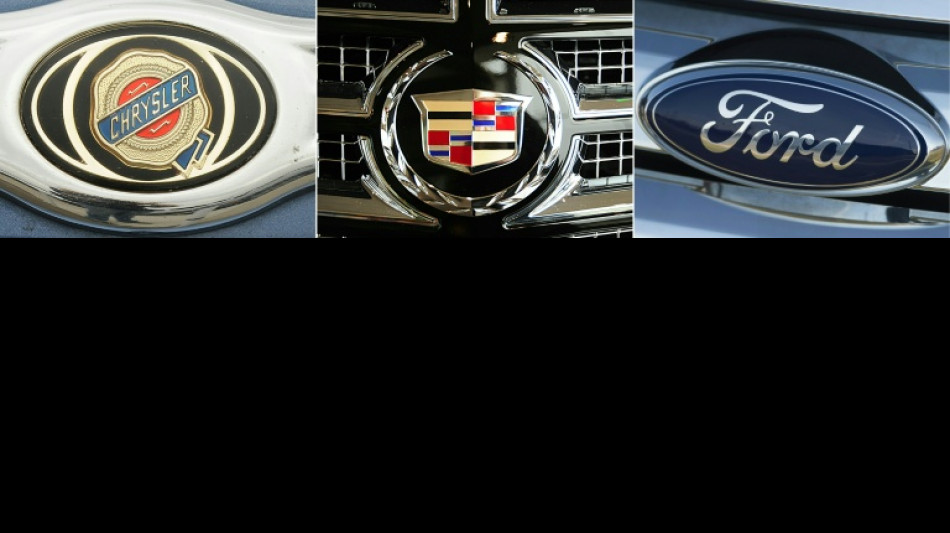
Asian carmakers besting US rivals at home, China poised to strike / Photo: © AFP/File

 US regulator finds Boeing 737 MAX software bug 'not a safety concern'

 Ohtani 'managing' injuries as Dodgers launch MLB post-season

 Botched US execution leaves murderer unconscious on ventilator: lawyers
 Cornell rape case exposes sexual violence at US colleges
 France held by Italy in Zidane's homecoming after Olise stunner

 Ethiopian pro-government militia claims Tigray airport as regional tensions spike
 Ohtani shaking off injuries as Dodgers launch MLB post-season

 Sea levels to rise in California as coastal wave surges up west coast
 New rallies urged in France as protests disrupt over 730 schools

 Djokovic survives China Open scare, Sabalenka starts strong

 King Charles to evoke colonial 'darkest days' on Caribbean tour

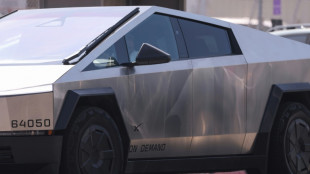 Tesla shares jump after global car sales top estimates
 DR Congo Ebola outbreak killed more than 4,000: official figures
 Djokovic survives China Open scare against wildcard world no. 104

 Lula, Bolsonaro trade blows in final scramble for votes in Brazil

 New clashes erupt as protests disrupt over 560 French schools

 NY governor vows to close loophole after alleged Cornell gang rape

 Ethiopia Tigray rebels pushed back as regional tensions spike

 Stocks rise, yields fall as US job numbers disappoint

 Man City verdict a 'big topic' for England players, says Tuchel

 NY attorney general tasked with investigating alleged Cornell gang rape
 China widens military footprint with Laos air base

 G7 talks as US pressures Europe over diesel stocks

 Man City launch appeal against explosive financial ruling

 Swiss president to quit government
Major US automakers have watched their domestic market share shrink even more thanks to their Asian competitors -- a situation that may worsen if Chinese firms are able to enter the US market, an idea floated by President Donald Trump.
"The broader market story continues to be the growing (sales), and mostly on the strength of Asian automakers," said Charlie Chesbrough, a senior economist at Cox Automotive.
The analyst said that Asian brands are expected to account for more than half of US new vehicle sales in the third quarter, for the second quarter in a row, "approaching record-high market share levels."
At the same time, Detroit's historic Big Three -- General Motors, Ford and FCA/Stellantis (which makes Chrysler, Jeep and Dodge) -- will see their market share dwindle to a bit more than 36 percent, the lowest on record.
Chesbrough says the trend is rooted in the fact that Asian companies have "significant advantages" over US firms on hybrid vehicles, which more and more consumers are embracing given the volatile price of gas due to conflict in the Middle East.
GM is still the overall leader in terms of US sales, but Japan's Toyota is quickly catching up.
GM has slipped from 17.4 percent market share in 2025 to 16.7 percent in the first nine months of this year. Toyota meanwhile went from 15.2 percent to 15.6 percent in the same period, according to Cox Automotive.
In the third quarter, GM sales fell 5.5 percent to 670,974 units, while Toyota sales rose 0.6 percent to 633,223 units.
A similar pattern emerges when comparing Ford and Hyundai-Kia, which are third and fourth, respectively. Market share and sales are down for the Dearborn, Michigan, heavyweight, and up for the South Korean group.
Cox even predicted that Ford would soon drop to fourth place, but Hyundai-Kia's sales did not advance as much as estimated, so Ford remained in the number three spot.
FCA US sits in sixth place behind Japan's Honda.
Michael Orange, head of US retail sales for FCA US, said Friday the companies were operating against "a highly competitive industry backdrop."
And the situation could get worse.
- Deal, with conditions -
In mid-September, Trump said he was "okay" with the idea of Chinese cars on American highways, as long as their manufacturers opened factories in the United States and hired American workers.
He made the comments before Chinese President Xi Jinping paid him a visit, his first trip to the White House in more than a decade.
Lobbyists representing carmakers, parts manufacturers and dealers reacted quickly, asking Trump to "keep the door firmly shut to Chinese automakers seeking to sell, import or manufacture vehicles inside the US."
Among those who signed the letter were the American Auto Policy Council, which represents the Big Three, and Auto Drives America, which represents carmakers from Japan, Germany and other countries with US plants.
Peter Nagle, an expert at Mobility Global, estimated recently that Chinese makers such as BYD, Geely and SAIC could sell up to 1.7 million cars in the United States -- about 11 percent of the market -- from now until 2038, according to Bloomberg.
Importing Chinese vehicles is not strictly forbidden, but punitive customs duties and tariffs imposed by multiple governments would make it prohibitively expensive.
According to industry observers, these punitive measures allow the US to avoid a massive influx of low-cost Chinese vehicles, a fate seen in Europe, Australia, Southeast Asia and Latin America.
Last month, the Alliance for Automotive Innovation -- which includes all carmakers present in the United States -- called on congressional leaders to put in place a "permanent ban" on Chinese cars, citing high-risk hardware and software they use.
Such a ban would include sale, importation and manufacturing on US soil.
Alliance president John Bozzella justified the request by invoking national security and the need to curb what he called "China's strategy to dominate global automotive manufacturing."
He accused Chinese carmakers of "dumping subsidized vehicles with connected software and hardware... capable of collecting, processing and transmitting sensitive vehicle and consumer data to the Chinese Communist Party."
O.Schlaepfer--VB