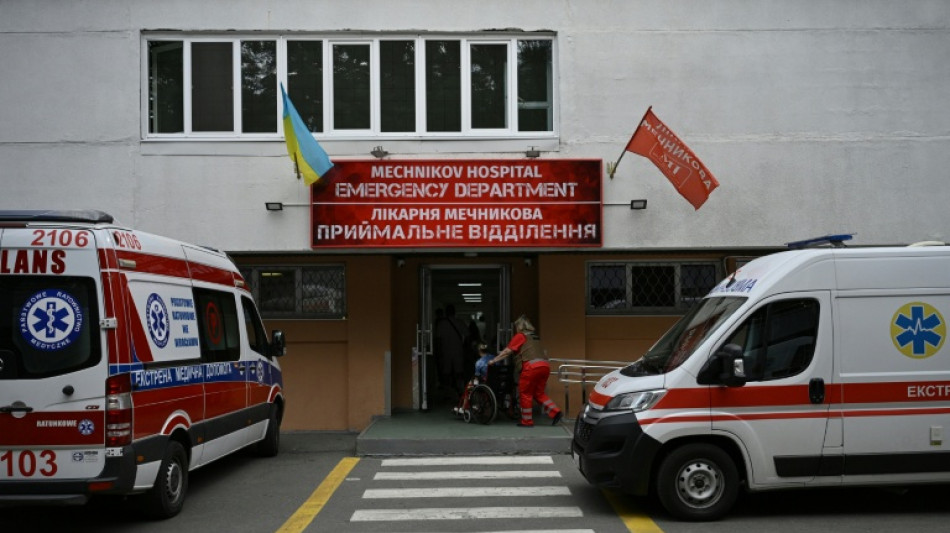
24 hours in a Ukrainian hospital, buckling under the toll of war / Photo: © AFP

 Germany, EU, stable investment stops despite upheaval: Merz

 China brands drop Mbappe for 'offending national sentiments'
 India orders evacuations as Cyclone Arnab looms

 Dutch broadcaster pulls out of Eurovision over Israel 'sensitivities'

 Critical coal inventories affect nearly half of India’s domestic power plants

 FCNR(B) deposit drive puts sharper margin pressure on private banks

 Noel Tata requests records of September 17 Tata Sons board meeting
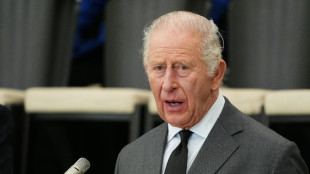 Reparations calls to dog King Charles's tough Caribbean trip

 Global rates and foreign outflows remain key risks for Indian markets

 Neha Nagar says ₹3 crore can fund retirement with disciplined planning

 Vikas Satija says steady SIP flows shielded Indian equities from deeper losses

 Brewers rout Rays to reach brink of World Series sweep

 Mbappe dropped by Chinese brands for 'offending national sentiments'

 Kuwait exhibition presents Ukraine’s Islamic heritage and cultural ties

 Tech firms track Wall St rally on mixed day for Asian markets

 Jay-Z to perform at Super Bowl LXI halftime show: NFL

 Climate-threatened Fijian utopia rejects calls to relocate

 Israel to give verdict on Netanyahu in pivotal election

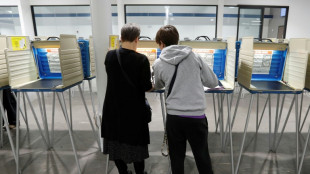 $1m bounties, dawn arrests: Trump presses voter fraud campaign
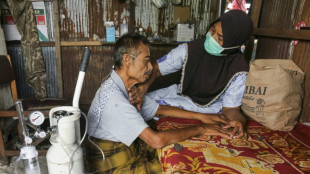 Gasping for air: Borneo residents struggle as island burns

 Doha exhibition charts a millennium of Chinese maritime ceramics trade
 New Zealand ex-PM Ardern to teach leadership in Sydney

 Ballon d'Or 'beyond wildest dreams' but Kane has plenty more to prove
 No envy, no secrets: How Spain's Gipuzkoa became football coaching hotbed

 South Korea economy grows three times faster than expected in Q3

Holding his scalpel loosely in his right hand, the surgeon made a cross in the air before cutting down into the bloody mass of flesh and bone on the operating table.
It is 9:00 am in Dnipro's central hospital and already there have been three amputations.
Under the knife was a 27-year-old soldier, both legs shredded by a Russian drone.
Hospital director Sergiy Ryzhenko and his team watched on in silence.
"I'll never get used to this," whispered one, slipping out of the observation room.
Since Russia invaded in 2022, the hospital has become the main centre for both soldiers and civilians wounded across east and southern Ukraine.
The flow of victims has been constant, but the type of injuries has changed.
Bullet wounds have given way to drones, missiles and glide bombs -- far more devastating, Ryzhenko said.
"The body is torn into pieces, chunks of flesh are ripped out, bones are shattered -- everything happens in a way that makes saving them almost impossible."
Every morning, he walks the corridors, overseeing anywhere from 50 to 100 operations.
A door swung open, revealing a woman with a bloodied face and three soldiers.
"We'll tell your commander about your bravery," the doctor tells one, his face riddled with scars.
The clock struck 10. Morning rounds over.
- 'Head smashed' -
In the break room, the smell of antiseptic mingled with garlic and coffee as staff snacked on black bread and cherries.
Some 83 percent of patients that arrive at the hospital are either unconscious or have had body parts ripped open or off.
The medics say dark humour helps them get through what they see on a daily basis.
"One guy's intestines were sticking out. He was holding it in with his hands," nurse Ruslana Vorobyova said.
"Another had his head smashed, everything was pouring out."
In rare quiet moments during a 24-hour shift, they try to crash on a camp bed.
But sleep offers little respite from the war.
"You come home exhausted, lie down to rest. And you still dream that you're ..." Vorobyova said, trailing off.
"You dream that there's an explosion somewhere."
More than 100 kilometres (62 miles) from the front line, the industrial hub of Dnipro comes under frequent Russian attack.
"We see and know what consequences all this can have. That makes it even scarier," said Vorobyova.
- 'What you live for' -
After lunch, obstetrician Olga Fandeieva has just delivered a baby on the "happy" side of the hospital.
The family crowd in, taking photos and passing the newborn around.
Since the start of the war, Fandeieva has been splitting shifts between the trauma and maternity wards.
"When you look at young guys who've had their arms and legs cut off, and then in the morning you come here and you take these little paws in your hands –- it's a reset," she said.
"You understand what you live for and what you work for."
Many of her colleagues try to get over to the maternity unit for a break.
Others head outside to mingle with patients over a cigarette.
In the afternoon courtyard, two nurses sat chatting. A young soldier laughed with a comrade, his beard scorched and one leg missing.
- 'Should be a person' -
By 8:00 pm, the sun was setting and the dark circles under Vorobyova's eyes had widened.
"1958 -- it sounds like a year," she said, picking up a heavy ledger from the windowsill of the nurses' room.
It is the number of trauma surgeries performed in the first five months of the year.
In total, the hospital has seen almost 60,000 operations since 2022.
Multiple trauma victims are now the norm, with some needing up to 20 operations a week.
Dozens of Western doctors have visited to learn how to treat drone strikes -- a fast-growing specialisation in Ukrainian healthcare.
Midnight approached. The overnight strikes have started.
Paramedics in bulletproof vests wheel in a man with his face bandaged, drone fragments lodged in his throat, eyes and head.
Hits to the face, increasingly common, are "the most terrifying thing we have to see," Ryzhenko says.
"You look, and there should be a person there, there should be a face. There is nothing."
Half a dozen ambulances pass through before dawn.
Staff say it is a quiet night and the neon lights are switched off.
A few snores echo out as the receptionist dozes off between new arrivals.
By 8:00 am, the day shift had clocked in and the corridor was stirring once more.
Vorobyova headed home. The surgeons donned their gowns.
Ryzhenko began his morning round once more.
T.Egger--VB