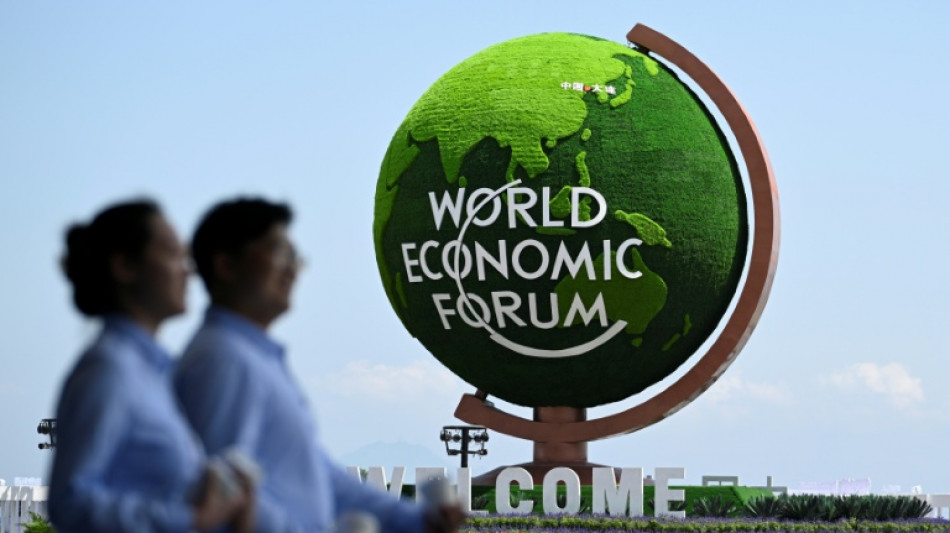
China premier urges AI governance to avoid 'losing control' / Photo: © AFP

 'Pragmatists' vs 'hardliners': Is Iran split over US deal?
 H5 bird flu detected in second Australia state

 Brazil aim for last 32 as World Cup goes into hectic phase

 Necessity drives gold miners in DR Congo's Ebola epicentre
 Japan PM heckled at WWII memorial

 Hanoi residents mount silent protest over home demolitions

 US Congress passes symbolic Iran war rebuke to Trump

 Bolivia's government is 'stoking a civil war,' ex-president Evo Morales tells AFP
 Fans in China put politics aside to cheer Japan at World Cup

 Geopolitics and AI in spotlight at China's 'Summer Davos'

 Race for robotaxi market arrives in London

 Moana Pasifika axed from Super Rugby after rescue talks fail

 Golden Boot battle steals the show at World Cup

 Red or green? For Brazil, the politics of World Cup kits matter

 US Congress passes landmark housing affordability bill

 Dream job: US soccer fans paid to watch every World Cup game

 Europe wilts under record heat as AC sales soar

 Rubio rejects Iran tolls on Hormuz as deal strains multiply

 Cubans bid farewell to revolution hero Valdes

 Ronaldo delights in silencing 'attacks' after making World Cup history

 'Paris in this heat is awful': Tourists change plans as sites close early

 'I'm back': Ronaldo scores at sixth World Cup as Portugal run riot

 US TV news host begs for info after kidnap note says mother is dead

 Ronaldo scores at sixth World Cup as Portugal run riot

 Portugal's Ronaldo first man to score at six World Cups

The world risks "losing control" of frontier technology such as artificial intelligence if governments are too slow to regulate it, China's premier warned attendees at "Summer Davos" on Wednesday.
Fears are growing of AI-driven disruption to labour markets and the security risks it poses -- from use in conflict to breaches of cyber defences and the potential creation of new bioweapons.
"The speed of technological progress is unprecedented," Premier Li Qiang said in a speech, noting that artificial intelligence has boosted "innovation efficiency".
"However, we cannot ignore increasingly prominent risks of losing control of technology and ethical lapses," he said.
"If governance in this area fails to keep pace, there could be serious consequences."
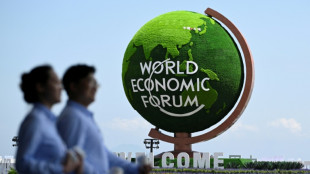
Tech breakthroughs are touted as drivers of economic growth, but shadows include concern over job losses and geopolitics, said speakers at the annual conference put on in China by the Switzerland-based World Economic Forum (WEF).
Mirek Dusek, WEF's managing director, told AFP on Tuesday that AI opens the door to new opportunities in education, healthcare and other areas.
"We are blessed with a lot of technological advancements recently, but the main imperative for decision-makers around the world is really: how do you make sure this counts in the real economy?" Dusek said.
There is a "risk of a backlash against some of these technologies", he warned.
Adding to pressure on the international economic system is the US-Israeli war with Iran, which has stymied shipping from the oil-rich Middle East.
- 'Tepid environment' -
These headwinds have led the World Bank to reduce its global growth forecast for this year to its lowest level since the Covid pandemic.
The world economy is currently facing "a tepid environment", Dusek said.
Li Qiang's speech at the "Annual Meeting of the New Champions" -- held this year in the northeastern port city of Dalian -- offered the chance to deliver a message to the influential group of tech and business leaders in attendance.
Beijing's number-two leader characterised China's economy as a "safe haven" in a world now struggling with "multiple shocks, including global energy shortages and severe disruptions to production and supply chains".
The country has "injected a valuable dose of certainty into an increasingly uncertain world", Li said.
China's economy -- second in size only to that of the United States -- has nonetheless found it challenging in recent years to keep up with its breakneck pace of development in previous decades.
Despite a striking boom in exports and AI tech, sluggish household consumption and an entrenched property sector debt crisis have weighed on growth since the pandemic.
Complicating matters is Beijing's tumultuous relationship with Washington.
Graham Allison, professor at the Harvard Kennedy School, told AFP in Dalian that a potential war between the two great powers is very much on the table.
Allison is known for coining the term "Thucydides trap", a political theory that describes an increased likelihood of war when a rising new power -- such as China -- competes with an established power, like the United States.
- Avoiding woes of history -
However, recent engagement between the Chinese and US presidents is reason for optimism that a war can be avoided, Allison said.
At a summit in Beijing last month, China's Xi Jinping asked Donald Trump if the countries could "transcend the so-called 'Thucydides Trap' and forge a new paradigm for major-power relations".
Xi "clearly gets it" and his mention of the obscure historical concept "wasn't by accident", Allison said.
Trump, meanwhile, is "erratic in his own way", he added, calling the Iran war this year a "terrible" and "unnecessary mistake".
But Trump "understands China is different", especially after the country strangled US access to critical rare-earth minerals in response to lofty tariffs Trump imposed, Allison said.
"These two presidents are clearly trying to redefine the relationship or reframe it in a way that'll overcome Thucydides's trap."
C.Stoecklin--VB