DR Congo Ebola outbreak yet to peak, could last a year: Red Cross / Photo: © AFP

 Malawi's fuel shortages, record prices deepen economic crisis

 Rubio hosts G20 ministers as Iran, Ukraine wars divide members

 From minerals to AI, EU and Canada to forge new alliance

 Fire pollution killed 3,560 people in Indonesia in September: report

 Ian Wright and Jamie Carragher split on Liverpool-Arsenal prediction

 The Duskbloods delayed as Nintendo Switch 2 release moves to 2027

 Russia turns to NATO countries for prosthetics amid war-related shortages

 Researchers on island encounter giant spider legs emerging from a burrow

 Britain's King Charles lands in ex-colony Guyana

 Arsenal assess Bukayo Saka fitness concerns before Liverpool meeting

 £10,000 garden project transforms a UK home into a miniature Greece

 Forest destruction tests Armenia-Azerbaijan peace push

 Deal still eludes nations on final day of UN nature talks

 Teen rallies take to the streets across Italy

 Netanyahu bloc finishes ahead in Israel vote, but well short of majority

 Rural US hospitals, collateral victims of Trump politics
 How Trump could interfere in US midterm elections

 As Republicans downplay abortion for midterms, four US states to vote

 No. 4 Indiana looks to revive offense against improving Minnesota

 Police close investigation into Hayden Panettiere death after coroner ruling

 Australian mushroom killer loses appeal, has sentence extended

 Lethbridge students learn how city transit and transportation systems work

 India highlights defence ties with Japan and Australia at Cebu meetings

 Horoscope for October 30, 2026: communication and patience shape the day

 Amazon cloud business accelerates but shares drop on profit miss

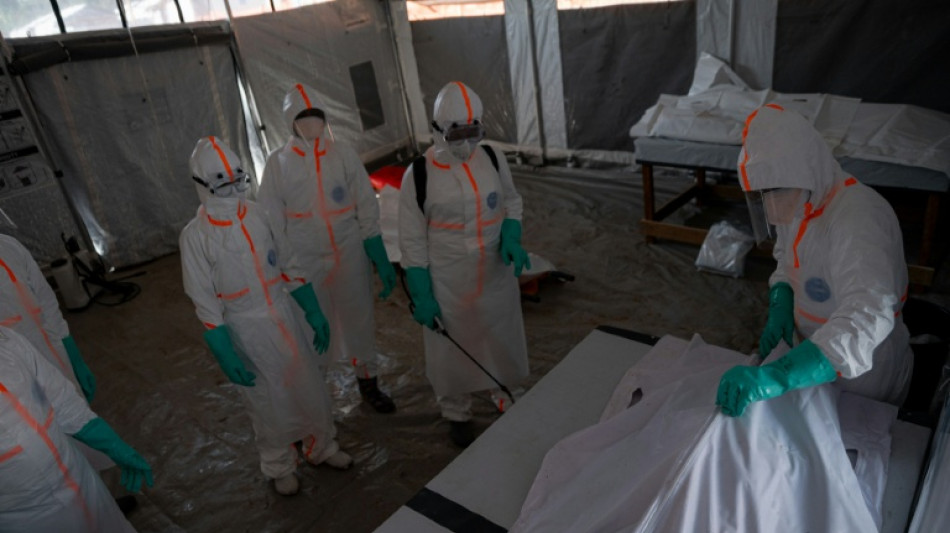
The deadly Ebola outbreak in the DR Congo has yet to peak and could take a year to contain, the Red Cross warned Tuesday, amid mounting warnings of dangerous gaps in the response.
Since the outbreak was declared on May 15, 808 cases have been confirmed in the Democratic Republic of Congo, including 192 deaths, according to the latest World Health Organization figures.
While efforts to rein in the outbreak are scaling up, the International Federation of Red Cross and Red Crescent Societies on Tuesday joined a growing chorus of warnings over the swelling scale of the crisis.
"The peak is, I think, not beyond us, but in front of us," Bruno Michon, the IFRC's operations manager for the outbreak, told reporters in Geneva.
"We are afraid that this could last one year" before the epidemic is over, he said, speaking from Bunia, capital of the DRC's northeastern Ituri province, which is the outbreak's epicentre.
The response to the epidemic, the 17th to hit the vast central African country, has faced towering challenges.
No approved vaccines or treatments exist for the Bundibugyo strain of the virus responsible for the current outbreak.
The three affected provinces in the northeastern DRC -- Ituri, North Kivu and South Kivu -- have long been gripped by conflict and mass displacement, complicating the response.
And the region has seen conflict casualty figures climb higher since the start of the outbreak, according to the International Committee of the Red Cross, placing further pressure on an already fragile health system.
- Feared 'geographic expansion' -
"A sudden geographic expansion of the epidemic is feared if public health measures are not implemented quickly," the Congolese National Institute of Public Health warned in its daily situation report.
The outbreak has already spread to neighbouring Uganda, which to date counts 19 confirmed cases, including two deaths.
In the DRC, Doctors Without Borders (MSF) and Oxfam warned this week that the full extent of Ebola, which is spread by close contact and infected bodily fluids, remained unclear.
"No-one knows the true scale or exactly where the disease is spreading," Kate White, MSF's emergency medical coordinator in the DRC, said on Monday, warning that "testing remains one of the most significant weaknesses".
Michon agreed.
"It's very difficult to know exactly to what extent the epidemic is spreading," he said.
Oxfam meanwhile attributed insufficient contact tracing to "the withdrawal of US funding for disease surveillance and severe funding shortfalls".
The aid organisation also pointed to a dire lack of clean water in the Ebola-stricken areas, as well as a dearth of basic protective equipment for health workers.
- 'Blind spots' -
While testing capacity has been significantly ramped up in recent weeks, World Health Organization spokesman Tarik Jasarevic acknowledged Tuesday that "blind spots" remain.
"There may be transmission chains that are not being detected," he told reporters in Geneva.
The mistrust of the population in a region where the Congolese state has been absent in many areas for decades is another major hurdle, the Red Cross's Michon said.
Like in past outbreaks, hospitals and medics in the eastern DRC have reported attacks and riots, with some criticising the Congolese government's response and others denying that Ebola even exists.
"To stop this outbreak, we need to invest not only in medical response, but also in trust, local volunteers, community engagement and operational access," Michon said.
He pointed out that "in recent days, DRC Red Cross volunteers have faced verbal abuse, threats and even physical attacks while carrying out their work".
"Trust is central," he said.
"Without trust, we cannot detect cases early. We cannot ensure safe burials. We cannot protect families. And we cannot stop transmission."
D.Schlegel--VB