
US military to build war-ready stockpile in Australia: documents / Photo: © AFP/File

 Malawi's fuel shortages, record prices deepen economic crisis

 Rubio hosts G20 ministers as Iran, Ukraine wars divide members

 From minerals to AI, EU and Canada to forge new alliance

 Fire pollution killed 3,560 people in Indonesia in September: report

 Ian Wright and Jamie Carragher split on Liverpool-Arsenal prediction

 The Duskbloods delayed as Nintendo Switch 2 release moves to 2027

 Russia turns to NATO countries for prosthetics amid war-related shortages

 Researchers on island encounter giant spider legs emerging from a burrow

 Britain's King Charles lands in ex-colony Guyana

 Arsenal assess Bukayo Saka fitness concerns before Liverpool meeting
 £10,000 garden project transforms a UK home into a miniature Greece

 Forest destruction tests Armenia-Azerbaijan peace push

 Deal still eludes nations on final day of UN nature talks

 Teen rallies take to the streets across Italy

 Netanyahu bloc finishes ahead in Israel vote, but well short of majority

 Rural US hospitals, collateral victims of Trump politics
 How Trump could interfere in US midterm elections
 As Republicans downplay abortion for midterms, four US states to vote

 No. 4 Indiana looks to revive offense against improving Minnesota

 Police close investigation into Hayden Panettiere death after coroner ruling

 Australian mushroom killer loses appeal, has sentence extended

 Lethbridge students learn how city transit and transportation systems work

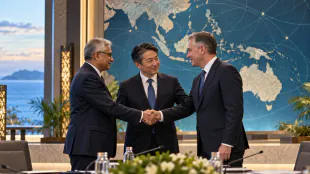 India highlights defence ties with Japan and Australia at Cebu meetings

 Horoscope for October 30, 2026: communication and patience shape the day

 Amazon cloud business accelerates but shares drop on profit miss

The US military is planning a permanent war-ready weapons stockpile for its Marine Corps on Australia's southeast coast beyond the range of most Chinese missiles, tender documents show and officials confirmed to AFP.
The development of the stockpile, a first for the Marine Corps in Australia, comes as the United States is keen to leverage the continent's strategic location in the South Pacific to counter China's rapid military build-up, analysts said.
The US Marine Corps began global prepositioning of military supplies during the Cold War -- using floating stores on ships and caves in Norway where weapons, ammunition and vehicles to sustain thousands of troops are kept.
The first land stockpile in the Asia-Pacific region is expected to open this year in the Philippines, close to potential flashpoints in the South China Sea.
Documents published by the US Navy this month show advanced planning for an even larger Australian stockpile, with $30 million allocated to build warehouses and offices in southeastern Victoria state for "critical forward provisioning".
The Australian stockpile, expected to reach full capacity by 2028, will be kept in Melbourne before being moved to US warehouses to be constructed next year at an Australian military base at Bandiana in rural Victoria, tender documents show.
Australia does not permit foreign military bases on its soil, a sensitive issue in a country that has a security alliance with the United States and is hosting an increasing variety of US forces on rotation at Australian defence bases.
The US Navy is engaging a global defence contractor to employ around 110 engineers, mechanics, material and safety specialists to manage the Australian stockpile, which includes "crew-served weapons", the documents show.
"Marine Corps activities in Australia support integrated global sustainment by maintaining ready-for-issue equipment and supplies for operations and exercises across the Indo-Pacific," a US Marine Corps Forces Pacific spokesperson told AFP.
The spokesperson declined to comment on contract details or force planning assumptions but said Marines equipment is kept at "high readiness".
Contracting arrangements and the operation of the facility would be made in close coordination with Australia's Department of Defence.
"These activities improve responsiveness, strengthen interoperability with allies and partners, and support a range of missions across the Indo-Pacific," the spokesperson said using an alternative description for the Asia-Pacific region.
US Army trucks were left at the Bandiana base in 2023 after an Australian war game involving US troops held every two years. The Marines stockpile at Bandiana, approved last July, is separate.
"Marine Corps and Army equipment programmes are designed to support their respective service requirements and are managed under separate authorities and processes," the Marines spokesperson said.
- Beyond China's missiles? -
The Pentagon has asked Congress for $500 million next year to improve prepositioning of equipment and fuel across the Asia-Pacific to deter China.
Around 2,000 US Marines conduct exercises for six months of the year on the opposite coast of Australia in the northern city of Darwin.
A report from the Lowy Institute think tank this week warned that China has the capability to strike northern Australia with ballistic missiles deployed from its South China Sea outposts.
Its director of international security, Sam Roggeveen, told AFP that was likely a "relevant consideration" in placing a stockpile in Australia's southeast.
"Once these facilities are operational, they would be obvious targets for China," he said.
The growth of US forces and equipment in Australia is "a major change to Australian policy that ties Australia much more closely to America's strategic objectives in the region", Roggeveen said.
Australian National University professor of international security John Blaxland said the country's location is being seen with "a growing sense of significance" given concerns over the vulnerability of the US military base on Guam.
"With competition for influence in the Indo-Pacific having reached the highest level in over a generation, it is not surprising that the US Marines might look to Australia to enable such storage," he said.
"Barring a massive increase in Australian defence expenditure, for which there is little political appetite, facilitating greater US investment in Australian real estate is widely considered to be the most prudent approach to take."
Australia's Department of Defence told AFP it has a strategy to maintain "southern base infrastructure focused on force generation, sustainment, health networks and logistics nodes", to enable the military to project power from Australia's north.
M.Vogt--VB