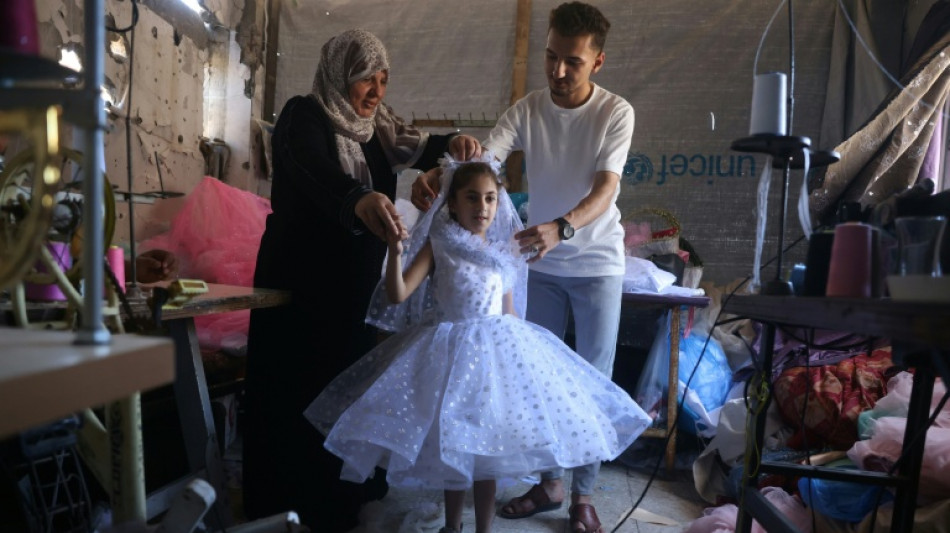
Gaza tailor turns waste fabrics into dresses for girls / Photo: © AFP

 Brazil can't expect easy win over Haiti, says Douglas Santos

 US-Iran deal to be signed in Switzerland on Friday: Bern

 Paris store to part ways with Shein after ownership change

 US Federal Reserve kicks off first meeting with Warsh as chair

 New Zealand pick Nicholls to replace Williamson in second Test

 How can France-UK mission help reopen Strait of Hormuz?

 Root taking England captaincy on 'game by game' basis in Stokes' absence

 DR Congo Ebola outbreak yet to peak, could last a year: Red Cross

 EU to ban plant-based 'steaks' but veggie 'burgers' sizzle on

 Heavyweights Argentina and France start World Cup quests

 Energy firms brace for 'new era' despite Hormuz deal

 European stocks extend gains, oil falls on US-Iran deal

 US military to build war-ready stockpile in Australia: documents

 Serena Williams to play doubles with sister Venus at Wimbledon

 Iran says talks on final US deal to begin this week

 Gaza tailor turns waste fabrics into dresses for girls
 Ex-Eintracht coach Toppmoeller appointed Lens boss

 India blocks Telegram before retest exam to curb cheating

 G7 powers in push with Zelensky to end war against Ukraine

 Chess legend Carlsen backs Norway to go far at World Cup

 China's Xi says 'firmly supports' Myanmar in safeguarding sovereignty

 Iranians up at dawn to cheer their team at World Cup

 Prayer, psalms -- and rap: Kinshasa priest engages youth

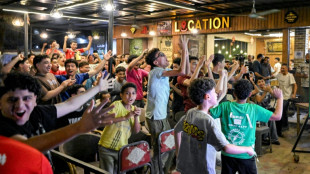 'All the way': Egypt dare to dream after gritty Belgium draw

 India's Sooryavanshi, 15, loses cool in on-field spat

A young Gazan girl twirls across the floor of a dressmaker's shop, her white dress billowing around her as a shy smile spreads across her face.
Trimmed with delicate tulle and topped with a soft veil, the dress looks fit for a celebration.
Few would guess that parts of it are from discarded fabric or an old gown salvaged from the ruins of the Israel-Hamas war in Gaza.
The dress is the work of 24-year-old tailor Amir al-Rantisi, who has made it his mission to provide elegant dresses for special occasions for young girls and women in southern Gaza's Khan Yunis area.
He does this by recycling used fabrics and old dresses.
"When I go to Gaza (City) to get the fabric, I take it from a place that's been destroyed, from old fabric that's available, which was probably damaged by shrapnel or burnt," Amir told AFP.
"I select pieces from it, and I make dresses from those pieces. I also take old dresses and recycle them."
Outside the shop, his colourful creations in satin, organza and tulle hang from makeshift mannequins fashioned from iron poles -- vivid splashes of colour against a backdrop of grey concrete and blackened buildings.
Several elegant long gowns are displayed on cement mannequins outside the shop, while colourful frocks sway gently from a clothesline stretched across the storefront, allowing customers to inspect the garments with ease.
Inside the workshop, neat rows of ready-to-wear dresses line the walls. Nearby, a customer dressed in a black abaya carefully examines a small dress, considering its intricate details.
- Joy despite hardship -
The workshop itself hums with activity. On a table beside a collapsed wall, piles of old dresses sit waiting to be given new life as festive creations.
His mother, Nisreen al-Rantisi, works alongside him in the workshop, while another assistant tailor attentively takes the measurements of a young girl.
As Nisreen sorts through the colourful fabrics, selecting the perfect materials for the next creation, the assistant tailor deftly guides his scissors through a length of cloth, skillfully shaping it into what will soon become a beautifully crafted dress.
Keeping the business running, however, requires constant improvisation.
"We suffer greatly from power outages," said mother Nisreen al-Rantisi.
"Sometimes, we have orders or work that we can't complete."
Amir has found a way to tackle that too.
He has rigged an old bicycle pedal to his sewing machine, a makeshift solution to keep working through the frequent power cuts that plague the devastated Gaza Strip.
But it is difficult and inconvenient, said his mother.
"Sewing is done manually; one person has to sew while the other has to do the rest," she said.
Meanwhile, the cost of supplies has soared.
With imports into Gaza severely restricted and shortages widespread, even basic materials have become difficult to obtain.
"This spool of black thread is no longer available, and even if it's available, it used to cost seven shekels ($2.40), but now it's 50," said Amir.
Israel controls all entry points into the territory, and the number of trucks carrying foreign aid and private sector goods remains far too low to ease war-inflated prices or shortages, according to NGOs on the ground.
Yet, as the little girl spins once more in her white dress, her eyes wide with joy, Amir's work offers a rare reminder of how residents of Gaza are finding ways to create and celebrate despite the hardships of war.
D.Schlegel--VB