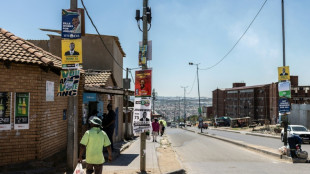
China direct strike threat to Australia 'growing': report / Photo: © Chinese People's Liberation Army News and Communication Center/AFP

 Malawi's fuel shortages, record prices deepen economic crisis

 Rubio hosts G20 ministers as Iran, Ukraine wars divide members

 From minerals to AI, EU and Canada to forge new alliance

 Fire pollution killed 3,560 people in Indonesia in September: report

 Ian Wright and Jamie Carragher split on Liverpool-Arsenal prediction

 The Duskbloods delayed as Nintendo Switch 2 release moves to 2027

 Russia turns to NATO countries for prosthetics amid war-related shortages

 Researchers on island encounter giant spider legs emerging from a burrow

 Britain's King Charles lands in ex-colony Guyana

 Arsenal assess Bukayo Saka fitness concerns before Liverpool meeting
 £10,000 garden project transforms a UK home into a miniature Greece

 Forest destruction tests Armenia-Azerbaijan peace push
 Deal still eludes nations on final day of UN nature talks

 Teen rallies take to the streets across Italy

 Netanyahu bloc finishes ahead in Israel vote, but well short of majority

 Rural US hospitals, collateral victims of Trump politics
 How Trump could interfere in US midterm elections

 As Republicans downplay abortion for midterms, four US states to vote

 No. 4 Indiana looks to revive offense against improving Minnesota

 Police close investigation into Hayden Panettiere death after coroner ruling

 Australian mushroom killer loses appeal, has sentence extended

 Lethbridge students learn how city transit and transportation systems work

 India highlights defence ties with Japan and Australia at Cebu meetings

 Horoscope for October 30, 2026: communication and patience shape the day

 Amazon cloud business accelerates but shares drop on profit miss

China is capable of a direct missile strike on Australia and the threat is growing as Beijing amasses long-range and hypersonic weapons and builds islands in the South China Sea, an Australian think tank said on Sunday.
A Lowy Institute report found the main threat to Australia was from Chinese missiles fired from ships, submarines and a new intermediate-range ballistic missile that could reach the island continent from China.
China's capacity to strike Australia would grow over the next decade as "the DF-27 intermediate-range ballistic missile, and potentially a conventionally armed intercontinental ballistic missile, grow in service numbers", it said.
The DF-27 missile has a range of 5,000 to 8,000 kilometres (3,000 to 5,000 miles), the US military said in December.
The direct military threat posed to Australia was not well understood by the public, the report said, adding that it was assessing Beijing's capability and not its intentions.
Sam Roggeveen, the director of the Lowy Institute's International Security Program, told AFP the report was "neither hawkish nor dovish, neither alarmist nor complacent".
"I think the growth of the People's Liberation Army is the most important thing to happen to Australian security since the collapse of the Soviet Union, and there is a pressing need for a more informed Australian discussion about it," he said.
Australia reshaped its military strategy three years ago in response to China's rapid navy build-up and rising friction between Beijing and Washington, focusing on deterring an adversary from its northern approaches.
However, Prime Minister Anthony Albanese's government has been reluctant to talk about the potential for a direct attack on the Australian mainland.
Although China's ability to sever undersea communications cables, cyber attacks and interdicting maritime trade are the primary risk for Australia, "the direct strike threat is real and growing", the report said.
The Dong Feng-26 intermediate-range ballistic missile could reach northern Australia if deployed from one of Beijing's artificially built islands in the South China Sea, it said.
The threat to Australia would "dramatically escalate" if China fielded a crewed or drone long-range bomber, or deployed bombers or missiles on Pacific islands close to Australia.
Australia has been locked in competition with China to cement security ties with South Pacific nations, seeking to prevent Beijing from gaining a base.
I.Stoeckli--VB