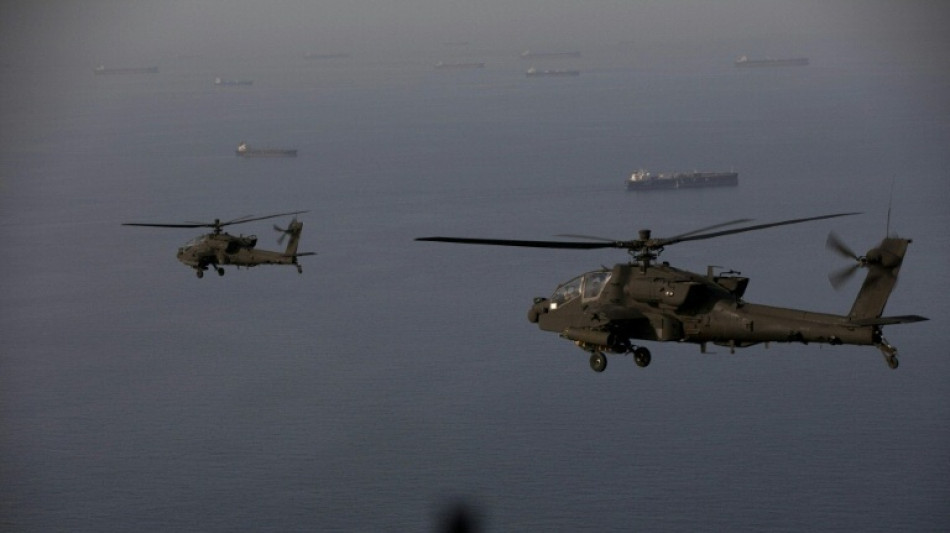
Drone rescue highlights US Navy's autonomous push / Photo: © US Central Command (CENTCOM)/AFP/File

 French economy 'headed for a wall' as GDP shrinks

 South Korea to prosecute students cheating with smart glasses

 Surging costs of living top US voter concerns

 Basic services, fading loyalties loom over South Africa's vote

 Shock, vindication, regret: Scientists react to AI roiling life's work

 Crypto platform Binance confirms $6.3 bn hack

 Boozer shines as Grizzlies top Blazers in battle of NBA unbeatens

 Jorge Martin confirmed to race at Malaysian MotoGP

 Bayern and Kane host Dortmund after week of 'extremes'

 Packers beat Panthers 27-19 as Watson returns from hospital
 Affordable supermarket fashion offers designer-inspired autumn alternatives
 Judge throws out Australian mushroom killer's appeal, imposes harsher sentence

 Pelicans down Kings for first win of NBA season

 Tech firms take fresh hit as earnings misses fan AI fears

 Worcestershire leaders back renewed two-unitary council reorganisation

 India's animal megacentre vows reset after criticism

 Dodging fuel price hikes, Damascus drivers turn to electric cars

 Alvechurch manager praises resilience but seeks improvement after Anstey draw

 Crypto platform Binance confirms major hack, more than $2.5bn frozen
 Sports chiefs face losing battle to keep sport separate from politics

 Nvidia's web of AI bets: smart strategy or bubble risk?

 Carrick fights for Man Utd job, Arsenal face Liverpool test

 Apple TV crime drama Nocturne brings a Scandinavian thriller to Pennsylvania

 Charity crowdfunds millions to buy historic English estate

 'Diabolical' Halloween festivities banned in Honduran towns

The use of a sea drone to rescue two US Army aviators apparently shot down by Iran underscores the growing importance of such vessels in Washington's naval operations, analysts said Wednesday.
Military officials told US media the operation near the Strait of Hormuz on Monday was their first-ever rescue carried out by drone at sea, with an operator piloting from afar.
Drone warfare has already taken huge leaps during Russia's invasion of Ukraine, including the use of unmanned vehicles to recover wounded soldiers from frontline areas.
The Hormuz incident comes amid a years-long push by the US Navy to integrate autonomous technology into Middle East operations.
"The surface drone that assisted in Monday's rescue of the Apache crew off the coast of Oman was a US Navy Corsair unmanned surface vessel operated by US 5th Fleet's Task Force 59," said Navy Captain Tim Hawkins, a spokesman for US Central Command (CENTCOM), which oversees American forces in the Middle East.
Hawkins told US media the pair, who President Donald Trump said had been shot down by Iran, were picked up by the drone. They were transported to another location before being plucked out of the sea by helicopter in a two-hour rescue operation.
Bryan Clark, a senior fellow at the Hudson Institute, said the drone's role in the rescue was a "surprise."
"These drones are being used for surveillance and aren't necessarily equipped for search and rescue. That said, this highlights their versatility and ability to take on new missions," he said.
Task Force 59 was unveiled in 2021 under the US Navy's Middle East command, focusing on testing and implementing unmanned systems and artificial intelligence.
"For pennies on the dollar we can put unmanned platforms out there, we can couple it with artificial intelligence and then, I think critically important, we can use our manned ships much more efficiently, much more effectively," then-Fifth Fleet Commander Vice Admiral Brad Cooper told reporters in October 2022.
Leaders of the congressionally mandated National Commission on the Future of the Navy wrote in a January op-ed: "A distributed fleet that combines manned platforms with unmanned surface and undersea vehicles can expand sensing, complicate enemy targeting, and cover a wider area."
- 'Persistent maritime awareness' -
The Corsair, made by Texas-based Saronic Technologies, was introduced to the Middle East theater in March, Hawkins said.
The 24-foot, diesel-powered "autonomous surface vessel" can be launched at sea, allowing larger ships to deploy and retrieve it without returning to port, Saronic said in a blog post.
During a January test run, the Corsair at times faced conditions that "could not have been endured by a human operator."
The company concluded that the vessel can loiter autonomously at sea for more than 50 days.
"This capability allows operators to maintain persistent maritime awareness without the cost, risk or fatigue associated with crewed operations," Saronic said.
- Hot water -
"The United States has been increasingly focused on using these systems effectively," said Scott Savitz, senior engineer at the Rand Corporation research organization.
CENTCOM and US Naval Forces Central Command "took a lead on this and that experimentation has presumably paid off."
Among the challenges of deploying sea drones in the Gulf is its water, which is hotter and saltier than other bodies, he said.
Other autonomous vessels in the region are involved in operations such as launching anti-air weapons, conducting surveillance, tracking submarines and clearing mines.
For Savitz, the aviators' rescue highlighted the functionality of drones beyond headlines about their role in attacks in the Ukraine war.
"I'm so pleased it will be a reminder to people that these things are not only useful for one-way explosive attacks," he said.
K.Sutter--VB