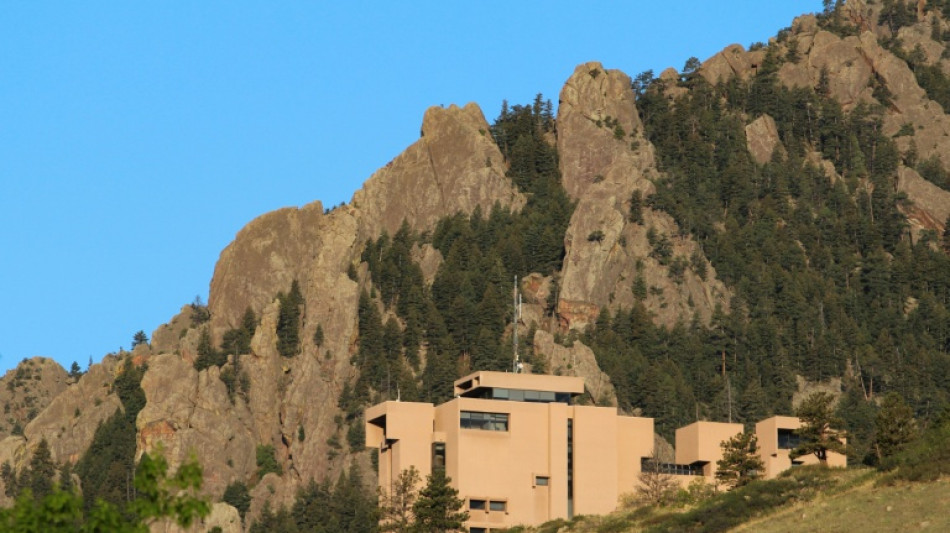
In Colorado, Trump cuts to climate research take toll / Photo: © AFP

 US eyes offshore nuclear reactors

 The Sterling Announces Luxury Cocktail Lounge Concept and Investor Showcase in Orlando
 Inter Miami signs Brazil veteran Casemiro but MLS probes deal

 White House accuses China's Moonshot of stealing Anthropic AI
 Pogacar sweating on Yates's fitness ahead of Tour Queen stage

 Ukrainian soldiers and civilians welcome new army commander

 UK fintech Revolut valuation soars to $115 bn: source

 German FM, on Africa tour, eyes business ties amid US, China pressure
 Rubio says at ASEAN meeting he expects 'positive' US visit by China's Xi
 Philipsen wins Tour de France 17th stage
 DonnaPro Introduces AI-Trained Executive Assistants for European CEOs
 Happy birthday, George! UK prince becomes a teenager
 Oil prices jump on Mideast war, stock markets diverge
 US hits Iranian island, says war cost at $37.5 bn
 Metal mining's carbon footprint far larger than thought: study
 TokenInsight Q2 2026 Report: TradFi Momentum Lifts MEXC to No. 2 in Commodity Perpetuals

 Leonardo chief sees potential for Germany to join GCAP fighter jet project
 Louvre heist gallery reopens to public, but with nothing to steal

 Ukraine's new army chief: who is Mykhailo Drapaty?

 India student protests keep up pressure on Modi government
 Italian FA chief says in touch with Guardiola over coaching vacancy
 Cooler inflation hands new UK PM Burnham an early boost
 Bezos holds talks with group interested in buying Liverpool stake: reports

 The student movement in India challenging Modi's government

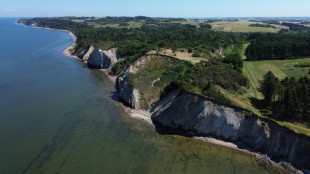 Danish fish fossil cliffs set to gain UNESCO status
In a vast Colorado laboratory nestled at the foot of the Rockies, a US scientist waits and wonders if President Donald Trump's administration will dismantle his acclaimed institute.
One of his projects, focused on adaptation to climate change, has already been axed, and he cannot hire any more PhD students, with a giant question mark over his funding.
"This is different than at any other time in my career," the researcher at the National Center for Atmospheric Research (NCAR) told AFP, asking not to be named to protect his job.
AFP spoke to a dozen scientists who recounted how facilities in Colorado -- one of the world's most important hubs for climate and meteorological science -- have been crippled since Trump returned to office last year.
From demoralized teams to the flight of young talent from the area, the picture they paint is indicative of the impact of the Republican president's policies.
As so many staff left these labs and research centers after their projects were reined in or canceled, the upheaval is likely to linger, the scientists, many of them based in Boulder, warn.
Such a brain drain could sap US ability to remain a global authority in climate and weather science, even after Trump has left the White House.
- Political backlash -
NCAR, which is housed in an imposing Brutalist building that dominates the skyline in Boulder, a university town, is a world leader in the development of weather and climate models.
Its work, largely paid for with federal funds, has allowed for major improvements in the prediction of extreme weather events and a reduction in the number of air accidents caused by severe wind shear.
But on December 16, the administration said it would move to dismantle NCAR, calling it a source of "climate alarmism."
When Dan -- who requested anonymity, so AFP has used a pseudonym -- learned the news, he was incredulous "because of how crucial NCAR is for American sciences."
"It was a combination of outrage, confusion and, like, how could this even be happening?" he told AFP.
Faced with an uncertain future, Dan decided to leave NCAR to take a job in another lab.
The alliance of 129 colleges and universities that runs NCAR took legal action in March to block at least part of the center's dismantling.
The group has argued that NCAR is the victim of political retribution targeting the state of Colorado, which has a Democratic governor.
As the case wends its way through the courts, the government has not yet made good on its threat to break up NCAR's various labs, which currently employ about 800 people.
But its repeated policy blows have deeply undermined the research ecosystem in Boulder.
- 'It affects morale' -
In the spring of 2025, John (also a pseudonym) was working on numerous projects in his lab at the National Oceanic and Atmospheric Administration (NOAA), where he has worked for more than 20 years.
But amid severance checks and threats of firing, the Trump administration gradually pushed civil servants toward the door -- and John took an early retirement deal on offer.
"My thought was, well, if I don't take that, they're going to lay off one of the younger scientists who needs this job much more than I do," he said.
In his division of NOAA, which works on improving weather forecasts, about 10 people, including the boss, left with him, taking with them invaluable knowledge and contacts.
"It affects morale," he said. "People don't function very efficiently if they're constantly worrying, 'Is my job going to exist next week?'"
The scientific community in Boulder, a city with a vibrant outdoors culture and trendy restaurants, largely depends on federal subsidies.
But the Trump administration has either canceled or frozen many of those grants: the University of Colorado at Boulder, a research hub, has lost 59 federal research awards since early 2025.
Separately, one NCAR scientist, who asked not to be named, told AFP that three of his projects suffered: two grants came more than a year late, and another was effectively cut in half.
Such drastic reductions have been noted at universities and research facilities across the United States.
- 'Death spiral' -
Tom Hamill, an alum of NOAA and NCAR who now works in the private sector, expressed his "genuine horror" over the situation.
"It's going to be a generation to recover from the damage the Trump administration has done," Hamill told AFP.
In his Boulder lab chock full of instruments, Kyle McMillan -- a PhD candidate in atmospheric chemistry -- is working to better understand what happens in the clouds.
"I am hoping to graduate in December. And so, yeah, I'm definitely in a crunch right now. I do not have a good plan yet," McMillan told AFP.
For Jim Hurrell, a former NCAR director who is now a professor of atmospheric science at Colorado State University, north of Boulder, federal funding cuts have hit hard.
"It pours some cold water on the enthusiasm of students coming through the system," he said.
Hurrell said he had seen a shift from student interest in pursuing climate science as a career.
Josh Hacker, another former NCAR scientist now working at a startup, said he feared Boulder's status as a research hub was at risk.
"When talent is leaving, it's also harder to keep remaining talent," Hacker said. "It's almost like a death spiral."
K.Hofmann--VB