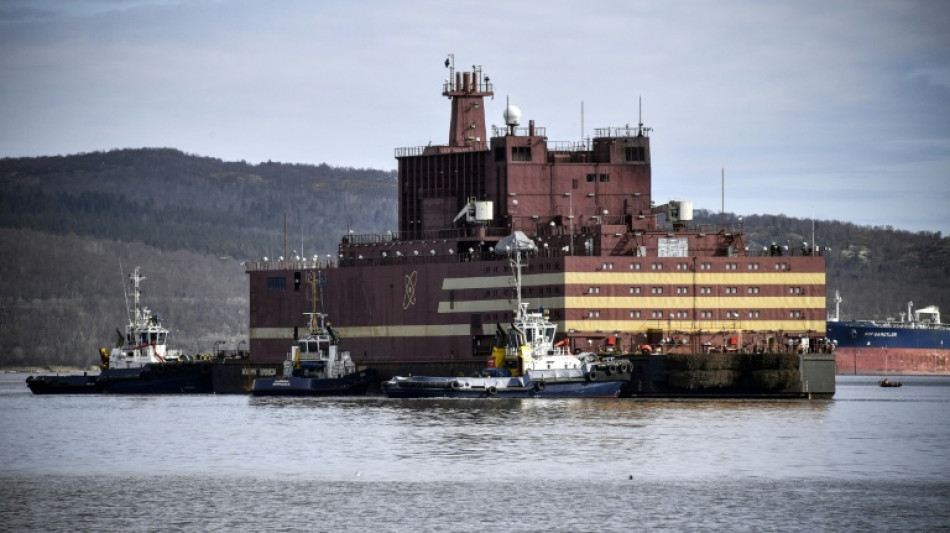
US eyes offshore nuclear reactors / Photo: © AFP/File

 Hong Kong court set to sentence activist Joshua Wong in security case

 Australia raises benchmark rate to highest level in 18 years

 'The Remarried Empress' Cast Discusses Bringing Fantasy Royal Drama to Life

 Asian stocks retreat as AI worries outweigh steep oil-price drop

 Hamad International Airport stages emergency drills during WATAN 2026

 Global failure to punish attacks leaves journalists at continuing risk

 Researchers Warn 'Bookkeeping Trick' Masks Beef Industry's Methane Emissions

 Climate Change Intensified Atlantic Hurricanes, Study Finds
 Qatar solar expansion opens scope for technical performance gains

The United States on Wednesday announced it had created a "clear framework" for the eventual deployment of offshore nuclear reactors, as part of the Trump administration's push to drastically ramp up atomic energy output.
Although no commercial US project is currently planned or approved, so-called floating nuclear power plants (FNPPs) are an area of growing interest, with Russia currently operating the sole plant, the Akademik Lomonosov in the country's far east.
The Department of the Interior's Marine Minerals Administration (MMA) said it signed a memorandum of understanding with the Nuclear Regulatory Commission (NRC) to advance the deployment of reactors in the Outer Continental Shelf -- 3.2 billion acres off the nation's coastlines that fall under federal jurisdiction.
"Submerged reactor systems have been safely deployed in naval applications for decades, demonstrating their potential as a reliable source of energy in demanding marine environments," MMA's Acting Director Matt Giacona said in a statement, adding it could "greatly strengthen America's energy security in the future."
Jeremy Bowen, director of the NRC's Office of Advanced Reactors added it created a "clear framework" for how the agencies could work together to ensure "clarity and confidence to potential future applicants and enable the safe, secure, and efficient deployment of emerging nuclear technologies."
Nuclear energy has long been used in naval ships and submarines as well as by icebreakers.
There is also growing interest in how it could help decarbonize global energy systems, according to the International Atomic Energy Agency (IAEA) -- though that is not a priority for the Trump administration, which has notably sought to halt offshore wind projects.
Canada, China, Denmark, South Korea, Russia and the United States are all working on marine small modular reactor designs, according to the IAEA, though for now Russia is the only country with one that is operational.
The Trump administration has said it aims to quadruple nuclear energy by the year 2050.
Conservationists reacted to the latest announcement with alarm.
"The Trump administration seems to have a never-ending store of terrible ideas for mistreating ocean life, and nuclear reactors on rusty old oil platforms is one of its worst," said Nick Katkevich, an oceans campaigner at the Center for Biological Diversity.
D.Schlegel--VB