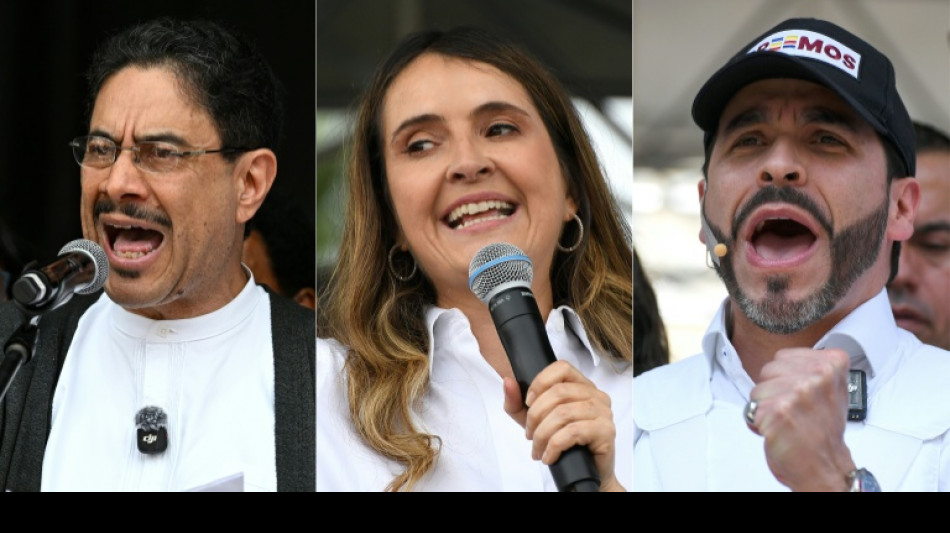
Colombia vote tests leftist rule as violence surges / Photo: © AFP/File

 Trump family project in Albania has already caused 'irreparable' damage: NGOs

 Bollywood blast master keeps it real with fire and fury

 Tearful fights, edible offerings: A glimpse into the Maradona trial
 What's the deal with peptides? The hyped market under US review
 Tesla shares fall as Musk touts ambitious -- and costly -- plans

 Houthis claim Red Sea tanker strikes as US hits Iran again

 Wildfires ravage parts of southern France, Italy and Spain

 Alphabet beats expectations in second quarter, cloud revenue nearly doubles
 Trump threatens Iran infrastructure, Tehran vows 'eye for eye'

 US teen withdraws lawsuit against Meta over social media addiction

 Lebanon PM says Beirut working for 'complete Israeli withdrawal'

 EU conditionally clears Paramount bid for Warner Bros.

 Philipsen snaps 'horrible' drought with Tour de France stage 17 victory

 US trial of Venezuela's Maduro set for June 2027

 New UK PM Burnham gets early boost as inflation dips

 Samsung launches new, more expensive foldable smartphones

 Philipsen ends 'horrible' drought with Tour de France 17th stage victory

 Hungary's Orban says graft case is 'pretext' to target his party
 South African tycoon Motsepe rules out presidential bid

 Trump threatens Iran bridges, power as payback for Hormuz attacks
 Germany's Merz replaces leader ousted over surrogacy row
 CAF chief Motsepe backs Infantino despite criticism

 Evacuees from Spain's wildfire struggle with scale of devastation

 Ancient Lebanese city of Tyre added to heritage danger list

 Extreme heatwave grips Tunisia as wide power cuts fuel frustration

Colombians vote Sunday in a presidential election overshadowed by a surge in violence, facing a stark choice between extending four years of leftist rule or shifting sharply right.
Barred from re-election, President Gustavo Petro leaves office after a turbulent term marked by car bombs, explosive drones and the assassination of a presidential candidate.
But joblessness has fallen and wages have risen, and polls show Petro's protege, leftist Senator Ivan Cepeda, 63, as the front‑runner.
The son of a slain senator, Cepeda has pledged to extend social programs and continue peace talks with armed groups, despite limited results.
"I give him my vote because my life changed under this government," said 23-year-old Natalia Rojas, a design student in Bogota and a beneficiary of a subsidized education program.
To win outright, Cepeda must secure more than half the vote.
Polls predict a June 21 runoff against right‑wing lawyer Abelardo de la Espriella.
Nicknamed "the Tiger," the 47‑year‑old millionaire has no political experience and runs an eccentric campaign. He campaigns in a bulletproof vest and delivers a hardline security message.
In an interview during the campaign, he told AFP he would seek US backing for a 90-day campaign of airstrikes and crop fumigation against cocaine-producing armed groups if elected.
"What De la Espriella wants is to put the house in order," said Wilmer Bolivar, a 47‑year‑old ex‑soldier.
He compared the approach to El Salvador's popular president Nayib Bukele.
The comparison is not accidental. De la Espriella has backed building Bukele-style megaprisons and his facial hair bears more than a passing resemblance to the Salvadoran leader.
But De la Espriella faces a tight race for second against opposition Senator Paloma Valencia, aged 50. She is backed by political kingmaker and former president Alvaro Uribe.
- Deeply polarizing -
Petro led Colombia's first-ever leftist government and has been deeply polarizing.
Poorer Colombians cheer his investment in social programs and the raising of the minimum wage. Unemployment fell, partly driven by state hiring.
The country remains one of the most economically unequal in the world.
"This election is marked by class struggle," said political scientist Alvaro Forero. "That is Petro’s main electoral ammunition," he told AFP.
To critics, Petro is erratic and his policy of "total peace" has let armed groups run rampant.
The policy has so far failed to demobilize armed groups that survived the 2016 FARC peace deal.
Experts say armed groups used talks to strengthen themselves.
Colombia remains the world's largest cocaine producer, and much of the violence is tied to drug trafficking.
Juanita Goebertus of Human Rights Watch said "2025 was a very bad year" for the country. Kidnappings more than doubled and displacement hit its highest level in nearly 20 years.
- Challenges -
Each candidate has faced serious threats throughout the campaign.
Last year's killing of right‑wing candidate Miguel Uribe has left many Colombians nervous about a return to the bad old days.
Rising drug trafficking also strained relations between Petro and US President Donald Trump. The dispute escalated into mutual insults and nearly derailed longstanding security cooperation.
Whoever wins will inherit a country with serious security problems and a fiscal deficit that has ballooned to seven percent of GDP.
Petro inherited a weak post‑pandemic economy, but since then tax collection has severely lagged behind bumper social spending.
"What's at stake is continuing Petro's change agenda or rejecting it," Forero said.
H.Weber--VB