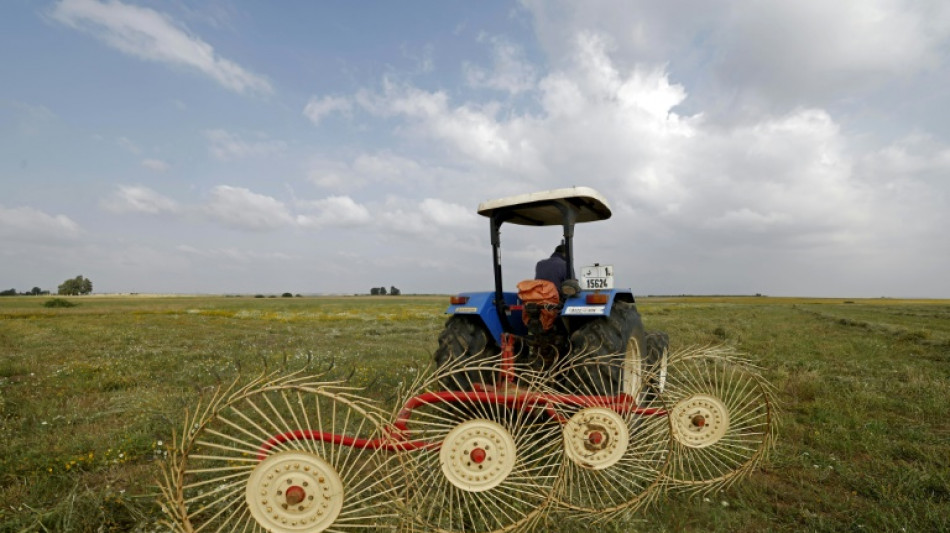
Morocco farmers saw hope in rain, but Mideast war inflates production costs / Photo: © AFP

 Houthis target Red Sea shipping as US hits Iran
 Record-equalling Red Sox streak halted at 15 wins
 Messi-less Miami beat Fire 3-2 to spoil Lewandowski's MLS debut
 Mercedes expect Hungary challenge from Hamilton and Ferrari
 In Ghana, one man's race to save critically endangered fish
 Wilson captain, Slipper absent in Kiss's first Wallabies squad
 New Mideast fighting puts eurozone rate-setters on alert

 Venezuelans search for animal companions lost in the quakes
 Argentine Football Association says US did not detain its president
 June heatwave cost UK economy more than £1bn: study

 Google-parent Alphabet beats expectations, cloud revenue nearly doubles
 US announces civilian nuclear deal with Saudi Arabia

 Tesla shares dip after profit misses expectations

 Red Sox tie club record with 15th straight MLB win

 US eyes offshore nuclear reactors
 The Sterling Announces Luxury Cocktail Lounge Concept and Investor Showcase in Orlando

 Inter Miami signs Brazil veteran Casemiro but MLS probes deal

 White House accuses China's Moonshot of stealing Anthropic AI

 Pogacar sweating on Yates's fitness ahead of Tour Queen stage

 Ukrainian soldiers and civilians welcome new army commander

 UK fintech Revolut valuation soars to $115 bn: source

 German FM, on Africa tour, eyes business ties amid US, China pressure
 Rubio says at ASEAN meeting he expects 'positive' US visit by China's Xi

 Philipsen wins Tour de France 17th stage

 DonnaPro Introduces AI-Trained Executive Assistants for European CEOs

Like many Moroccan farmers, Mehdi el-Maazi was hopeful that rare heavy rains would yield an abundant harvest this year -- but those hopes were quickly shattered as the Middle East war sent fuel and fertiliser costs soaring.
Morocco, where agriculture employs about a quarter of the working population and where drought had persisted for seven consecutive years, recorded massive rainfalls last February and December.
Across the rural region of Marchouch, about 70 kilometres (43 miles) south of Rabat, landscapes that had long been parched have turned green again, and farmers have taken back to working their fields.
Following the rains this winter, the country expected a strong cereal harvest, with output estimated to reach nearly nine million tonnes -- more than double last year's. Overall agricultural output was also set to rise by about 15 percent from last season.
But the war in the Middle East, which began in late February, has disrupted maritime traffic through the Strait of Hormuz, not only sending global energy markets into a tailspin but also choking fertiliser supplies.
Prior to the war, Maazi would normally spend around 1,200 dirhams ($130) per hectare on diesel to run his tractor. Now, he said, the cost has climbed to 1,800 dirhams.
"We were happy at first about the arrival of the rain," said the 32-year-old lentil farmer. "But with the increase in diesel prices, everything changed."
Farmers also say higher fuel prices are driving up the cost of nearly everything needed to produce crops.
Abdelkader Toukati, another farmer in the area, said he hoped "the price of diesel will fall before the beginning of the harvest season".
- 'Working to pay for fuel' -
High prices have meant that workers' wages have also risen and even "the cost of renting harvesting machines doubled", Toukati added.
Abdelaziz Drissi, who rents out agricultural machinery, also complained that there was little to no financial reward.
"There is no longer any profit," he said. "We are only working to pay for fuel."
Rising energy costs have had a direct impact on key farming supplies, driving up prices for seeds, fertilisers, pesticides and animal feed.
Livestock breeder Abdessadaq el-Fayd said grain feed prices had sharply risen in recent months.
"We used to buy it for 90 dirhams" per sack, he said. "Today, it costs 110 to 120 dirhams."
A recent report by the kingdom's High Commission for Planning projected economic growth of five percent in the first quarter of 2026, up from 4.1 percent in the previous quarter, driven in part by agricultural activity.
In an effort to alleviate rising costs, the Moroccan government in March announced aid for transport operators.
And last month, Prime Minister Aziz Akhannouch pledged to "improve distribution chains so that prices remain at a reasonable level".
But farmers interviewed by AFP said the measures have yet to rein in prices.
Rachid Benali, president of the Moroccan Confederation of Agriculture and Rural Development, said the price hikes "mainly concern fuels and nitrogen fertilisers".
But while the high costs "will have no impact on either volume or quality" of harvests, they "will automatically be reflected" in produce prices at markets, he added.
P.Vogel--VB