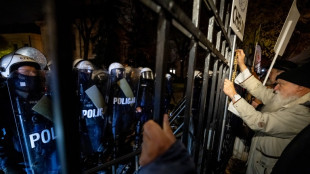
Shot for throwing stones: Israeli forces killing West Bank teens weekly / Photo: © AFP

 Young Canadians focus on mental health at key climate trial

 'Breath of fresh air' truce brings hope to Ukraine's ravaged Kherson
 British king reflects on colonial atrocities in Guyana
 Nations agree crucial texts in overtime at UN nature summit

 NBA Trail Blazers lose guard Morant for four weeks
 UN nature summit in extra time as nations grapple for deal
 Complaints upheld against Swiss TV commentary on Israeli bobsleigher

 Tielemans glad Man Utd sticking with Carrick
 Scottish police probe Andrew, Epstein stay at royal castle: UK media
 Medvedev into Vienna semis and books ATP Finals place
 UN nature talks in extra time as nations struggle to reach deal
 Meta settles, leaving Snap sole defendant in new social media trial
 Chelsea manager Alonso dismisses talk of Estevao loan deal

 Thousands of students, workers hold peaceful protests in Italy

 Iraola glad to raise Liverpool fans' hopes but says hard work ahead
 Pope Leo makes history with US midterm vote
 Arsenal boss Arteta fires 'Disneyland' warning at Dowman after Fleetwood red card

 Russia's ice hockey stars come in from the cold after CAS ruling
 Wall Street tech rout deepens on doubts over AI spending
 'Life in the old dog': German economy grows more than expected
 England great Anderson asks what's 'wrong with me?' after Lancashire exit
 Markets lashed by tech rout as earnings fan AI fears
 Germans to join Europe's youth protest wave
 Novaya Gazeta closure part of Russia's 'giant military campaign': Muratov to AFP
 US oil giants report profit surge again on Iran war
Youssef Shtayyeh came home from school on an April afternoon, dropped his bag in the hallway and headed straight back out to join his friends.
Minutes later, he was dead -- shot by an Israeli soldier, just 100 metres (yards) from his home.
He was 15. His is not an isolated case.
Since Israel launched a major military operation against armed Palestinian groups in the northern West Bank in January 2025, one Palestinian minor has been killed every week on average across the territory, up from one every three weeks in 2021, according to UNICEF.
Seventy teenagers, mostly aged 15 to 16, have been killed to date, 65 of them by Israeli forces, according to a UNICEF report dated May 12.
Then came Youssef Kaabnah, 16, killed on May 13.
Then Fahd Oweis, 15, two days later.
The Israeli military said both had "hurled stones" at soldiers.
It is almost certainly what Shtayyeh had been doing too, on April 23, in Nablus -- the largest city in the northern West Bank, a Palestinian territory occupied by Israel since 1967.
Youssef and his friends were on a side street above a main road when a couple passing in a car spotted them throwing stones -- and the military convoy below.
One jeep stopped. Then the others.
"A soldier got out, then two more. They started shooting at the kids," the passing driver told AFP, declining to be named for safety reasons.
- 'Designed to kill' -
A neighbour filmed what followed.
Two shots. Then screams.
Youssef grabbed the car door.
"He said, 'Please don't leave me, I'm scared. Take me to my father, take me home,'" the driver recalled.
Youssef's father Sameh Shtayyeh, a 48-year-old building contractor, told AFP he had no idea what had caused the soldiers to open fire on his son as he "wasn't there".
In a panic, the driver told the boy to get in the car and sped to the hospital.
By the time they reached the facility, the boy was silent.
Youssef's heart had stopped.
"A gunshot wound -- entry in the back, exit through the chest," surgeon Bahaa Fattouh, who treated him, told AFP.
Doctors resuscitated him and rushed him to the operating theatre. His heart stopped again.
This time, it did not revive.
"Earlier, we used to treat minor injuries -- legs, arms, rubber bullets," said Fattouh.
But since the Hamas attack on Israel on October 7, 2023, "we only see lethal wounds -- chest, head."
Wounds, Fattouh said, that were "designed to kill".
"Most patients die on the operating table."
- 'Standard procedure' -
AFP contacted the Israeli military on the day of the incident, and again after returning from Nablus last week.
The response was identical, word for word: "A terrorist threw stones at soldiers. The soldiers applied the standard arrest procedure, which ended with fire being directed at the suspect."
Israeli daily Haaretz recently quoted the military's commander for the West Bank, Major General Avi Bluth, saying troops had killed 42 Palestinians for throwing stones in 2025.
He described stone-throwing as "terrorism".
Standing at the spot where his son fell, Sameh Shtayyeh stares down at the road below.
"Whether he threw stones or not -- what does it matter? Where is the danger to an army patrol?" he asks bitterly.
In protests "in Israel, in France, people throw stones and bins" and face nothing worse than arrest, he said.
He buried Youssef in the family village of Tell, five kilometres (three miles) from Nablus.
Weeks later, women were still holding a vigil at the flower-covered grave, topped with a portrait of the teenager showing him on a football pitch with a ball at his feet.
His father had promised to take him to Saudi Arabia to watch Cristiano Ronaldo play.
Now, each time Sameh comes home, Youssef is not there to greet him.
His eldest son returns from school -- but Youssef is not there.
He glances at the back seat of his car. Youssef is not there.
C.Bruderer--VB