Ukraine can down Russian drones en masse. But missiles are a problem / Photo: © AFP

 Repsol says profit more than triples on higher oil prices

 TotalEnergies says profit doubled on Mideast war
 Giant swing on Swiss peak aims to boost summer tourism as Alps warm

 ASEAN to call for open straits as US-Iran war casts shadow

 AI catches up with humans to score 100% at top maths contest

 South Korea election office raided in fake turnout figures probe: investigators

 Killer whales: orcas blow fish to bits 'for fun', study finds

 Deadly wildfires force thousands from homes in parts of Europe

 Tech bounce lifts Asia stocks, oil extends gains on US-Iran fears

 Surrounded by militias, Sudanese fear endless cycle of war

 Commonwealth Games 'where champions are made' despite slimmed down model, argues president

 Trump family project in Albania has already caused 'irreparable' damage: NGOs

 Bollywood blast master keeps it real with fire and fury

 Tearful fights, edible offerings: A glimpse into the Maradona trial

 What's the deal with peptides? The hyped market under US review

 Tesla shares fall as Musk touts ambitious -- and costly -- plans

 Houthis claim Red Sea tanker strikes as US hits Iran again

 Wildfires ravage parts of southern France, Italy and Spain
 Alphabet beats expectations in second quarter, cloud revenue nearly doubles
 Trump threatens Iran infrastructure, Tehran vows 'eye for eye'

 US teen withdraws lawsuit against Meta over social media addiction
 Lebanon PM says Beirut working for 'complete Israeli withdrawal'

 EU conditionally clears Paramount bid for Warner Bros.

 Philipsen snaps 'horrible' drought with Tour de France stage 17 victory

 US trial of Venezuela's Maduro set for June 2027

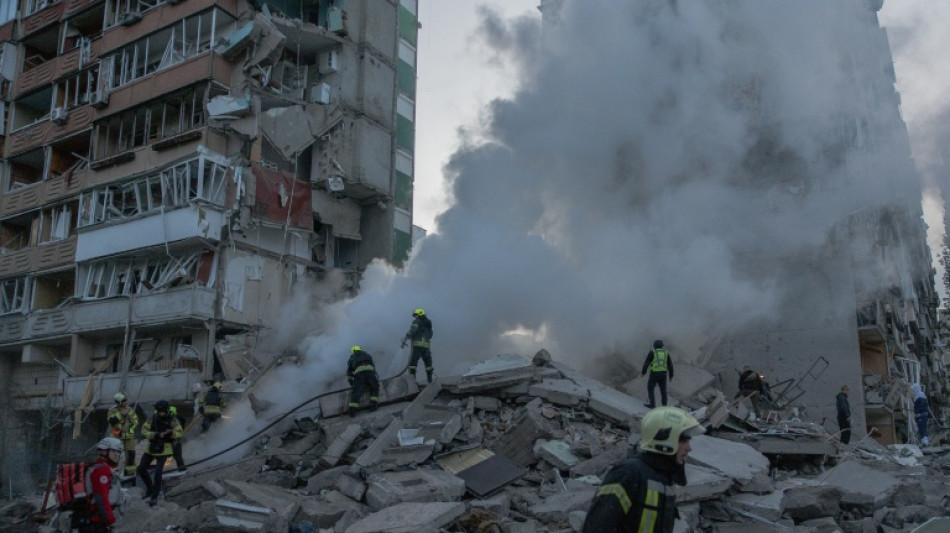
A massive Russian bombardment of Kyiv this week that lit up the night sky, sent thunderous booms echoing through the capital, and killed two dozen civilians, has revealed a stark dichotomy in Ukraine's air defence architecture.
Ukraine -- at war for more than four years -- has become the envy of some of the world's most powerful militaries in combating long-range drones.
But at the same time it is uniquely vulnerable to Russian missiles, and remains almost entirely reliant on its Western allies to counter them.
Russia fired 675 drones and 56 missiles in the seven-hour barrage that ripped open a Kyiv apartment block, killing 24 people.
Ukraine's homegrown air defence network -- electronic jamming systems, anti-aircraft guns, helicopters and jets, and smaller interceptor drones -- took down all but 22 of the Russian drones.
But 15 missiles got through.
For Ukraine, it once again revealed their acute shortage of sophisticated Western anti-missile systems and the expensive ammunition for them.
"The real damage was done by missiles, especially in Kyiv," Sergii Beskrestnov an advisor to the defence minister said in the aftermath of the attack.
President Volodymyr Zelensky praised Ukraine's air force for downing 94 percent of the Russian drones.
But he conceded: "The most difficult challenge is defending against ballistic missiles."
- Ammo is 'hard to find' -
He repeated his call to allies for urgent help, including via the PURL system that Kyiv's partners use to buy US weapons for Ukraine.
After the attack, Britain's Defence Minister John Healey said he had "directed for UK deliveries of air defence and counter-drone systems to be accelerated as fast as possible."
But the war in the Middle East -- which saw US allies expend huge quantities of air defence ammunition protecting sites in the Gulf -- has exacerbated a shortage Ukraine has faced since the start of the war.
Ammunition for the US-made Patriot batteries that Ukraine uses can cost around $4 million apiece.
The United States produces only around 600 per year, and several can be needed to down a single ballistic missile.
Zelensky has said that Middle East countries used 800 PAC-3 interceptors to counter Iranian drones and other projectiles, adding that Ukraine had never had that many during its war.
A senior Ukrainian put the problem with missile interceptors for air defence batteries in stark terms to AFP: "They've become harder to find."
Just days before Russia unleashed its latest barrage, a representative of the Ukrainian air force told state media that ammunition was already being rationed due to "supply problems."
"The launchers that are part of certain units and batteries are half-empty -- and that's putting it mildly. They have a limited number of missiles," the official, Yuriy Ignat, said.
He added that Ukraine's stockpiles were already low following a devastating Russian campaign against Ukrainian energy facilities over the winter.
Air force representatives are sometimes negotiating with allies for as little as between 5 and 10 missiles for Western supplies systems, like Patriot batteries, he said.
- Few short term options -
The war in the Middle East may also present a solution for Kyiv.
Ukraine's success in drone warfare has attracted the attention of rich Gulf states that have been targeted with the same types of Iranian-designed drones that Ukraine is now well versed in countering.
Zelensky, on several visits to the region, has inked various air defence agreements with many countries in the region.
The details have not been revealed, but he had earlier proposed sharing Kyiv's anti-drone expertise in return for Patriot ammunition or investment in Ukraine's defence industry.
Lockheed Martin, the US-based producer of PAC-3 Patriot batteries plans to ramp up production over the next seven years.
Over the long-term, Ukraine can also expand its domestic capacities with help from allies.
But options to fend off the attacks Ukraine is facing right now are limited, said Jade McGlynn, Research Fellow at the Department of War Studies, King's College London.
"Bluntly I can't see any significant solution or significant improvement that's available in the short term, beyond just giving Ukraine more, more of the air defence systems that are a bit more available than the Patriots," she told AFP.
J.Sauter--VB