Strong US economy's resilience to shocks tested by Iran war / Photo: © AFP

 EU fines Google 890 mn euros, risking US fury

 France evacuates thousands of tourists as fire rages in pine forest

 French Jewish DJ sues after activists disrupt stage show: lawyer

 Nokia says AI, cloud boosted sales in second quarter

 Repsol says profit more than triples on higher oil prices

 TotalEnergies says profit doubled on Mideast war

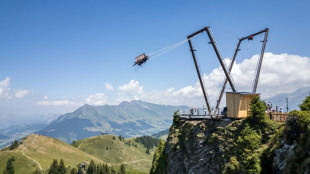 Giant swing on Swiss peak aims to boost summer tourism as Alps warm

 ASEAN to call for open straits as US-Iran war casts shadow

 AI catches up with humans to score 100% at top maths contest

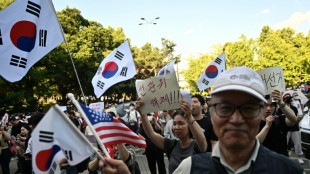 South Korea election office raided in fake turnout figures probe: investigators

 Killer whales: orcas blow fish to bits 'for fun', study finds

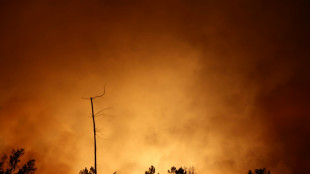 Deadly wildfires force thousands from homes in parts of Europe

 Tech bounce lifts Asia stocks, oil extends gains on US-Iran fears

 Surrounded by militias, Sudanese fear endless cycle of war

 Commonwealth Games 'where champions are made' despite slimmed down model, argues president

 Trump family project in Albania has already caused 'irreparable' damage: NGOs

 Bollywood blast master keeps it real with fire and fury
 Tearful fights, edible offerings: A glimpse into the Maradona trial

 What's the deal with peptides? The hyped market under US review

 Tesla shares fall as Musk touts ambitious -- and costly -- plans

 Houthis claim Red Sea tanker strikes as US hits Iran again

 Wildfires ravage parts of southern France, Italy and Spain
 Alphabet beats expectations in second quarter, cloud revenue nearly doubles
 Trump threatens Iran infrastructure, Tehran vows 'eye for eye'

 US teen withdraws lawsuit against Meta over social media addiction
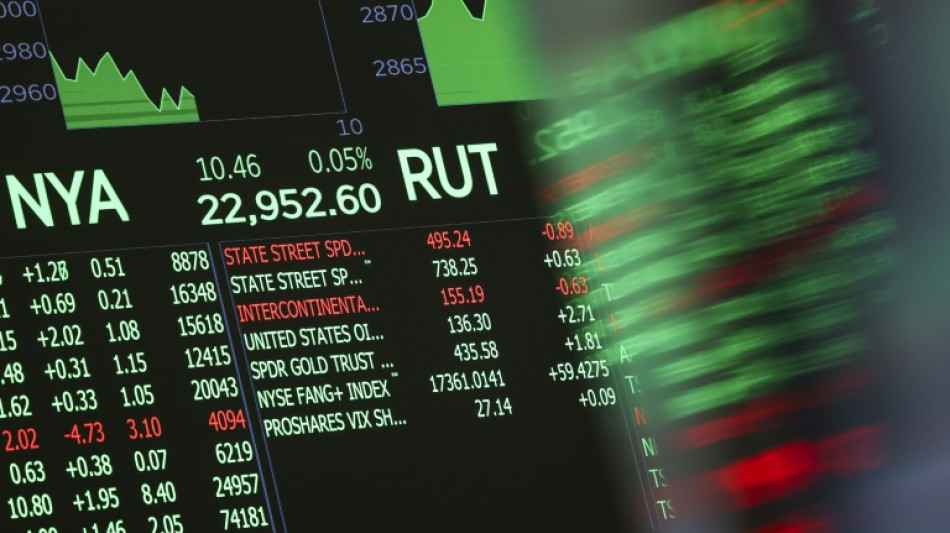
If you look at the numbers, the United States economy seems to be doing surprisingly well despite massive successive shocks from the pandemic, Ukraine war, tariffs, and now the Iran war energy crunch -- but economists warn that resilience is precarious.
GDP growth came in at a robust 2.0 percent last quarter, unemployment is steady, the stock market is booming, and inflation -- while high -- is nowhere near its pandemic peak.
US President Donald Trump has pointed to these figures as proof his economic policies, including upending the international trade order with tariffs, are working.
"The economy is resilient, but it's also kind of precariously perched," said Mark Zandi, chief economist at Moody's Analytics.
He pointed to concerns about job growth, often used as a proxy for economic activity.
While unemployment has remained steady, job growth has see-sawed wildly between expansion and contraction in the last year, with new jobs heavily reliant on a single sector: health care.
The US-Israel war on Iran has sent energy prices surging, after Tehran blocked the key Strait of Hormuz waterway through which a fifth of all global energy supplies normally pass.
The shock is being felt at the pump for consumers, but also for private sector companies as they see their input costs skyrocket.
"It wouldn't take much to push this resilient economy over the cliff into a downturn," said Zandi.
Excluding health care, analysts warn that the US economy has lost jobs over the last year. Zandi said there had not been mass layoffs, but that many companies were "right on the edge."
If the Iran war drags on, spiking energy prices further and snarling global supply chains, "at some point the economy is not going to be able to digest all the shocks," he said.
"I think recession risks are uncomfortably high," he added.
- 'Firing on all cylinders' -
Claudia Sahm, chief economist at investment firm New Century Advisors, told AFP the economy had been surprisingly robust, but it was too early to predict the full effects of the Iran war.
She said the world's largest economy had come out of the pandemic "firing on all cylinders," and that strength had helped it weather subsequent storms, including the current energy shock.
"Some of the resilience just comes from the fact that we were on a pretty strong footing," she said.
For Sahm, the current scenario -- with high energy prices, tariffs and policy uncertainty -- is "unlikely to be enough to derail the economy."
The real issue, she said, would hit if there was a "crisis of confidence," particularly in new artificial intelligence (AI) technologies that are powering much of the optimism on Wall Street and in the private sector.
It is AI-related technology stocks that have powered the US stock market this year, despite recent turmoil due to the Iran war.
The Nasdaq Composite is up around 13 percent, the S&P 500 more than eight percent and the Dow more than three percent in that period.
But "the stock market isn't the economy," said Moody's Zandi, warning that money made in Wall Street disproportionately benefits higher-income households.
- K-shaped economy -
For working-class families, inflation -- especially of basics like fuel and groceries -- tends to define their experience of the economy.
In April, those numbers came in at multi-year highs, with fuel prices at the pump up around 51 percent since the war began, and grocery prices at their highest level since 2023.
That inequality has given rise to what economists have begun to call the "K-shaped economy," where consumption for higher-income Americans is rising, but it is falling for lower-income people.
A recent study by the US Federal Reserve Bank of New York found that retail spending growth since 2023 has been driven by households making more than $125,000 a year.
Still, Sahm says that the American economy's buffers across the board are dwindling, and there is a limit to how much it can take.
"There's resilience," she said, but "it's not endless."
C.Koch--VB