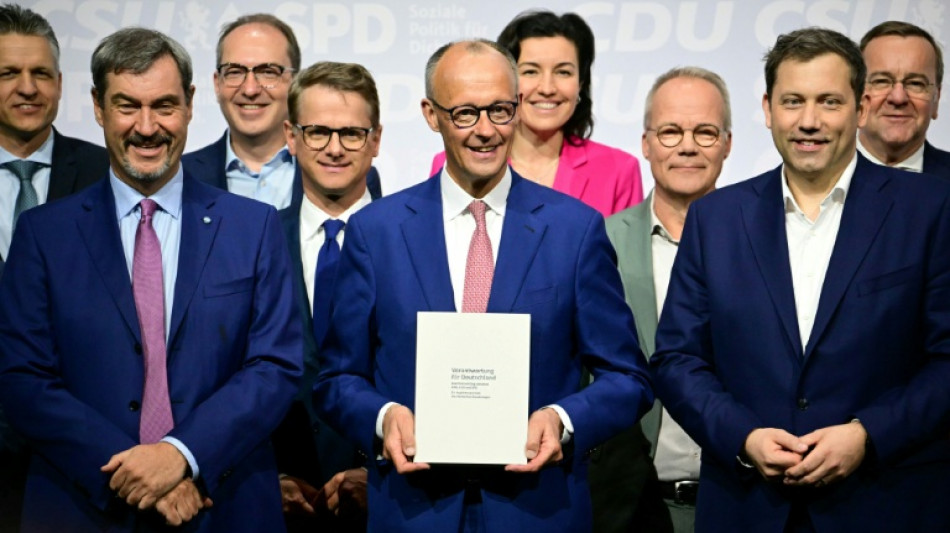
A year into Merz government, German far right stronger than ever / Photo: © AFP/File

 Farm workers wilt in sweltering Italian shanty town

 Keys to face Maria in Eastbourne final

 Venezuela earthquakes toll doubles amid desperate rescue efforts

 Mercedes dominate opening practice at Austrian GP

 Wawrinka announces farewell fete with Federer and Murray

 Lukashenko will always be threat to Ukraine: Belarus opposition leader

 European heatwave's unlikely accomplice: an ocean 'cold blob'

 Japan's progress paying off at World Cup, says Troussier

 Dozens of international teams rushing to Venezuela: UN

 Floods kill two in Taiwan as twin storms approach Japan

 In the heat, Ivorians don't think twice about using aircon
 Belgium cancels Waterloo battle reenactment due to heat

 Mayweather-Pacquiao rematch postponed indefinitely

 Four injured, flights cancelled in Japan as twin storms approach

 Russia pulls team from gymnastics World Cup event over flag row

 Venezuelans hunt for survivors after quakes kill at least 235

 Mexico's Sheinbaum and Spanish king use World Cup to mend diplomatic rift

 'Die together': Ukraine's LGBTQ soldiers fighting Russia -- and for their rights
 Wole Soyinka university theatre: a talent factory for Nigeria and beyond

 Climate change to blame for intensity of Europe heatwave: scientists

 Venezuelan mother digs with bare hands for missing son

 Нуша Аубель и Дитмар Войдке: как Потсдам бросает на произвол судьбы малыша с тяжелой формой инвалидности

 Turkey beat US 3-2 with last-gasp winner
 Asian stocks suffer fresh rout as rollercoaster week draws to close

 Japan coach hopes World Cup success can inspire Asian rivals

German Chancellor Friedrich Merz took office a year ago vowing to revive the political centre, but the far-right AfD party has risen to the top of the polls while his own coalition's popularity is falling.
The conservative chancellor, who came to power on May 6 last year at the head of a coalition with the centre-left Social Democrats (SPD), had argued that the far-right Alternative for Germany (AfD) could be weakened by effective governance.
But after a year beset by public squabbles within his government and growing criticism of his failure to halt an economic slump, the AfD is more popular than ever.
The AfD, which finished second in the 2025 elections with 20.8 percent, is now approaching 28 percent in polls -- the result Merz's centre-right CDU/CSU alliance achieved in the vote.
The anti-immigrant AfD is now firmly entrenched in German politics and cannot be viewed merely as the beneficiary of protest votes, according to political scientist Benjamin Hoehne of Chemnitz University.
"The AfD now has a very loyal electorate that remains faithful regardless of current events or party leaders," he told AFP.
More worryingly for Merz, the "the core electorate" for Germany's mainstream centrist parties is "disappearing", Hoehne added.
- Mainstream parties fading -
For decades, the CDU/CSU and SPD dominated German politics, but Merz's CDU party is now polling below 25 percent -- and the SPD has slipped under 15 percent.
This change is particularly pronounced in former communist states of eastern Germany, where the AfD appears certain to come top in two regional elections in September -- and might even claim outright majorities.
But the AfD has also been on the rise in the more prosperous west. In two regional elections there this year, the party hit new highs, with nearly 20 percent of the vote.
For AfD politicians and supporters, those results prove that Merz's conservatives are making a mistake by allying with the centre left rather than with the far right, where they contend there is more common ground.
But Merz and his party remain committed to the so-called "firewall", a consensus across much of the German political world against allying with the AfD, which is seen by mainstream parties as anti-democratic and racist.
The AfD accuses the ruling coalition of incompetence.
"With his coalition with the SPD, Friedrich Merz won't be able to win back a single AfD voter," Bernd Baumann, leader of the AfD's parliamentary group, told AFP.
"Merz will continue to lose a massive number of voters to the AfD, because incompetent governments get voted out," he added, referring to the disputes that are paralysing decision-making within Merz's governing coalition.
- Sliding poll numbers -
The chancellor had vowed to diminish the AfD's appeal with two main strategies: a tough stance on immigration to outflank the far right on the issue, and bold reforms to prove that centrist parties are still capable of acting.
Tighter immigration rules have led to a significant decrease in arrivals -- but the chancellor does not appear to be benefitting politically.
Meanwhile, his reform drive has stalled because of constant bickering between the CDU and SPD, with the long-struggling economy making a slower-than-expected recovery.
Political scientist Marc Debus of the University of Mannheim said Merz's decision to focus on immigration may have backfired.
"Studies show that, generally speaking, right-wing populists are strengthened when the issue of immigration is raised up the political agenda, when positions are aligned with those of right-wing populist parties, and when their rhetoric is adopted," he told AFP.
A poll at the weekend in the Bild daily showed just 16 percent of Germans are satisfied with the government -- with only 24 percent believing the coalition will survive until the end of its term in 2029.
The previous German government, headed by Olaf Scholz, collapsed in 2024 amid bitter infighting between his SPD and its two coalition partners.
Public dissatisfaction, Debus said, "significantly improves the electoral chances of right-wing populist parties".
D.Schaer--VB