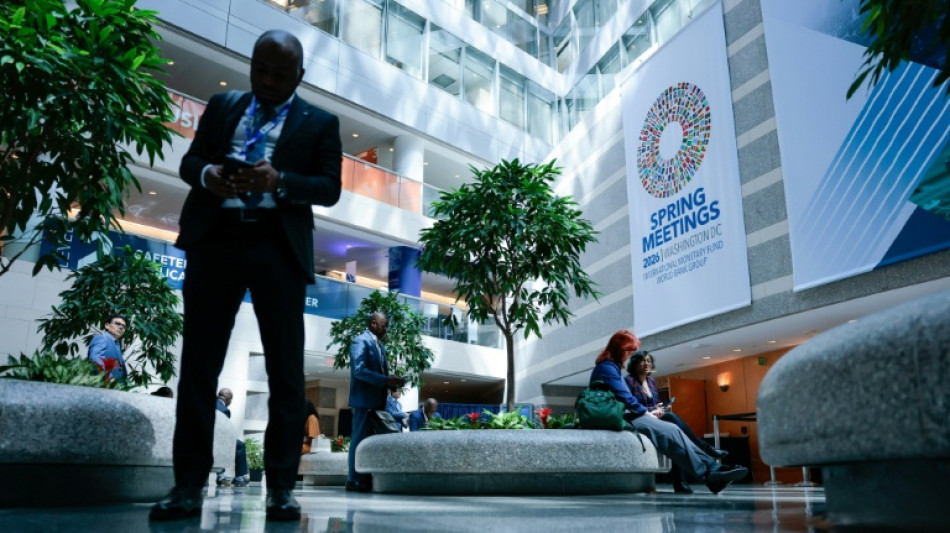
World Bank chief economist warns of hunger risk from war in Iran / Photo: © AFP

 Japan change World Cup training sites in Mexico over conditions
 Crypto scammers prey on French victims from Albania

 China's Xi to visit North Korea next week

 Irish racing great O'Brien bids to make Epsom Derby history
 Australia seizes 100,000 cockroaches in bug-breeder bust

 Asian stocks take another hit from AI, Mideast worries

 Nazi party records released online shatter German family myths

 US allying itself with Colombian 'narco-traffickers,' Petro accuses
 Putin to confront weak economy at 'Russian Davos', under threat of Ukrainian drones
 Thousands protest in Albania against Kushner real estate project

 US imposes sanctions on Cuban president, Castro family members

 Trump confirms mass rally, scrapping US 250th concerts

 Wemby counts on 'normal' Spurs to bounce back in NBA Finals

 Dangerous livestock pest case confirmed in Texas

 Latest 'Scary Movie' aims to cancel 'cancel culture,' creators say

 Lyles reigns in Rome 100m, Pathirage stuns with javelin

 Trump announces $700 mn support for US coal projects

 SpaceX IPO: rockets, AI losses and Musk in control

 Four-wicket Robinson sparks New Zealand collapse in 1st Test after England slump

 Four-wicket Robinson rocks New Zealand in 1st Test after England collapse

 Qualifier Chwalinska sets up Andreeva French Open final clash

 Unfazed Antonelli plans to race with freedom

 Designer Gabriela Hearst still believes in 'brilliance of humanity' despite AI
 Qualifier Chwalinska downs Shnaider to reach French Open final

 UN nuclear watchdog raises 'proliferation' fears over Iran sites

The conflict in the Middle East could push millions more towards hunger as its economic fallout reverberates further around the globe, the World Bank's chief economist warned in an AFP interview on Wednesday.
"You have about 300 million people who suffer from acute food insecurity already," Indermit Gill said. "That'll go up by about 20 percent very, very quickly," as knock-on effects grow.
Gill spoke on the sidelines of the International Monetary Fund-World Bank Spring Meetings in Washington.
The blocking of the Strait of Hormuz, a key oil supply route, has sent fertilizer prices soaring since they rely on oil-based inputs.
Higher prices for fertilizers, which are used in agriculture, may entice countries to halt food exports and hoard more food for themselves, further driving up food prices.
"Those export bans scare us massively," Gill told AFP.
Most exposed are people in countries that are at war or have fragile governments.
If the situation isn't resolved soon, "hunger will start to stalk these countries massively."
Currently, the shortage of petrochemicals and their economic effects are being most felt in Asia, Gill explained, but "as the crisis gets longer, it's very rapidly going to spread first to Africa."
"The food that's in the market right now has already been grown," Gill said, but the real effects could be felt in a few months.
- Lower growth, higher inflation, more expensive debt –
Low-income people across the world tend to spend a larger share of their earnings on basic needs like food and fuel.
"If you get inflation in, especially in the kind of things that the poor consume relatively more often, that inflation is going to hurt massively," Gill went on.
Gill also warned that inflation – not just in food prices – could rise from about 3 percent globally to as much as 4.7 percent this year, in the most extreme scenario where the conflict stretches to August.
At the same time, global growth could be cut by as much as 40 percent on a yearly basis, if the crisis drags on.
Higher inflation mixed with lower growth would be a "double whammy" for the debt sustainability of poor countries, further hindering their ability to deal with this and future crises.
Gill warned that many headline figures for regional growth may appear too rosy, as the massive US, Chinese, and Indian economies, which are generally more insulated from external shocks, tend to drag up estimates.
When you remove them from the estimates, "you start to see a lot more vulnerabilities," Gill said.
"And by the way, that extreme scenario, with every passing day, is not that extreme of a scenario -- because we're getting closer and closer to August."
E.Gasser--VB