'Blindsided': US farmers strained as fertilizer costs surge on war / Photo: © AFP

 Sicily braces for post-wedding blowout of Dua Lipa, Callum Turner

 Japan change World Cup training sites in Mexico over conditions

 Crypto scammers prey on French victims from Albania

 China's Xi to visit North Korea next week

 Irish racing great O'Brien bids to make Epsom Derby history

 Australia seizes 100,000 cockroaches in bug-breeder bust

 Asian stocks take another hit from AI, Mideast worries

 Nazi party records released online shatter German family myths

 US allying itself with Colombian 'narco-traffickers,' Petro accuses

 Putin to confront weak economy at 'Russian Davos', under threat of Ukrainian drones

 Thousands protest in Albania against Kushner real estate project

 US imposes sanctions on Cuban president, Castro family members

 Trump confirms mass rally, scrapping US 250th concerts

 Wemby counts on 'normal' Spurs to bounce back in NBA Finals

 Dangerous livestock pest case confirmed in Texas

 Latest 'Scary Movie' aims to cancel 'cancel culture,' creators say

 Lyles reigns in Rome 100m, Pathirage stuns with javelin

 Trump announces $700 mn support for US coal projects
 SpaceX IPO: rockets, AI losses and Musk in control

 Four-wicket Robinson sparks New Zealand collapse in 1st Test after England slump

 Four-wicket Robinson rocks New Zealand in 1st Test after England collapse

 Qualifier Chwalinska sets up Andreeva French Open final clash

 Unfazed Antonelli plans to race with freedom

 Designer Gabriela Hearst still believes in 'brilliance of humanity' despite AI
 Qualifier Chwalinska downs Shnaider to reach French Open final

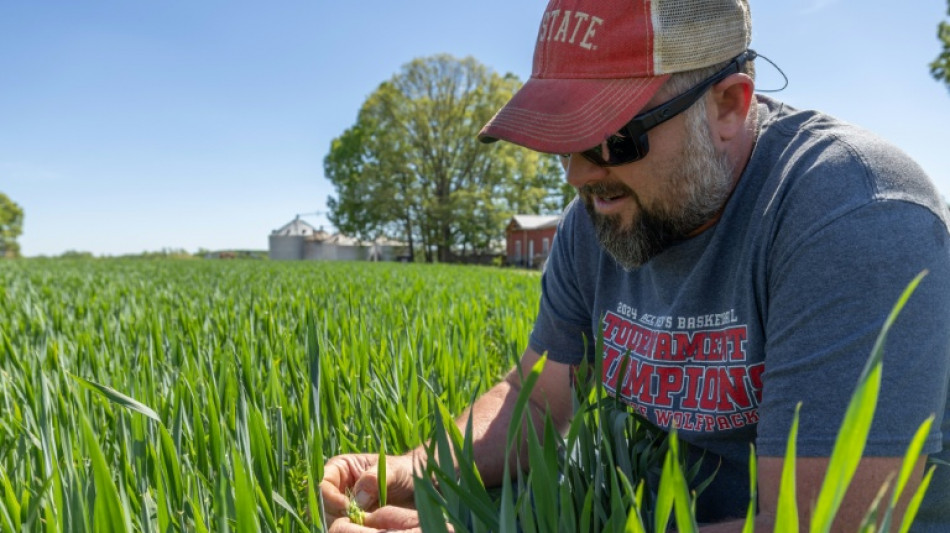
On Andy Corriher's farm in North Carolina, planting and preparations are underway for his corn and soybean crops -- but fertilizer costs have surged on war in the Middle East, and orders he placed weeks ago have yet to arrive.
The 47-year-old is among US farmers facing a double whammy of soaring fertilizer and diesel prices after US-Israeli strikes on Iran triggered Tehran's blockage of the Strait of Hormuz, a critical waterway for such shipments.
"This time of year is when the majority of fertilizer is put out in this country," Corriher told AFP.
"We got hit at the worst possible time, because we're trying to buy fertilizer when it skyrockets and when the supply also gets cut."
The cost hikes strike at a major support base for President Donald Trump, who won 78 percent of the 2024 vote in farming-dependent counties, said news service Investigate Midwest.
Trump blamed "price gouging from the fertilizer monopoly" on Saturday, vowing: "American Farmers, we have your back!"
But spring planting is already ongoing, with Corriher loading bags of dry fertilizer onto a tractor, hauling them to his fields.
"I've ordered several loads of liquid nitrogen a few weeks ago, and they're still saying they're not sure when it'll be delivered," Corriher said.
Since the war, Corriher estimates that the nitrogen fertilizer he uses rose by at least 40 percent in price.
The cost of urea -- a common nitrogen-based fertilizer -- had jumped by around 50 percent at the port of New Orleans.
Corriher has reduced usage by a third, a decision he worries might hurt his yields.
- 'Gut shot' -
Russell Hedrick, who farms up to 1,000 acres including corn and soybeans around Hickory, North Carolina, said around 75 percent of his fertilizer purchases were made after prices rocketed.
Like himself, many US farmers lack storage to stock up far ahead of planting, the 40-year-old told AFP, after blending fertilizers and nutrients to be sprayed on his fields.
He has cut fertilizer use to the "bare minimum," with an option to add more later.
Even before the war, rising costs meant "farmers have essentially become like Breaking Bad chemists with fertilizer, to get the most out of it," he said.
Agriculture Secretary Brooke Rollins said 80 percent of American farmers had bought fertilizer for the spring planting season before the conflict. But that's cold comfort to those who lacked funds and capacity to do so.
Those remarks were "a gut shot," said Marshville-based farmer Derrick Austin.
Austin, 55, called his supplier upon learning of the strait's blockage, knowing that costs would jump.
"Thankfully, he let me buy three loads of nitrogen at the old price per ton so I could at least fertilize my wheat crop," he said. "It was devastating."
Fertilizer supply has diminished before, like in 2021 when China restricted phosphate exports to prioritize domestic needs.
Usually, farmers can see that coming, Hedrick said.
"This year, we just kind of got blindsided."
- 'Collateral damage' -
Corriher said he has been a supporter of Trump, but added of the war: "It didn't seem like we had really thought out all the consequences to the American people."
"I feel like these things were kind of overlooked as part of collateral damage," he said.
The surge in gas and diesel prices have hit farmers and other American households: "Everybody seems to be suffering."
Asked if the war has changed perceptions of Trump, Austin said: "I'm starting to question some of his reasoning."
But to him, the Trump administration "still beats some of the alternatives."
Hedrick said he has voted for Trump thrice: "He's human like the rest of us. I think he makes good calls, I think he makes mistakes."
He said if the conflict's resolution brings "long-term peace" and a reopened Strait of Hormuz, "that's all I can hope for."
The US agriculture economy has "been in a recession for the last couple of years," said Iowa State University professor Chad Hart.
Net farm income has declined while business costs remain high.
Although margins are squeezed this year, the hit may be less than anticipated as many farmers managed to apply fertilizer last fall or earlier this spring.
But the 2027 crop would be "a big concern" if fighting persists, Hart said.
R.Braegger--VB