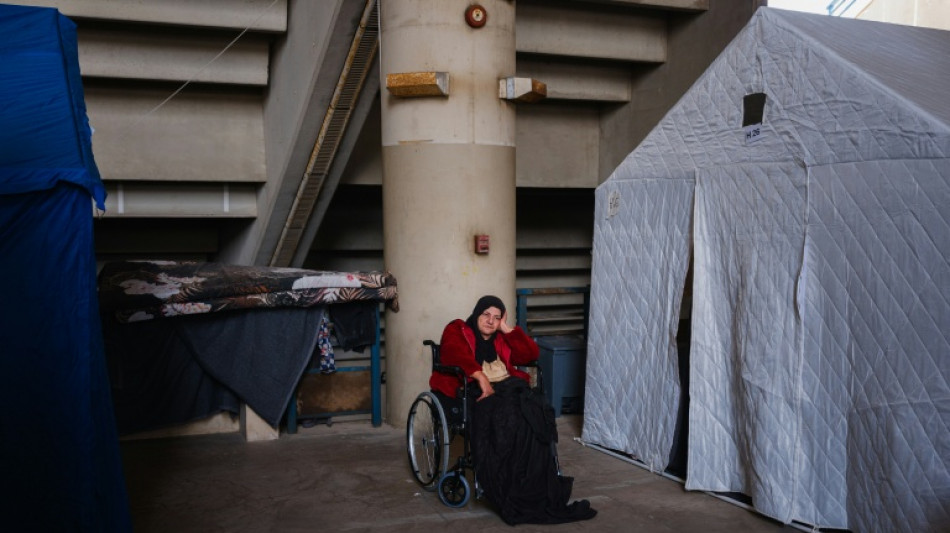
In Beirut's largest stadium, displaced people with disabilities face 'ordeal' / Photo: © AFP

 US judge blocks Trump restrictions on legal immigration
 Eurovision viewing figures drop to 131 million after boycott

 Leak on space station triggers brief safety alert

 Smith steadies England as New Zealand set 254 to win first Test
 Can Peru's new president survive a hostile Congress?
 Revived Hamilton leads Ferrari one-two in Monaco practice
 Putin rules out imminent Zelensky meeting

 Zverev eases past Mensik to reach second French Open final

 England collapse gives New Zealand hope in first Test
 Argentine rock legend Carlos 'Indio' Solari dies at 77
 Russian economy has not collapsed, Putin says at key forum
 AI fever spreads, but are markets masking economic cracks?

 MEXC Lists YOM (YOM) with 200,000 YOM and 40,000 USDT in Airdrop+ Rewards
 Strong US job growth beats expectations in May, firming recent gains

 'No hope': Indian crew stranded off Turkey for months
 From Siberia to French Open final, Andreeva living 'dream'

 Leclerc beats Hamilton as Ferrari shine in Monaco F1 practice
 Lawsuit seeks to stop US 'third-country' deportations to Eq.Guinea
 Celtic fans oppose potential Keane move over Israel stay
 Feared global hunger crisis 'coming to pass' as Mideast war lingers: UN
 Macron blasts 'unacceptable' lapses over girl's suspected murder

 Sea drone explodes in the Romanian port of Constanta, no casualties

 Nearly 1.5 million displaced in Haiti: UN

 Former France rugby coach Saint-Andre eyes making history with Aix
 France probes judicial 'dysfunction' after girl's suspected murder
In the stands of Beirut's largest stadium, it is the shouts of children displaced by war that echo, not the songs of fans.
Beneath the concrete steps, more than a thousand people fleeing Israeli bombs on Lebanon sleep in tents, including around 50 wheelchair users and people with other mobility challenges.
The vast sports complex, which opened its doors to displaced people during the previous war in 2024, is one of the few shelters able to take in people with disabilities, despite being poorly adapted to their needs.
"If there's a strike, the people around me could run away and leave me behind; I can't get up and move if no one helps me," says 62-year-old Fatima Nazli, who uses a wheelchair.
The state has not put in place any strategy to evacuate people with disabilities, said Sylvana Lakkis, head of the Lebanese Union for People with Physical Disabilities.
"We submitted a policy and proposal" to the government, but "they never listened", she told AFP.
"Every time there is a crisis, we, people with disabilities pay the price."
Nazli and her husband had to leave their apartment in Beirut's southern suburbs, shelled by Israel since Lebanon was pulled into the Middle East war on March 2.
They are living in a tent in a section of the stadium where she is forced to ask Red Cross volunteers for help to get down the flight of steps leading to the only bathrooms she can access.
– 'Living in constant fear' –
The couple expects to move to another section of the stadium, where two access ramps and four accessible toilets were recently installed.
In the meantime, Nazli and her husband, Abu Ali, who did not wish to give his full name, go back to their apartment from time to time to take a shower and pick up clean clothes, gripped by fear because the neighbourhood "could be bombed at any moment" by the Israeli air force.
The Camille Chamoun Sports City, on the edge of Beirut's southern suburbs, has witnessed the twists and turns of Lebanon's troubled history.
Destroyed by bombing during the Israeli invasion in 1982 and rebuilt after the end of the civil war in 1990, it has fallen into disrepair due to a lack of funds for its upkeep.
Football legend Pele once trod its turf, and international sporting competitions have been held there.
But the stadium has also served as a warehouse for food supplies, and Hezbollah held the lavish funeral for its leader Hassan Nasrallah, killed by Israel, there in September 2024.
– 'An ordeal' –
"This place was not built to be lived in," says stadium director Naji Hammoud, who opened its doors "the next day" after the first evacuation warnings issued by the Israeli army in the southern suburbs in early March.
More than a million people have been displaced and Israeli strikes have killed more than 1,200 people, including 124 children, Lebanese authorities say.
Many displaced people are sleeping on the streets of the capital or in their cars, and Hammoud wants the facility to take in "as many as possible".
Around the tents, workers are busy renovating the unsanitary restrooms, installing showers and connecting them to the water supply, and hooking up electricity.
"I can't wash myself on my own, I need help," explains Khodr Salem, a shopkeeper from the south of the country, who has difficulty walking and uses a crutch because of an infection in his leg.
"We lived like kings in our homes. Our life has become an ordeal," the old man says through tears, sitting on a mattress in his tent.
For Lakkis, Lebanon doesn't have enough accessible shelters: the few schools able to receive people with disabilities fill up quickly.
Many displaced people therefore have to find relatives who can host them or pay exorbitant rents to landlords, explains Fadi Al-Halabi, executive director in Lebanon of the Ecumenical Disability Advocates Network.
"The international community must take into account the needs of people with disabilities" and allocate a share of the international aid budget to them, he said.
F.Mueller--VB