
Costa Rican president survives second Congress immunity vote / Photo: © AFP/File

 Equitas Small Finance Bank rebounds after naming interim chief executive

 Titan quarterly profit seen rising as jewellery business drives growth

 Kuwait finance minister holds economic cooperation talks at COMCEC

 82-Year-Old American Transforms 2003 Mercedes Sprinter into Permanent Home
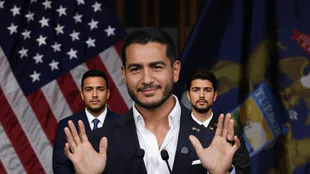
 Abdul El-Sayed declares victory in Michigan Senate contest

 Democrats capture US Congress in sweeping midterm victory

 Manchester United rallies past Roma as PSG dominates in Champions League

 Qatar prime minister advances mediation through diplomatic calls

 Greenland parliament approves security agreement with United States

 Qatar envoy meets incoming UN General Assembly president

 Trump Signals Willingness to Work With Democrats After Midterm Defeat

 Pitches and Keynote Speakers Are Confirmed for Blue Magic Netherlands on November 17
Costa Rica's conservative President Rodrigo Chaves on Tuesday survived a second attempt to strip him of immunity so he can be prosecuted for alleged wrongdoing.
The Central American country's congress voted 35 to 21 in favor of removing his immunity -- three ballots below the 38-vote majority needed for the motion to pass the 57-seat chamber. The president of the legislature announced the result.
In July, the country's Supreme Court asked congress to take away 64-year-old Chaves's immunity so he could be put on trial for alleged corruption.
In that case, prosecutors claimed he had forced a communications agency hired by the presidency to give $32,000 to his friend.
The presidency allegedly used funds from the Central American Bank for Economic Integration, a multi-lateral development bank, to contract the agency.
In September, lawmakers rejected the Supreme Court's request, only for Costa Rica's Supreme Electoral Tribunal (TSE) to approach Congress with the same request but for a different alleged crime.
The TSE wants to prosecute Chaves for allegedly using his presidential office to campaign for his political party ahead of February 2026 elections.
Presidential terms in Costa Rica are limited to one.
Chaves, who looks to El Salvador's iron-fisted President Nayib Bukele for inspiration on fighting a surge in organized crime, has backed one of his former ministers, Laura Fernandez, to replace him.
M.Betschart--VB