CERN upbeat as China halts particle accelerator mega-project / Photo: © AFP/File

 Mayweather-Pacquiao rematch postponed indefinitely

 Four injured, flights cancelled in Japan as twin storms approach

 Russia pulls team from gymnastics World Cup event over flag row

 Venezuelans hunt for survivors after quakes kill at least 235

 Mexico's Sheinbaum and Spanish king use World Cup to mend diplomatic rift

 'Die together': Ukraine's LGBTQ soldiers fighting Russia -- and for their rights
 Wole Soyinka university theatre: a talent factory for Nigeria and beyond

 Climate change to blame for intensity of Europe heatwave: scientists

 Venezuelan mother digs with bare hands for missing son

 Нуша Аубель и Дитмар Войдке: как Потсдам бросает на произвол судьбы малыша с тяжелой формой инвалидности

 Turkey beat US 3-2 with last-gasp winner

 Asian stocks suffer fresh rout as rollercoaster week draws to close
 Japan coach hopes World Cup success can inspire Asian rivals
 'Unbearable': tracking heat in one of New Delhi's poorest areas

 Sheinbaum and King Felipe VI use World Cup to mend diplomatic rift

 Viral bullying videos test Bhutan's digital transition

 Venezuela races to search for survivors after quakes kill at least 235
 Attack on ship in Hormuz leads UN to halt evacuation plan for trapped sailors

 Yoon leads Women's PGA Championship, Korda satisfied with 'solid' start

 Japan to play Brazil in World Cup knockouts after nervy Sweden draw

 Better to qualify this way, says Ecuador World Cup hero Plata

 Advocaat 'proud' of Curacao as minnows exit World Cup

 Iglesias -- Spanish World Cup striker unafraid to speak out about injustice

 Anderson to join Man City from Forest for British record fee: reports

 Ecuador upset Germany to reach World Cup last 32 as Curacao eliminated

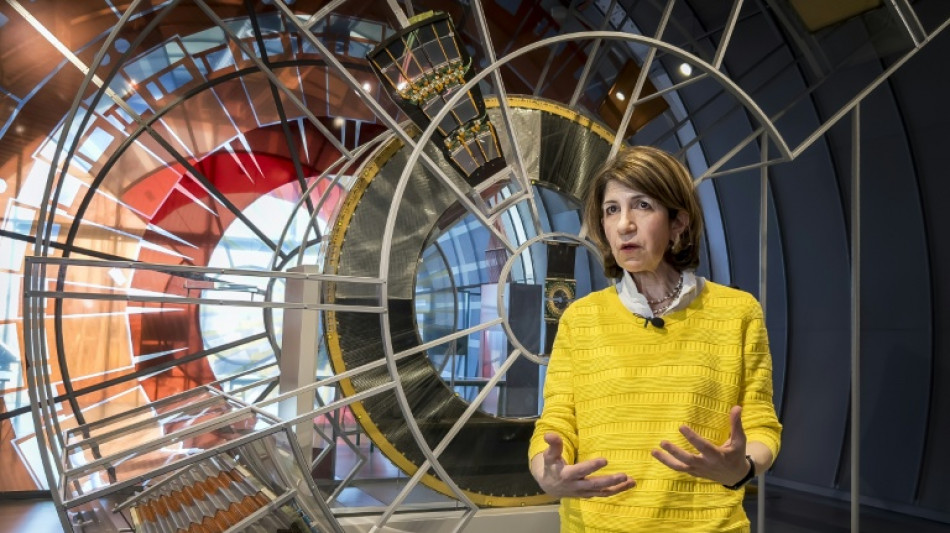
The chief of the CERN physics laboratory says China's decision to pause its major particle accelerator project presents an "opportunity" to ensure Europe's rival plan goes ahead.
Ten years ago, China announced its intention to build the Circular Electron Positron Collider (CEPC), which at 100 kilometres (62 miles) long would be the world's largest particle accelerator.
But Beijing recently put the project on ice, CERN's director-general Fabiola Gianotti told a small group of journalists at a recent briefing.
China's CEPC would be way bigger than CERN's Large Hadron Collider (LHC) -- currently the world's largest, whizzing particles into each other at phenomenal speeds.
The 27-kilometre proton-smashing ring running about 100 metres (330 feet) below the border between France and Switzerland, has, among other things, been used to prove the existence of the Higgs boson.
Dubbed the God particle, its discovery in 2012 broadened science's understanding of how particles acquire mass.
CERN, the European Organization for Nuclear Research whose main offices also straddle the border near Geneva, seeks to unravel what the universe is made of and how it works.
The LHC is expected to have fully run its course by around 2040, and CERN is considering building a far larger collider to allow scientists to keep pushing the boundaries of knowledge.
- Search for dark matter -
The planned Future Circular Collider (FCC) would be a ring with a circumference of 91 km and an average depth of 200 metres.
Scientists believe that ordinary matter -- such as stars, gases, dust, planets and everything on them -- accounts for just five percent of the universe.
The FCC will try to reveal what makes up the other 95 percent of the energy and matter in the universe -- so-called dark matter and dark energy, which scientists have yet to observe directly.
The gigantic project, costing around $17 billion, has not yet received the green light from CERN's 25 member states.
But the CERN Council, its decision-making body, "issued a very positive opinion on November 7" regarding the feasibility study, which includes geological, territorial, technological, scientific, and financial aspects, announced Gianotti.
"If all goes well, the project could be approved in 2028," she added.
The FCC, which could become operational by the end of the 2040s, is considered excessive by its opponents, especially if China was doing similar research in a similar-sized ring at a cheaper price.
But China's halt gives CERN a clear run.
- Window of opportunity -
"The Chinese Academy of Sciences, which filters projects, has decided to give the green light to a smaller, lower-energy collider, rather than the larger CEPC, which is in direct competition with CERN," said Gianotti.
In China, Wang Yifang, head of the Institute of High Energy Physics at the Chinese Academy of Sciences, confirmed to AFP that the CEPC was not included in the next five-year plan.
"We plan to submit CEPC for consideration again in 2030, unless FCC is officially approved before then, in which case we will seek to join FCC, and give up CEPC," he said.
For Gianotti, "this is an opportunity: firstly, because if the Chinese project had been approved, it would likely have started much sooner than the FCC."
"It's also interesting to know that, if the FCC is approved, the Chinese would abandon their project to come and work with us," added the Italian, whose five-year term finishes at the end of December.
Gianotti will be succeeded by British physicist Mark Thomson.
But China's decision has provided an argument for the Co-cernes collective, which brings together local opponents of the FCC who fear the effects of the massive digging project.
If a super collider was of "real scientific interest, China would undoubtedly not have abandoned it," it says.
L.Wyss--VB