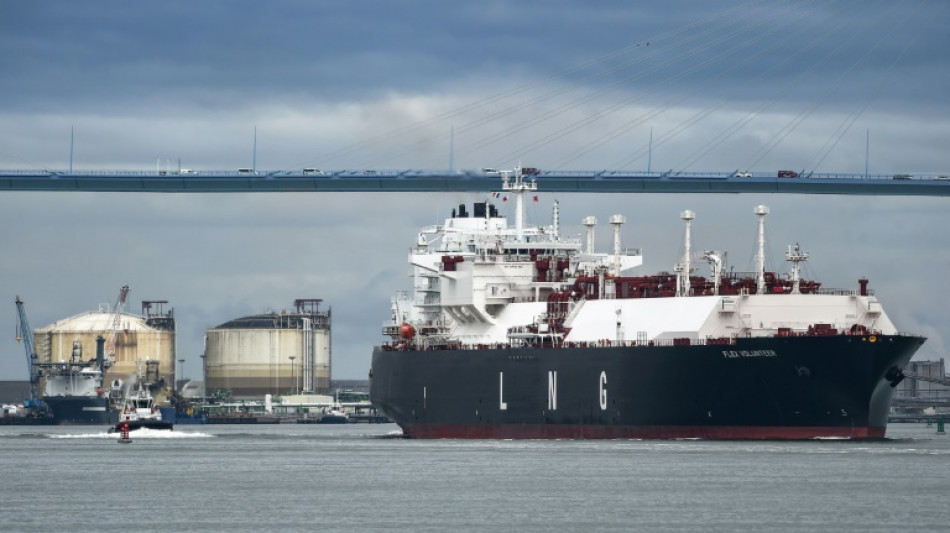
EU agrees deal to ban Russian gas by autumn 2027 / Photo: © AFP

 Caudullo challenges Montpellier to be 'watertight' against Dupont threat

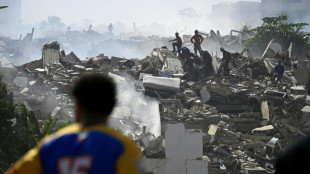
 Venezuela earthquakes toll soars to 589 amid desperate rescue effort

 Stokes strikes on England return before Duckett runs riot against New Zealand

 UK hottest June day record broken for third day in a row: Met Office

 Tech jitters send stocks lower, oil prices fall

 Stokes strikes on England return as New Zealand all out for 438
 Caudullo challenges Montpellier to be 'watertight' against Dupont
 Osaka sinks Wang to reach first grass court final

 UN demands probes into US ICE custody deaths
 Stokes strikes as New Zealand make England feel the heat
 Lyles enjoying freedom to focus on speed and stuff off the track
 How the British royal family is funded, and where the money goes
 Russia-annexed Crimea declares 'emergency' amid Ukraine strikes
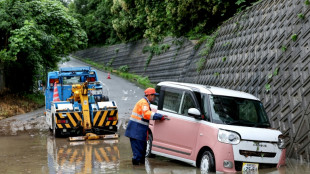
 Stocks slide on renewed tech slump, oil prices fall
 EU hits France's Sanofi with flu vaccine antitrust probe

 Europe heatwave swamps hospitals, halts parties

 MEXC Reports 142% Volume Surge for MU Futures Following Record Micron Earnings Beat
 Serena Williams to face Joint in Wimbledon return after four-year absence

 UN says Iran nuclear pledge needs 'very strong' verification
 New Zealand internal report warns of Chinese military forays in Pacific
 Mbappe v Haaland as France face Norway in World Cup group decider

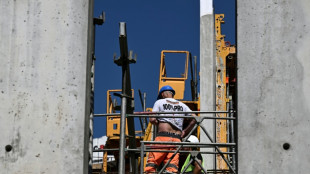 European economies suffer from heatwave

 Hospitals overwhelmed as Europe heatwave shifts east

 努莎·奧貝爾與迪特馬爾·沃伊德克 波茨坦如何辜負一名重度殘障幼兒
 'Very strong' nuclear verification needed in Iran after war: IAEA head

European Union lawmakers and member states reached a deal Wednesday to ban all imports of Russian gas by autumn 2027, as the bloc seeks to choke off key funds feeding Moscow's war chest.
The overnight accord aims to break a dependency the bloc has struggled to end despite the invasion of Ukraine, and marks a compromise between EU capitals and the European Parliament, which wanted the ban to hit sooner.
"We've made it: Europe is turning off the tap on Russian gas, forever," EU Energy Commissioner Dan Jorgensen wrote on X.
"We've chosen energy security and independence for Europe. No more blackmail. No more market manipulation by Putin. We stand strong with Ukraine."
Under the deal, long-term pipeline contracts -- considered the most sensitive because they can run for decades -- will be banned from September 30, 2027, provided storage levels are sufficient, and no later than November 1, 2027.
For liquefied natural gas (LNG), long-term contracts will be prohibited from January 1, 2027, in line with a call by Commission President Ursula von der Leyen to tighten sanctions on Moscow.
Short-term contracts will be phased out earlier: from April 25, 2026 for LNG and June 17, 2026 for pipeline gas.
The move aims "to end dependency on Russian energy following Russia's weaponisation of gas supplies with significant effects on the European energy market," said a European Council statement.
The timeline must still get final approval from the European Parliament and member states.
European companies will be able to invoke "force majeure" to legally justify breaking existing contracts, citing the EU import ban.
- Weaning off Russian energy -
The overnight deal also calls on the Commission to draft a plan in the coming months to end Russian oil imports to Hungary and Slovakia by the end of 2027.
Hungarian Prime Minister Viktor Orban -- the EU leader closest to the Kremlin -- thumbed his nose at Brussels last month by vowing to keep importing Russian hydrocarbons during a meeting with President Vladimir Putin.
The EU moved to wean itself off Russian oil in 2022 but granted exemptions to the two landlocked countries.
Nearly four years after Russia's invasion of Ukraine, the bloc is seeking to finally cut off a lucrative stream of energy revenue for Moscow.
The share of Russian gas in EU imports has fallen from 45 percent in 2021 to 19 percent in 2024. But while Europe has slashed pipeline deliveries, it has partly turned to LNG -- shipped by sea, unloaded at ports, and fed back into the network.
Behind the United States (45 percent), Russia remains a key supplier, accounting for 20 percent of EU LNG imports in 2024 -- around 20 billion cubic meters out of roughly 100 billion.
Imports of Russian LNG into the EU were still expected to amount to 15 billion euros this year.
M.Vogt--VB