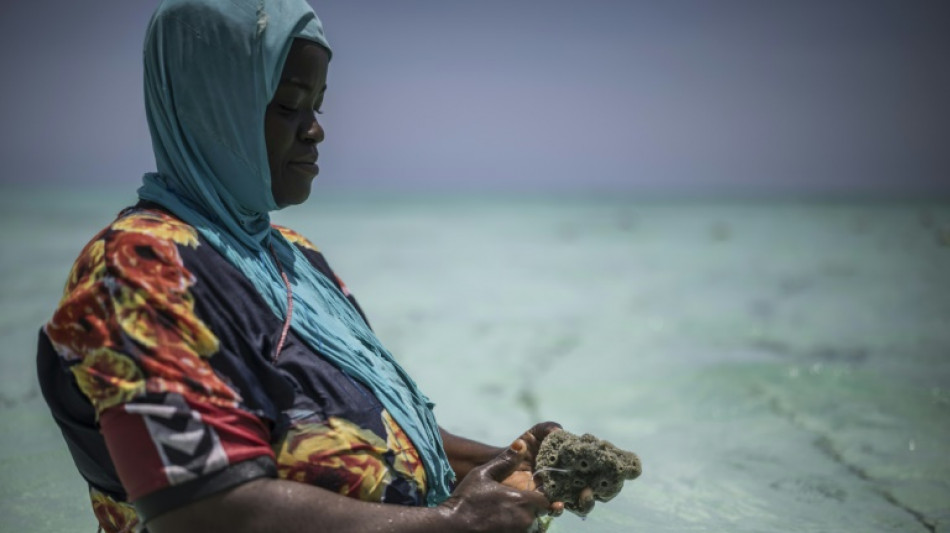
Zanzibar women turn to sponge farming as oceans heat up / Photo: © AFP

 Stokes falls cheaply as England collapse in New Zealand decider

 Russell bounces back to beat Antonelli in final practice

 Iran says US violated peace deal as both sides trade fire

 Injured Australian pair Leckie, Italiano out of World Cup

 Farmers fear drought as Italy's longest river runs dry

 Budapest Pride to push for equality after reversed ban

 World Cup fans get taste of American life -- at the mall

 World Cup turns New York's Times Square into global fan hub

 Lebanon, Israel and US sign trilateral framework pact

 Cape Verde extend World Cup fairytale to set up Argentina meeting

 Messi to start dead-rubber World Cup group match on bench

 US and Iran trade strikes putting new strain on Mideast ceasefire

 Maple Leafs make teen McKenna top pick in NHL Draft

 California appeals court orders Weinstein resentencing for sex assault

 Scheffler fires 60 to grab 36-hole PGA Travelers lead

 Austria's Rangnick shuts down conspiracy talk ahead of Algeria World Cup clash

 Should we fear an AI bubble bust?

 US strikes Iran sites after cargo ship attack

 Gueye double keeps Senegal's World Cup hopes alive

 US stocks recover from tech tremors as oil prices fall

 OpenAI restricts limited release of new model to US only

 Scheffler fires 60 to grab early PGA Travelers lead

 Trump blasts 'godless' Democrats in incendiary speech to evangelicals

 Venezuela earthquakes kill 920, tens of thousands missing

 Hundred hero Duckett punishes New Zealand after Stokes sparks England revival

Around 10 in the morning each day, women in hijabs and loose long dresses wade through Zanzibar's turquoise shallow tides to tend their sponge farms -- a new lifeline after climate change upended their former work.
Rising ocean temperatures, overfishing, and pollution have steadily degraded marine ecosystems around the island, undermining a key source of income for locals in Jambiani village who long depended on farming seaweed.
Instead, they have turned to sponge cultivation under a project set up by Swiss NGO Marine Cultures.
Hot temperatures have killed seaweed, and declining fish stocks have driven many fishermen to quit, said project manager Ali Mahmudi.
But sponges -- which provide shelter and food for sea creatures -- tend to thrive in warmer waters.
They are also lucrative as an organic personal care product, used for skin exfoliation. Depending on size, they can fetch up to $30 each and a single farm can have as many as 1,500 sponges.
From the shore, black sticks can be seen jutting out of the water, holding lines of sponges.
"I was shocked to learn that sponges exist in the ocean," Nasiri Hassan Haji, 53, told AFP, recalling when she first learned about the practice more than a decade ago.
The mother-of-four once farmed seaweed, describing the work as labour-intensive with meagre returns.
In 2009, Marine Cultures launched a pilot farm with widowed women in Jambiani to test their potential in the archipelago, where more than a quarter of the 1.9 million population live below the poverty line.
With demand for eco-friendly products on the rise, the market has grown steadily, with the US National Oceanic and Atmospheric Administration estimating the value of the natural sponge market at $20 million in 2020.
"It has changed my life, I have been able to build my own house," said 53-year-old Shemsa Abbasi Suleiman, smiling with pride.
Many other women have now joined a cooperative to expand the project, but it was not always smooth sailing.
"At first I was afraid of getting into it because I did not know how to swim. Many discouraged me saying the water is too much and I will die," said Haji.
Thanks to an NGO programme, she learned to swim at the age of 39.
- Sponges restore coral reefs -
As well as making money for locals, sponges are beneficial to the marine environment.
Studies show that a sponge's skeletal structure aids carbon recycling within coral reef ecosystems, while its porous body naturally filters and purifies seawater.
An estimated 60 percent of the world's marine ecosystems have been degraded or are being used unsustainably, according to the United Nations, which warns that the "ocean is in deep crisis".
Sponges are also known to help restore coral reefs, which support 25 percent of marine life and are currently under threat.
"What attracted me to this is the fact that we are not destroying the environment," said Haji.
C.Kreuzer--VB