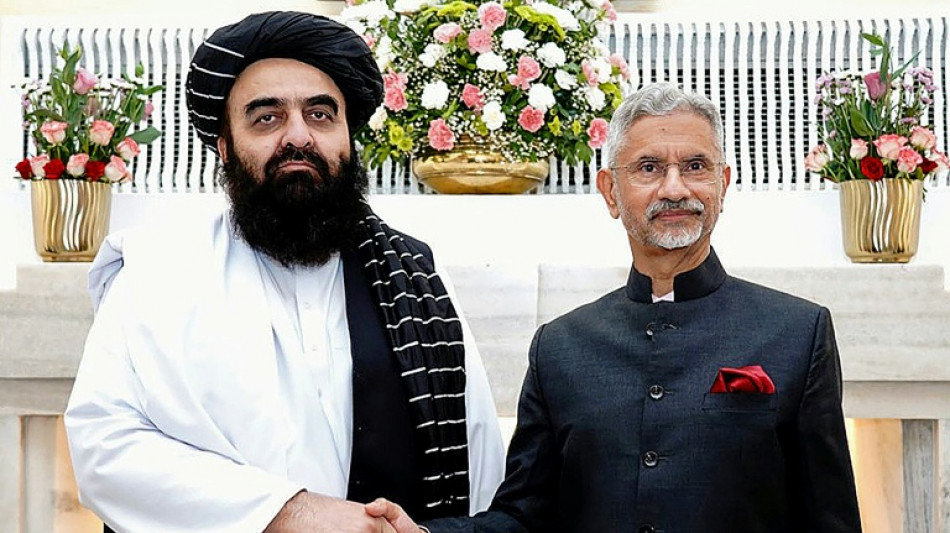
Growing India-Taliban ties anger neighbouring Pakistan / Photo: © India's Ministry of External Affairs/AFP/File

 From rubble to music: Gaza's Oud repairman

 Cycling industry bets on smart bikes to boost sales

 In Idaho, the next generation of US nuclear reactors nears reality

 Africa the winner of expanded World Cup amid mixed fortunes for minnows

 Asia's vendors grapple with rising costs of ever-present plastics

 Messi scores again as Argentina head into World Cup last 32 on a high
 Wissa proud to deliver World Cup joy to war-torn DR Congo

 South Korea's 'dismal' World Cup ends in group phase

 Colombia and Portugal through to World Cup last 32 after thrilling draw

 Wissa sends DR Congo into World Cup last 32 clash with England
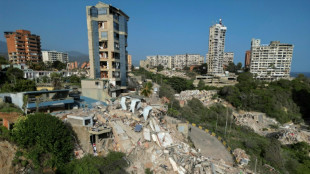
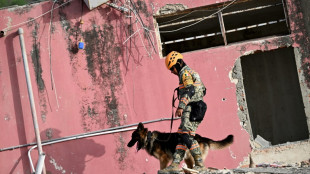 A painful wait by a pile of rubble in quake-hit Venezuela

 Tuchel delighted to have Bellingham in 'sweet spot' for England at World Cup

 Bellingham says 'job done' but England must improve at World Cup

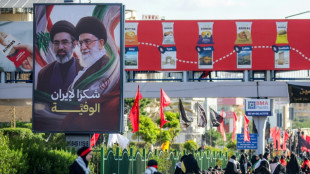 Trump threatens to annihilate Iran after new exchange of attacks

 Scotland boss Clarke resigns after World Cup exit confirmed: official

 Kane, Bellingham on target as England clinch top spot

 Bellingham, Kane score as England beat Panama to reach World Cup last 32
 Canada's Davies 'available' for historic knockout clash

 Hovland seizes one-shot PGA Travelers lead over Scheffler

 Mauvaka double inspires Toulouse to fourth-straight Top 14 in storm-impacted final

 Solidarity, sadness among Venezuelans made destitute by quake
 Iran says US violated peace deal as both sides attack

 'We need help': Venezuelans furious at slow official response to quakes
 Venus Williams relishes 'very special' Wimbledon reunion with sister Serena

 Ravindra leads New Zealand rally in England finale after Archer's double strike

As fighting between Pakistan and Afghanistan escalated into rare, bloody combat this month, Islamabad pointed fingers at another adversary, accusing India of fuelling the conflict.
Pakistan's Prime Minister Shehbaz Sharif said that New Delhi had "incited" the Afghan Taliban, while his Defence Minister, Khawaja Muhammad Asif, described Kabul as acting like a "proxy of India".
Existential archrivals, Pakistan and India have fought repeated wars since partition cleaved the subcontinent at the end of British rule in 1947.
They have also long swapped claims of stoking militancy in each other's territory as part of alleged destabilisation campaigns.
But in recent months, Islamabad has warily watched India cosy up to Taliban-governed Afghanistan, even as its own relations with Kabul sharply deteriorated.
The diplomatic reconciliation culminated in the Taliban foreign minister's arrival in New Delhion October 9 the first visit by a top Taliban leader since the hardliners returned to power in 2021.
As India rolled out the red carpet for UN-sanctioned minister Amir Khan Muttaqi, explosions rocked Kabul as well as a market near the Pakistan border.
Wahid Faqiri, an Afghan expert in international relations, said rapprochement between India and the Taliban had compelled Pakistan to react.
By inviting the Taliban foreign minister for a week of talks, New Delhi aimed to "aggravate the ongoing tension between Pakistan and Afghanistan", he said.
While the October 9 explosions officially went unclaimed, the Taliban government accused Islamabad of an "unprecedented" incursion, and retaliated with its own offensive.
The exchanges set in motion more than a week of deadly artillery barrages and drone strikes -- the worst violence between the South Asian neighbours in years.
After an initial truce collapsed, a second ceasefire was inked on October 19.
- 'Blaming its neighbours' -
One-time allies Afghanistan and Pakistan have had frosty relations since the withdrawal of US-led troops and return of the Taliban government.
Initially, Islamabad struck an optimistic tone, with then-intelligence chief Lieutenant-General Faiz Hameed giving public assurances that "everything will be fine".
But Islamabad has since continuously accused the Taliban authorities of providing a safe haven to militant groups as deadly terror attacks in Pakistan surge.
The Pakistani Taliban (TTP) and its affiliates are behind much of the violence -- largely directed at security forces.
In October alone, over 100 security personnel and police officers were killed in attacks carried out by assailants from Afghanistan, a Pakistani security source told AFP.
For two years now, the rising violence in Pakistan has also helped fuel a mass deportation campaign, with millions of Afghan migrants and asylum seekers blamed for driving up crime and pushed back across the border.
Former Pakistani diplomat Maleeha Lodhi said the Taliban foreign minister's trip to New Delhi may have been an "irritant, but wasn't the motivation for the Pakistani reprisals".
"The principal driver for Pakistan's ire and frustration with the Taliban authorities is their refusal to rein in TTP," she said.
Pakistan's military has also accused New Delhi of supporting the TTP.
India's foreign ministry denies the charge, and instead accuses Pakistan of trying to evade responsibility for its domestic turmoil and security problems.
"It is an old practice of Pakistan to blame its neighbours for its own internal failures," it said.
- 'Solidarity' -
The bonhomie between New Delhi and Kabul was initially "difficult to justify" in India due to the dominant public perception of Islam as contrary to Prime Minister Narendra Modi's popular Hindu nationalism, said Praveen Donthi, an analyst at International Crisis Group (ICG).
The absence of women journalists at an initial press conference during Muttaqi's visit also sparked strong criticism, but public opinion shifted, Donthi said, when the Taliban minister expressed "solidarity" with India over an April 22 terrorist attack in Pahalgam.
That attack in the flashpoint Kashmir region precipitated a four-day war between the nuclear-armed foes, with New Delhi accusing Islamabad of backing the terrorists.
The Afghan minister's solidarity may have bought him some fans in India, but it aggravated Islamabad, with the joint statement describing the disputed region as "Jammu and Kashmir, India" -- suggesting Indian sovereignty.
At the end of the Afghanistan-India exchange, New Delhi announced it would upgrade its diplomatic mission in Kabul to a fully fledged embassy.
That represented another stepping stone towards the Taliban government's ultimate goal of formal international recognition, a move only Moscow has made and that analysts say remains far off for India.
For now, the rekindling is a significant win for the Taliban authorities, and a pointed shift in the complex India-Pakistan-Afghanistan relations.
G.Haefliger--VB