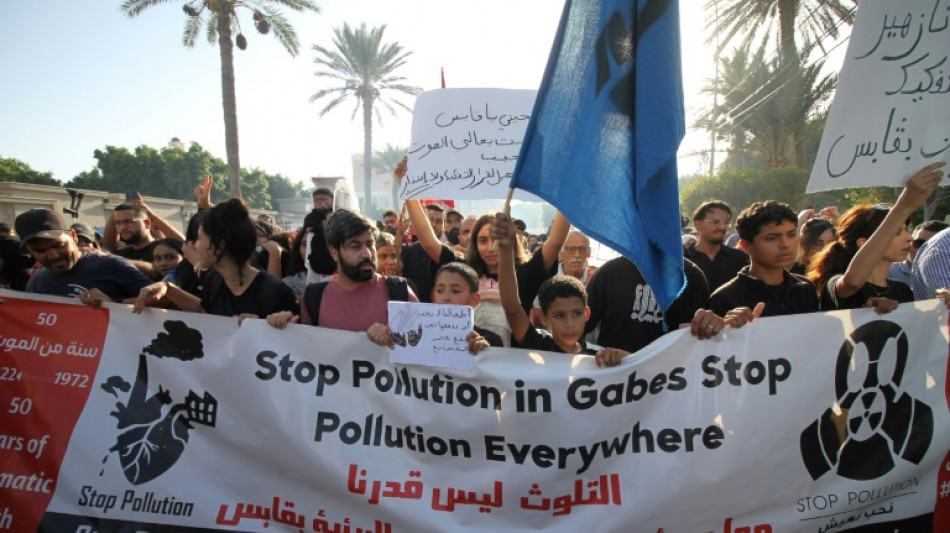
'Deadly poison': Ageing fertiliser factory stifles Tunisian town / Photo: © AFP

 Bergs wins Eastbourne final to clinch first ATP title

 Iran warns challenge to Hormuz routes will spike Middle East tensions

 From rubble to music: Gaza's Oud repairman

 Cycling industry bets on smart bikes to boost sales

 In Idaho, the next generation of US nuclear reactors nears reality

 Africa the winner of expanded World Cup amid mixed fortunes for minnows

 Asia's vendors grapple with rising costs of ever-present plastics

 Messi scores again as Argentina head into World Cup last 32 on a high
 Wissa proud to deliver World Cup joy to war-torn DR Congo

 South Korea's 'dismal' World Cup ends in group phase

 Colombia and Portugal through to World Cup last 32 after thrilling draw

 Wissa sends DR Congo into World Cup last 32 clash with England
 A painful wait by a pile of rubble in quake-hit Venezuela
 Tuchel delighted to have Bellingham in 'sweet spot' for England at World Cup
 Bellingham says 'job done' but England must improve at World Cup

 Trump threatens to annihilate Iran after new exchange of attacks

 Scotland boss Clarke resigns after World Cup exit confirmed: official

 Kane, Bellingham on target as England clinch top spot

 Bellingham, Kane score as England beat Panama to reach World Cup last 32
 Canada's Davies 'available' for historic knockout clash

 Hovland seizes one-shot PGA Travelers lead over Scheffler

 Mauvaka double inspires Toulouse to fourth-straight Top 14 in storm-impacted final

 Solidarity, sadness among Venezuelans made destitute by quake
 Iran says US violated peace deal as both sides attack

 'We need help': Venezuelans furious at slow official response to quakes

Ikram Aioua has seen her 12-year-old son rushed to the hospital three times in the past weeks for gas poisoning.
Like thousands who have turned out to protest in her southern Tunisian city of Gabes, Aioua is demanding the closure of a nearby chemical factory, blaming it for a range of serious health issues.
"I was in the classroom when I felt my throat burning and my head getting heavy, then I fainted," said Ahmed, Aioua's son.
The factory "is deadly poison", his 40-year-old mother cried. "It must be dismantled."
Since early September Gabes has recorded an increasing number of respiratory distress and other health problems, sparking fresh protests.
Other students in Ahmed's school at Chott Essalem, a coastal neighbourhood not far from the phosphate processing plant, have also complained of ailments linked to the factory's pollution.
Emna Mrabet said her chest recently started to burn before she "vomited". Her eyes were swollen as she spoke with AFP, visibly weary after her release from the hospital.
Her mother said she would hold her from going back to school "until the authorities find a solution".
Several residents have recently been hospitalised for gas poisoning and other issues, with 122 on Tuesday alone, according to the authorities.
- 'Gas leaks' -
Locals in Gabes have said the factory, which processes phosphate to make fertilisers, has been emitting more toxic gases into the air lately.
That comes on top of the solid radioactive waste the plant, opened in 1972, discharges into the Mediterranean.
The sea has taken a dark grey hue, with the air smelling acrid about anywhere in the city of some 400,000 inhabitants.
Ahmed Guefrech, a local assembly member, blamed the toxic gas leaks on "dilapidated units installed 53 years ago, with run-down equipment and no maintenance".
"The leaks are not new, but their increased frequency has made them even more dangerous."
Although the Tunisian state had promised in 2017 to begin the plant's gradual closure, authorities earlier this year said they would ramp up production instead.
Authorities did not respond to AFP's request for comment.
The leaks were also driven now by "an increase in production that exceeds the plant's condition", Guefrech added, insisting that "dismantling" it was the only solution.
Khayreddine Debaya, the coordinator of local campaign group Stop Pollution, agreed.
According to Stop Pollution and studies, the waste dumped by the plant has contaminated beaches and farmland, devastated local fishing and contributed to unusually high rates of respiratory disease and cancer.
Residents have also ramped up rallies, usually called by Stop Pollution, to demand closing the plant, with police at times using tear gas to disperse gatherings.
- 'Dismantle' -
Others said they were now taking the issue to court.
A group of lawyers representing students who suffered poisonings is planning to sue the Tunisian Chemical Group, which runs the factory.
"A first complaint will be filed soon to suspend the operations of the polluting units," said lawyer Mehdi Telmoudi, who heads the defence committee.
"A second complaint will seek to dismantle the group altogether," he added.
But the issue remains politically sensitive in a country where phosphate mining and processing are rare economic assets.
President Kais Saied has vowed to revive the sector long hindered by unrest and underinvestment, calling it a "pillar of national economy".
Taking advantage of rising world fertiliser prices, the government now wants the plant's output to nearly quintuple by 2030, from less than three million tonnes a year to 14 million tonnes.
Last Saturday, citing maintenance failures, the president dispatched representatives from the energy and environment ministries to Gabes.
But many believe there is little to be done to modernise the decades-old plant.
"Nothing will change and the plant that's killing us will stay," said Radhia Sarray, a relative of Ahmed, Aioua's 12-year-old son.
The 58-year-old said she, too, was hospitalised recently for poisoning and that she was already afflicted with cancer.
R.Fischer--VB