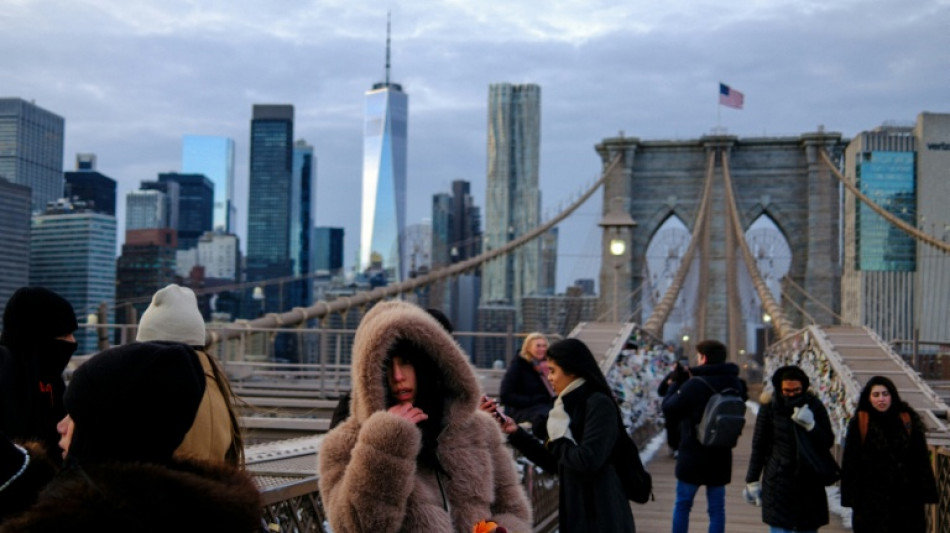
Arctic blast to wallop N. America -- is climate change to blame? / Photo: © AFP

 Alexander-Arnold and Palmer return to England squad for Nations League

 Russians vote as Ukraine war drags on for fifth year

 Backpackers fret over Australian visa crackdown

 Most Asian stocks track Wall St rally, yen drops after BoJ rate hike
 Russians begin voting in controlled election as war drags on

 Trump 'clearly' wants dialogue with Pyongyang: South Korean President

 Bank of Japan hikes rates to 31-year high to battle inflation
 Thailand's Muslim separatists vow to fight to the end

 Mideast turmoil, AI set to dominate UN gathering of world leaders

 Australia to detain tourists who overstay visa, minister says

 Championship rivals brace for renewal of bitter feuds

 In Brazil's Amazon, the hunt for oil fuels hopes and fears

 Australian athlete who soiled herself apologises for continuing Hyrox race

 Baby orangutans in India expose 'frightening' scale of trafficking

 Doom Loop? Ed Sheeran struggles against Gaza tide
 Sudanese women hold fast to threatened henna body art

 Man Utd misery puts Carrick under pressure, Spurs feeling the heat
 Prized Mexican relic returns on loan, two centuries on

 Venezuela unblocks some censored news sites

 Samba stars on debut in Man City rout of Norwich

 Oversight Board blasts 'inadequate' Meta safeguards for AI deepfakes

 The Easter Island origins of buzzy Malkovich drama 'Wild Horse Nine'

 Third body recovered after Grand Canyon flash flood

 Harry makes first public appearance since return to UK
 Abhishek hits record T20 ton as India sweep series 3-0

An unusually brutal winter storm is set to pummel more than 160 million Americans from Friday, as a stretched "polar vortex" sends a devastating blast of Arctic air, bringing heavy snows and freezing rains.
Winter Storm Fern is forecast to engulf an area well over half the length of the continental United States, stretching from Texas and the Great Plains region to the mid-Atlantic and northeastern states.
Scientists say the increasing frequency of such disruptions of the polar vortex may be linked to climate change, though the debate is not yet settled and natural variability also plays a role.
– What is the polar vortex? –
The polar vortex is a large region of cold, low-pressure air that circulates counterclockwise high above the Arctic, in the stratosphere some 10 to 50 kilometers (six to 30 miles) above Earth's surface.
In a typical winter, it forms a relatively compact, circular system that helps lock in the coldest air to high northern latitudes.
"Usually the vortex spins merrily along and has little effect on our weather, but occasionally it moves or stretches southward over North America, bringing with it a jolt of cold," Jennifer Francis, a senior scientist at the Woodwell Climate Research Center, told AFP.
– What happens when it stretches? -
At times, big atmospheric waves that form closer to the ground can travel upward and knock the polar vortex out of whack.
Rather than completely breaking down -- as happens during dramatic "sudden stratospheric warming" events -- the vortex can stretch out into a more oval shape.
"Think of it like a rubber band being pulled," Judah Cohen, a climate dynamics scientist at MIT, told AFP.
"That allows the cold air to expand much further south, like we're like we're seeing this week here in the United States."
Jason Furtado, a meterologist at the University of Oklahoma whose research focuses on long-range forecasting, said these stretching events aren't as long-lasting as complete breakdowns, but are significant nonetheless, especially for North America.
-Is it linked to climate change? –
This is where the science becomes more debated.
There is broad agreement -- reflected in assessments by the UN's climate science body -- that the Arctic is warming much faster than the global average, through a process known as Arctic amplification, and human-caused climate change is behind it.
Cohen argues that this uneven warming helps amplify large atmospheric waves over Eurasia, which in turn makes the polar vortex spill more frequently over North America.
"Studies suggest these aberrations in the vortex are happening more often in a warming world, which favors more frequent winter extremes," said Francis.
Furtado said observations from the past 20 years do show an increase in such events, but he cautioned against drawing strong long-term conclusions tying them directly to human-caused climate change.
"In my opinion, it's harder to make that connection going out much further, simply because I think we just don't have enough data."
R.Fischer--VB