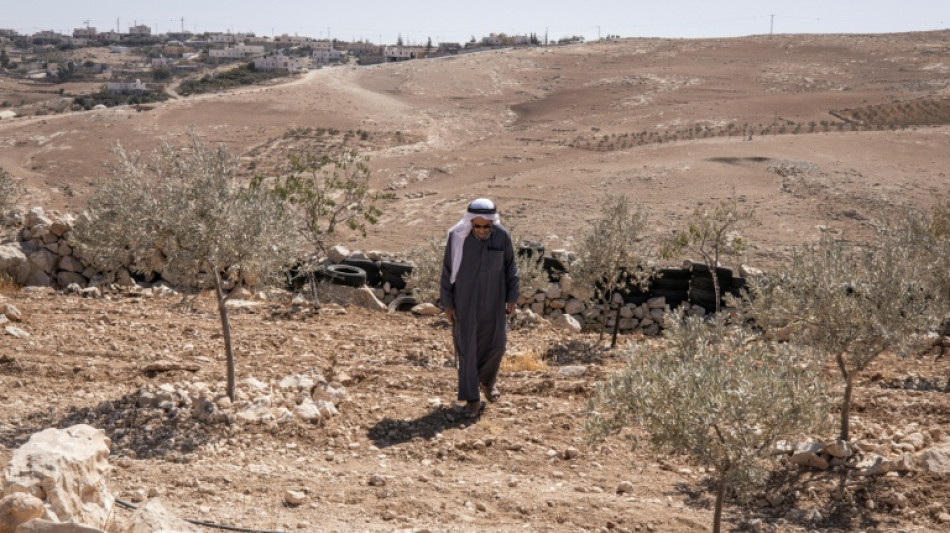
Israeli settlements close in on West Bank herding community / Photo: © AFP

 Bromell upsets Lyles, Duplantis shines at Paris Diamond League

 Man Utd reveal Ugarte knee injury in Uruguay World Cup defeat

 Stokes out for 30 in final Test innings after shock England retirement
 Wolff praises 'cold-blooded' Russell, enjoys Antonelli enthusiasm at Austrian GP
 Stokes announces shock England exit as Mitchell bats New Zealand into commanding lead

 Russell overcomes 'tricky run of form' to revive title bid

 Europe swelters as heatwave moves east, excess deaths rise

 Raducanu hopes to feature at Wimbledon despite injury woe
 Russell holds off Verstappen to win Austrian Grand Prix

 England captain Stokes to retire from international cricket
 South Africa maintain World Cup semi-final hopes with nervy win over Bangladesh

 Japan's Ogura wins maiden MotoGP as Bezzecchi crashes in Assen

 Ravindra and Mitchell strengthen New Zealand's grip on England decider
 BIS warns 'pressure points' putting global economy at risk
 Ntamack aims to bring Toulouse Top 14 win 'energy' to Nations Championship campaign

 'High-strung' camels race in Australian outback

 Algeria and Austria reach World Cup knockouts after 3-3 thriller

 DR Congo advance but Iran out as wild World Cup group stage wraps
 Austria and Algeria reach World Cup knockouts after 3-3 thriller

 Where are they? Dogs disappear before South Korea meat ban

 China's bull wrestlers fight to keep tradition alive

 England top group to set up DR Congo World Cup clash, Portugal held

 England moving on at World Cup but questions linger

 Venezuela quakes kill 1,400 as time running out to find survivors
 Australia World Cup goalkeeper Patrick Beach has beach named after him

In the occupied West Bank's Jordan Valley, Naef Jahaleen fears for the future as Israeli settlers come for the land home to one of the area's last Bedouin herding communities.
Life was good before in Ras Ein Al-Auja, the Bedouin herder says, but settlement outposts have grown one after the other over the past two years.
Settlers' trailers have gradually given way to houses with foundations, some built just 100 metres (109 yards) from Bedouin homes.
In May, settlers diverted the village's most precious resource -- the spring after which it is named.
But for the community of 130 families, the worst issue is the constant need to stand guard to avoid settlers cutting power and irrigation pipes, or bringing their own herds to graze near people's houses.
"The settlers provoke people at night, walking around the houses, disturbing the residents, making people anxious, scaring the children and the elderly," 49-year-old Jahaleen said, adding that calling the Israeli police in the area rarely yielded results.
"There's no real protection," he said.
"A settler could come to your house -- you call the police, and they don't come. The army doesn't come. No one helps," Jahaleen told AFP after a meeting with other villagers trying to coordinate their response.
- Land grabs -
Most Palestinian Bedouins are herders, which leaves them particularly exposed to violence when Israeli settlers bring herds that compete for grazing land.
It is a strategy that settlement watchdog organisations call "pastoral colonialism".
"They have started to bring in Jewish colonisers and give them some small herd or a few sheep or cows and take over a specific area. From there, this armed coloniser starts to herd," Younes Ara, of the Palestinian Authority's Colonization and Wall Resistance Commission, told AFP.
Settlements have expanded since Israel occupied the West Bank in 1967, with more than 500,000 settlers living in the Palestinian territory, excluding Israeli-annexed east Jerusalem. Some three million Palestinians live in the territory.
Jahaleen said Israeli herding, combined with repeated harassment, aimed to make Palestinians leave an area.
"You never know when or how they'll harass you. The goal is to make you leave," Jahaleen said as he stood guard near his home one night, occasionally flashing a powerful torch up a gully near where young settlers had been bringing supplies.
That night, Jahaleen was joined on his watch by Doron Meinrath, a former army officer who sometimes leads volunteers for an Israeli organisation called Looking the Occupation in the Eye.
Several foreign and Israeli activists help Jahaleen by standing watch, documenting settlers' moves, calling the Israeli police or army, and trying to deter violence with their presence, taking turns for eight-hour shifts day and night.
"Let's go after them," Meinrath said as he saw a car drive down a hill on an illegal road finished last winter that connects the nascent Israeli outpost to a formal settlement.
All Israeli settlements in the West Bank are deemed illegal by the United Nations under international law.
Once caught up with the young man's Toyota -- which was missing a headlight and had a cracked windscreen -- Meinrath marked down the number plate and reported it to the police as a vehicle unsafe for the road.
His aim was to get the vehicle impounded, in a bid to slow further land grabs.
- Changing times -
Even with the inexorable growth of settler outposts, Meinrath said he felt organisations such as his posed "a problem" for the settler movement.
Although he had always been left-wing, Meinrath said his opinions fortified as he saw Israel change and the settlement movement become stronger politically.
Finance Minister Bezalel Smotrich and other members of Prime Minister Benjamin Netanyahu's cabinet openly call for the West Bank's annexation, and more specifically that of the Jordan Valley.
Abu Taleb, a 75-year-old herder from Ras Ein Al-Auja, said he saw the land he was born on change, too.
Nestled between rocky hills to the west and the flat Jordan Valley that climbs up the Jordanian plateau to the east, his community used to be self-sufficient.
But since settlers cut off access to the spring, he and his sons must pay to refill the water tank they need to quench their sheep's thirst every three days.
After another settlement outpost sprang up a stone's throw from his home, Taleb must now also bring his sheep into their pen when settlers arrive with their own herd, for fear of violence.
"My life as a child was good. But now, their lives are not good," he said, pointing to three of his grandchildren milling around under the shade of a lonely acacia tree.
"They grew up in a bad life. These kids are afraid of the settlers everywhere."
G.Frei--VB