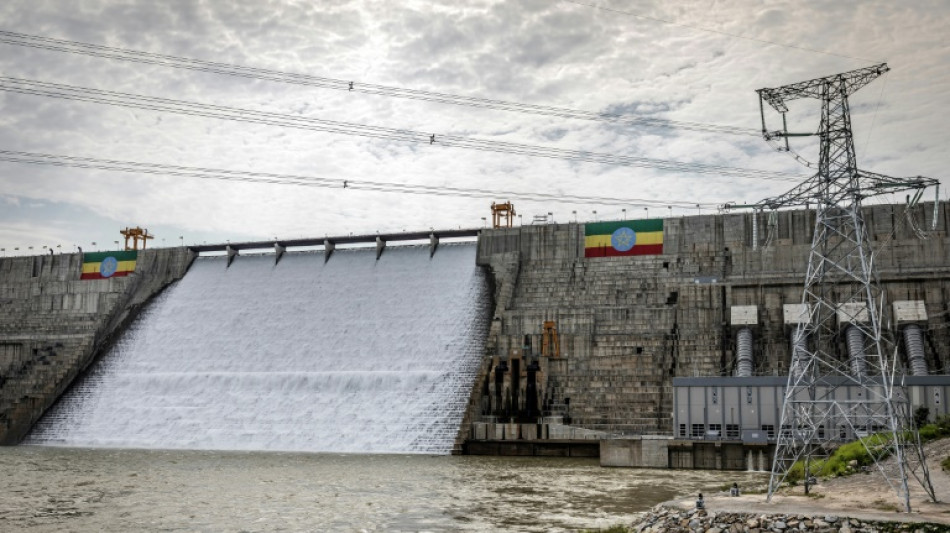
Ethiopia inaugurates Africa's biggest dam / Photo: © AFP

 Years on, families bury 68 Indigenous victims of Guatemala civil war
 'Deliberate' Monaco explosion wounds Ukrainian oligarch

 Paraguay shock Germany, Brazil advance at World Cup

 'I recognized her ring': identifying Venezuela's dead in a makeshift morgue
 Tuchel defensive headache as England ready for DR Congo clash
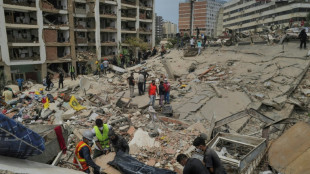
 US reopens Venezuela port as quake deaths top 1,700

 Coach says Japan getting closer to World Cup glory despite defeat

 NBA Grizzlies deal Morant to Portland: report
 Sweden ready for 'game of our lives' in France World Cup clash

 MLS Chicago Fire announce signing of Poland's Lewandowski
 Tech rebound lifts Dow to record, yen hits 40-year low against dollar

 US Supreme Court rules on dragnet searches of cellphone location data
 South Korea fans target coach Hong with boos as World Cup squad returns
 Vaughan calls for England change after Stokes bows out with defeat
 Europe's deadly heatwave scorches east, Slovakia hits record
 French Open champ Andreeva sails into Wimbledon second round

 Shooter in custody dispute kills six at German family shelter
 Sinner survives scare and fall to reach Wimbledon second round

 Serena set for much-anticipated Wimbledon return
 Ex-NBA stars Malik Beasley, Ed Davis indicted in betting case
 EU, China bet on talks to avoid trade war
 Pyjamas and bets: Brazil YouTube channel reshapes World Cup viewing

 Queueing, strawberries and all white: it must be Wimbledon

 Stokes backs Brook '100 percent' to succeed him as England Test captain

 Ebola outbreak in DR Congo spreads to fourth province

Ethiopia was set to inaugurate Africa's largest hydroelectric project on Tuesday that has promised to revolutionise the country's energy sector but sparked diplomatic rows with downstream neighbour Egypt.
For Ethiopia, the Grand Renaissance Dam (GERD) is a national project of historic scale and a rare unifying symbol in a country torn apart by ongoing internal conflicts.
Towering 145 metres (476 feet) high and stretching nearly two kilometres (1.2 miles) across the Blue Nile near the Sudanese border, the $4-billion megastructure is designed to hold 74 billion cubic metres of water and generate 5,000 megawatts of electricity -- more than double Ethiopia's current capacity.
That makes it the largest dam by power capacity in Africa, though still outside the top 10 globally.
Images on state media showed Prime Minister Abiy Ahmed touring the site early Tuesday with Kenyan President William Ruto, Somalia's President Hassan Sheikh Mohamud and African Union chief Mahmoud Ali Youssouf.
The festivities began the night before with a dazzling display of lanterns, lasers and drones writing slogans like "geopolitical rise" and "a leap into the future", watched by Abiy who has made the project a cornerstone of his rule.
Some 45 percent of Ethiopia's 130 million people lack electricity, according to World Bank data, and frequent blackouts in Addis Ababa force businesses and households to rely on generators.
Analysts argue the GERD, under construction since 2011, could transform Ethiopia's economy, boosting industrial production, enabling a shift towards electric vehicles and supplying power-hungry neighbours through regional interconnectors that stretch as far as Tanzania.
But neighbouring Egypt, dependent on the Nile for 97 percent of its water, sees a looming disaster.
With a population of 110 million and little rainfall, Egypt's reliance on the river is absolute.
President Abdel Fattah al-Sisi has repeatedly called the dam an "existential threat" and vowed Egypt would take all measures under international law to defend its water security.
"Whoever thinks Egypt will turn a blind eye to its water rights is mistaken," he told reporters last month.
The standoff has sharpened regional rivalries. Egypt has strengthened ties with Eritrea and Somalia -- both of which have tense relations with Ethiopia -- and coordinates closely with Sudan, which also worries about reduced flows.
Attempts at mediation by the United States, World Bank, Russia, the UAE and the African Union have all faltered over the past decade.
"For the Egyptian leadership, GERD is not just about water, it is about national security. A major drop in water supply threatens Egypt's internal stability. The stakes are economic, political and deeply social," said Mohamed Mohey el-Deen, formerly part of Egypt's team assessing GERD's impact.
The tensions have not been all bad for Ethiopia's government.
"Ethiopia is located in a rough neighbourhood and with growing domestic political fragility, the government seeks to use the dam and confrontation with neighbours as a unifying strategy," said Alex Vines, of the European Council on Foreign Relations.
I.Stoeckli--VB